




























































































Darwinian finches of three different size of beaks-large, intermediate and small feeds on seeds size with bimodal distribution. Under such condition natural selection will favor finches having beak size (1) […]

Darwinian finches of three different size of beaks-large, intermediate and small feeds on seeds size with bimodal distribution. Under such condition natural selection will favor finches having beak size (1) […]

Antibiotic resistance among bacteria represents (1) Balancing selection (2) Stabilizing selection (3) Directional selection (4) Disruptive selection Introduction Antibiotic resistance is one of the most pressing challenges in modern medicine. […]

The two phylogenetic trees given below represent evolutionary patterns in species or population. The differently colored or dashed lines represent a single or gene genealogy. Select the option that correctly […]

The replica plating experiment of Lederberg supports (1) Natural selection (2) Mutation (3) Conjugation (4) Transformation Introduction The origin of genetic variation is a central question in biology. Are mutations […]

After implication of Green Air Act in England whichinsect form become virtually absent- (1) Biston betularia carbonifera (2) Biston betularia typical (3) Drosophila (4) Apes Americana Introduction The story of […]

The following statements were made describing the properties of a UPGMA tree (Unweighted Pair Group Method with Arithmetic Mean): A. It describes species relationships and is therefore the best method […]

A certain organism developed an adaptation as to adaptexisting environment but if this adaptation prove usefulfor some other function as well, it is termed as- (1) Co-adaptation (2) Adaptive radiation […]

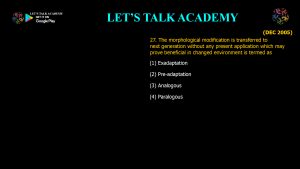
The morphological modification is transferred to nextgeneration without any present application which mayprove beneficial in changed environment is termed as (1) Exadaptation (2) Pre-adaptation (3) Analogous (4) Paralogous Introduction Evolution […]

Given are some statements with reference to the use of genes in plant molecular systematics. A. mtDNA are not preferred over cpDNA or rDNA because they generally show slow rate […]

During Beagle voyage of Charles Darwin he observed that the flora of tropical America is most similar to- (1) Asia (2) Temperate America (3) Europe (4) Australia Introduction Charles Darwin’s […]


