







































































































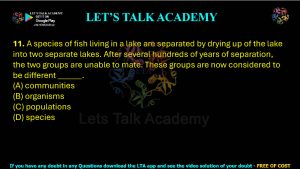











Biological species concept cannot be applied on (1) Parthengenetic species (2) Sympatric species (3) Species producing viable hybrids (4) Species of aquatic ecosystem The biological species concept is one of the […]

Biological species concept cannot be applied on (1) Parthengenetic species (2) Sympatric species (3) Species producing viable hybrids (4) Species of aquatic ecosystem The biological species concept is one of the […]

The formation of 2 species from one parent population due to geographical isolation will be termed as- (1) Allopatric speciation (2) Sympatric speciation (3) Parapatric speciation (4) Peripatric speciation […]

The wings of insects and the wings of bats represent a case of (1) divergent evolution (2) convergent evolution (3) parallel evolution. (4) neutral evolution. The evolution of flight […]

Fore limb of human and flippers of whale are embryologically homologous structures. What does the study of homologous structures tell us about evolution? A. This is the example of adaptive […]

Which one of the following statements is NOT TRUE about homologous characters? (1) Similar traits may not be homologous (2) Similar traits may be a result of convergent evolution (3) […]

In order to study evolutionary relatedness between two given individuals, homology and analogy are considered. By this study we may observe the following possible information: A. Presence of homologous structures […]
Flufftails in mainland Asia show high variation in tail colour. However, in the far out Pacific island, the flufftails show very little variation in tail colour. This variation in tail […]

Wings of insects and birds have become flat, large and stream lined, due to common requirement of flight. This is an example of (1) Convergent evolution (2) Parallel evolution (3) […]

Insect wing and bird wings are example of (1) Coevolution (2) Convergent evolution (3) Divergent evolution (4) Parallel evolution The evolution of flight is one of nature’s most remarkable […]

In several populations, each of size N =20, if genetic drift results in a change in the relative frequencies of alleles, A. What is the rate of increase per generation […]


