








































































Fertilization happens when a sperm cell successfully meets an egg cell in the fallopian tube. Zygote formation by sperm and egg is result of – (1) membrane fusion (2) exocytosis […]

Fertilization happens when a sperm cell successfully meets an egg cell in the fallopian tube. Zygote formation by sperm and egg is result of – (1) membrane fusion (2) exocytosis […]

In regulative development, the prospective potency of cells (1) Equal to prospective fate (2) More than prospective fate (3) Lesser than prospective fate (4) Not determined In embryology, the terms […]

In an early embryonic transplantation experiment prospective skin cells were transferred near future muscle cell but then also it differentiates into skin cell. The cell would be termed (1) Determined […]

3. Which of the following is the last to occur after the binding of a sea urchin sperm to an egg? (1) Initiation of mRNA synthesis (2) Increase in cytosolic […]

Mosaic developmental pattern is always (1) Autonomous (2) Non autonomous (3) Conditional (4) Regulative Mosaic developmental pattern is a fundamental concept in embryology describing how cells in an embryo acquire […]

Homeotic genes are responsible for (1) Maintaining gaps in segments (2) Provide gradient for anterior posterior axis of embryo (3) Codes secretory morphogens (4) Formation of organ at defined locations […]

Sperms are morphologically fit but are unable to actively swim (hyper activation) due to lack of (1) Spermatogenesis (2) Spermiogenesis (3) Prostrate glands (4) Capacitation Introduction to Sperm Motility and […]

Homeotic genes are responsible for (1) Development of anatomical structures (2) Homeostasis (3) Cell cycle regulation (4) Adaptation to stress Homeotic genes are fundamental genetic components that orchestrate the blueprint […]

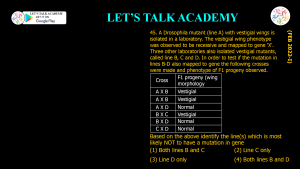
From a newly fertilized mouse egg, maternal pronucleus was removed and replaced with a second paternal pronucleus. Following observations/ statements were made: (A) This will result in formation of an […]

52. Vascular endothelial (VE)-cadherin is an important cell adhesion molecule for endothelial cells. Endothelial cells that are unable to express VE-cadherin still can adhere to one another via N-cadherin (neural […]


