




































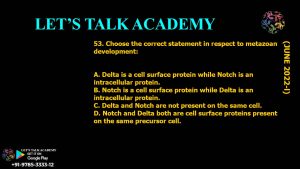














C. elegans embryo uses both autonomous and conditional modes of specification. The following statement are about specification of cell lineages: (A) The signals from the P1 blastomere instructs the EMS […]

C. elegans embryo uses both autonomous and conditional modes of specification. The following statement are about specification of cell lineages: (A) The signals from the P1 blastomere instructs the EMS […]

In an experiments, sperm removed from epididymis of a male mouse was added in a dish containing appropriate media and oocyte. No fertilization was seen. However, when sperm from epididymis […]

The following figure represents the interaction between different blastomeres in a 4-cell stage of C. elegans embryo: The following statements were made regarding the above: A. The fate of […]

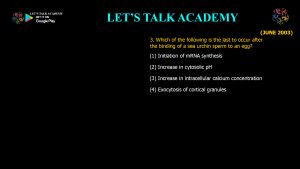
21. Capacitation of sperms in humans (1) occurs during copulation. (2) occurs after the acrosome reaction. (3) takes place in the ampulla of the oviduct. (4) takes place in the […]

C. elegans embryo uses both autonomous and conditional modes of specification. Conditional specification at the 4-cell stage can be seen in the development of the endoderm cell lineage and also […]

A two-celled embryo is made of blastomeres A and B. If the two blastomeres are experimentally separated, the ‘A’ blastomere generates all the cells it would normally make. However, the […]

Amphibian oocytes remain for years in the diplotene stage of meiotic prophase. Resumption of meiosis is initiated by (1) gonodatropic hormone. (2) growth hormone. (3) oestrogen. (4) progesterone. Introduction […]

The zygote of C. elegans exhibits rotational cleavage. When the first two blastomeres formed (P1 and AB) are experimentally separated, the following outcomes may be possible: (A) The P1 cell […]

At the 2-celled stage of Caenorabditis elegans development the blastomeres were experimentally separated and allowed to proceed in development. One of the blastomere (P1) developed generating all types of cells […]

19. During fertilization in amphibians, the fusion of egg and sperm plasma is preceeded by (A) release of enzymatic contents from the acrosomal vesicle through exocytosis (B) binding and interaction […]


