


























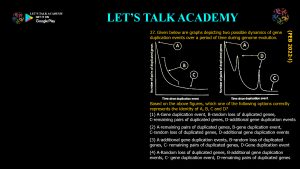

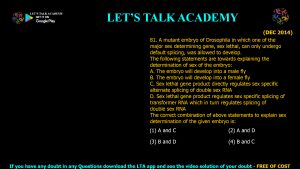














































56. In Agamous mutant (flower within flower phenotype) which of the following statements is valid? (1) Class A genes are expressed in the first two whorls, Class B genes are […]

56. In Agamous mutant (flower within flower phenotype) which of the following statements is valid? (1) Class A genes are expressed in the first two whorls, Class B genes are […]

Plants with apetala2 mutation show a phenotype that lacks (1) sepals only. (2) both sepals and petals. (3) petals only. (4) stamens only. Introduction APETALA2 (AP2) is a key floral […]

Which of the floral whorls is affected in apetala 3/pistillata (ap3/pi) mutants? (1) Sepals and petals. (2) Petals and stamens. (3) Stamens and carpels. (4) Sepals and stamens. Introduction Floral […]

Which of the floral whorls is affected in agamous (ag) mutants (1) Sepals and petals (2) Petals and stamens (3) Stamens and carpels (4) Sepals and carpels Introduction The AGAMOUS […]

Floral organ development is controlled by overlapping expression of ‘A’ class, ‘B’ class and ‘C’ class genes in different whorls. In an Arabidopsis mutant, the flowers had sepals, sepals, carpels […]

51. Among the following which gene product migrates from leaves to shoot meristem during transition of shoot meristem into floral meristem? (1) Flowering locus T (2) Flowering locus D (3) […]

In plants gene ‘sepallata’ is NOT involved in formation of organ (1) Sepals (2) Petals (3) Stamens (4) Carpels Introduction SEPALLATA (SEP) genes are a group of MADS-box transcription factors […]

Three classed of genes A, B and C regulates the development of flower in Arabidopsis. If a loss-of-function mutation occurs in the B-type genes, what will be the composition of […]

Organ Identity genes are responsible for correct positioning of floral organs on floral meristem. Mutation in them will lead to (1) Loss of all organs from whorls (2) More number […]

Light signals for flowering is received by (1) Flower bud (2) Apical bud (3) Leaves (4) Flower bract Introduction Plants rely on environmental cues like light duration to time their […]


