












































































































15. Two plants with white flowers are crossed. White flowers arise due to recessive mutation. All F1 progeny have red flowers. When the F1 plants are selfed, both red and […]

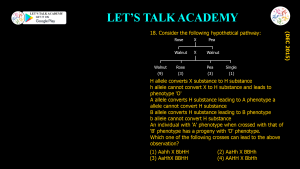
15. Two plants with white flowers are crossed. White flowers arise due to recessive mutation. All F1 progeny have red flowers. When the F1 plants are selfed, both red and […]

14. A plant heterozygous for a dominant trait was selfed. The progeny had 140 plants showing the dominant trait and 20 plants showing the recessive trait. A researcher hypothesised that […]

13. A plant with red fruit is crossed to a plant with white fruit. The F1 progeny had red fruits. On selfing the F1 two kinds of progeny were observed, […]
12. Two interacting genes (independently assorting) were involved in the same pathway. Absence of either genes function leads to absence of the end product of the pathway. A dihybrid cross […]

The following is the biochemical pathway for purple pigment production in flowers of sweet pea: Recessive mutation of either gene A or B leads to the formation of white flowers. […]

10. When two independent pure lines of pea with white flowers are crossed, the F1 progeny has purple flowers. The progeny obtained on selfing shows both pruple and white flower […]

9. Two mutant plants, both bearing white flowers, were crossed. All F1 plants had red coloured flowers. When an F1 plant was selfed it produced progeny with either red or […]

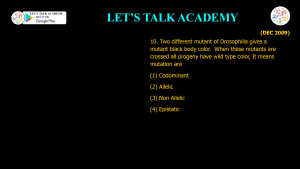
8. A cross is made between two plants with white flowers. All the F1 progeny had red coloured flower. This is because of (1) complementation (2) recombination (3) translocation (4) […]

7. There are two mutant plants. One shows taller phenotype than wild type, whereas the other has the same height as the wild type. When these two mutations were brought […]

A cross between hens with different comb shape was carried as shown in figure. The conclusion which can be drawn is (1) Single gene is involved for comb shape (2) […]


