




































































































































































3. You discover a simple microbe which has a minimal genome. It only has 30 genes for basic metabolism, 20 genes for the ribosome, and 20 genes for DNA and […]


3. You discover a simple microbe which has a minimal genome. It only has 30 genes for basic metabolism, 20 genes for the ribosome, and 20 genes for DNA and […]

2. The α-helix in proteins is formed due to a. Intramolecular hydrogen bonds b. Intermolecular hydrogen bonds c. van der Waals interactions between amino acids d. Ionic interactions α-Helix Formation […]

1. Single nucleotide polymorphisms (SNPs) are: a. disease-causing mutations in the human genome b. an example of standing genetic variation in the human population c. errors during genome sequencing d. […]

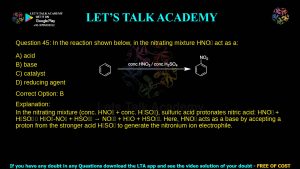
15. In the reaction shown below, in the nitrating mixture HNO3 act as a: a. acid b. base c. catalyst d. reducing agent In the nitrating mixture used for nitration […]

14. If the organic reactant in a Wurtz reaction mixture (RX and sodium) has n C-C bonds, the hydrocarbon product will have how many C-C bonds? a. n/2 b. n-1 […]

13. The R group of a particular Grignard’s reagent is an un-branched alkyl chain with n carbons. How many chiral carbons do you expect the product to have if this […]

12. The standard enthalpy of formation at 298 K for methane is -74.8 kJ mol–1. What additional information is required to determine the average energy for C–H bond formation? a. […]

11. You are observing a chemical reaction (𝑅 → 𝑃) either in the absence or presence of an enzyme catalyst, which has 𝐾M = 106 𝜇𝑀. At equilibrium 20 moles […]

10. What is the role of sulphur in the vulcanization of rubber? a. It acts as a catalyst for the reaction, thereby accelerating its rate b. It participates in di-sulphide […]

9. Which substance is expected to exhibit the greatest surface tension at 25°C? a. CH3OCH3 b. C2H5OH c. CH3CH(OH)CH3 d. CH2(OH)CH2OH CH2(OH)CH2OH exhibits the greatest surface tension at 25°C among […]


