





















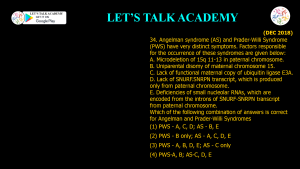
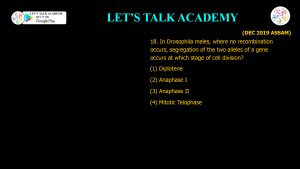
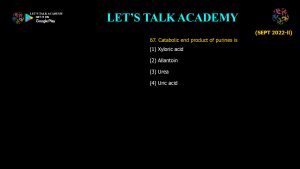
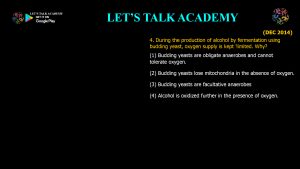


































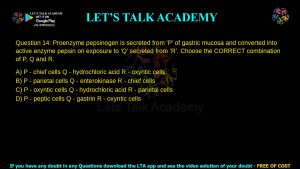










Q.18 What is the role of bile salts in the mammalian digestive system?(A) Bile salts convert pepsinogen to pepsin, and thus facilitate protein digestion(B) Bile salts emulsify fat, and thus […]

Q.18 What is the role of bile salts in the mammalian digestive system?(A) Bile salts convert pepsinogen to pepsin, and thus facilitate protein digestion(B) Bile salts emulsify fat, and thus […]

Q.17 What is the significance of the isomerization of glucose 6–phosphate to fructose 6–phosphate for theprogression of glycolysis?(A) As functional groups, ketones are more reactive than aldehydes(B) Cleavage of glucose […]

Q.16 Which one of the following isomers is thermodynamically most stable? The thermodynamically most stable isomer in the given question is option (C), because both substituents occupy equatorial positions, minimizing 1,3‑diaxial steric interactions […]

Q.15 Which one of the following is the major product of the hydrogenation reaction given below? Under catalytic hydrogenation with H₂/Pd‑C in ethanol, only the isolated C=C double bond of […]

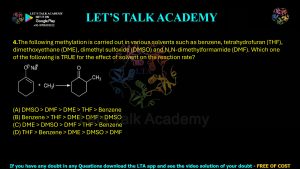
Q.14 The following methylation is carried out in various solvents such as benzene, tetrahydrofuran(THF), dimethoxyethane (DME), dimethyl sulfoxide (DMSO) and N,N–dimethylformamide(DMF). Which one of the following is TRUE for the […]

Q.13 Which one of the following features/properties does glucose acquire through intramolecularhemiacetal formation?(A) Ability to function as a reducing agent(B) An additional chiral carbon(C) Ability to form anhydride linkage with […]

Q.12 IUPAC name of the following molecule is(A) 3–Bromo–3,5–dimethyl hexane(B) 4–Bromo–2,4–dimethyl hexane(C) 3–Bromo–2–isobutyl butane(D) 4–Bromo–2–methyl–4–ethyl pentane The correct IUPAC name of the given molecule is 4‑Bromo‑2,4‑dimethylhexane, which corresponds to option (B). […]

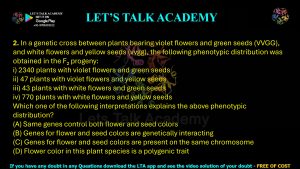
Q.11 In a genetic cross between plants bearing violet flowers and green seeds (VVGG), and white flowerand yellow seeds (vvgg), the following phenotypic distribution was obtained in the F2 progeny(assume […]

Q.10 Let 𝐴 = (2 1 1 1) and 𝐵 = (2 −50 1 ). If 𝐴𝑋 + 3𝐵 = 0, then the determinant of 𝑋 is(A) −18 (B) −6 […]

Q.9 The moment of force in terms of fundamental dimensions is(A) MLT−1 (B) MLT−2 (C) ML−1T−1 (D) ML2T−2 Introduction In physics, understanding the dimensional formula of moment of force helps […]


