












































































Q.38 If an optician prescribes a corrective lens of power -2.0 D, the required lens(A) is a concave lens.(B) is a convex lens.(C) has a focal length of +50 cm.(D) […]


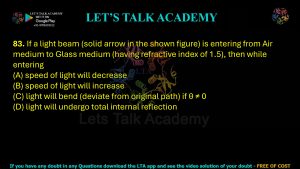
Q.38 If an optician prescribes a corrective lens of power -2.0 D, the required lens(A) is a concave lens.(B) is a convex lens.(C) has a focal length of +50 cm.(D) […]

Q.37 Which of the following statements is/are CORRECT regarding self-inductance of a longsolenoid having cross sectional area (𝐴𝐴), length (𝑙𝑙) and having 𝑛𝑛 turns per unit length filledwith material of […]

Q.36 Consider the equation \( x^3 – 1 = 0 \). If one of the solutions to this equation is 1, the other solution(s) is/are (A) ( -\frac{1}{2} + \frac{\sqrt{3}}{2} […]

Q.35 In a double stranded DNA, which of the following ratios is/are always equal to 1?A, T, G and C denote the number of bases.(A) (A+T)/(G+C) (B) (A+G)/(T+C) (C) A/G […]

Q.34 Glucose is incubated with enzymes of the glycolytic pathway (except pyruvate kinase), γ32P-ATP, and unlabeled inorganic phosphate. Which of the following products is/are formed? The correct labeled product(s) formed […]

Q.33 Which of the following statements is/are CORRECT for G protein–coupled receptor (GPCR)mediated signaling?(A) GPCRs contain seven membrane spanning regions.(B) GPCRs are linked to heterotrimeric G protein consisting of α, […]

Q.32 Plasmid mediated antibiotic resistances in bacteria are acquired by(A) hydrolysis by β-lactamase (penicillin resistance).(B) expression of aminoglycoside modifying enzyme (kanamycin resistance).(C) mutation in DNA gyrase (quinolone resistance).(D) overproduction of […]

Q.31 Antibody binds to antigen in solution through(A) ionic interactions. (B) hydrogen bonds.(C) van der Waals interactions. (D) hydrophobic interactions. Antibody-antigen binding in solution involves multiple non-covalent interactions, with no […]

Q.30 In the 1 H NMR spectrum, which one of the following compounds will show a triplet? The compound that shows a clear triplet in its 11H NMR spectrum is option (A), ethyl […]

Q.29 Which one of the following statements is CORRECT?(A) BF3 is a stronger Lewis acid than BI3 .(B) CO and CN– are good π-accepting ligands.(C) cis-Diamminedichloroplatinum (II) has zero dipole […]


