





































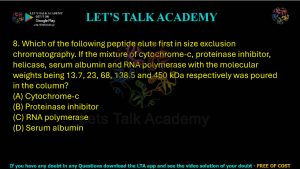











































Q.42 Which of the following technique(s) can be used to separate proteins according totheir molecular weights from a mixture of proteins?(A) Ion exchange chromatography(B) Size exclusion chromatography(C) Sodium dodecylsulfate – […]

Q.42 Which of the following technique(s) can be used to separate proteins according totheir molecular weights from a mixture of proteins?(A) Ion exchange chromatography(B) Size exclusion chromatography(C) Sodium dodecylsulfate – […]

Q.41 Four statements about lipids are given below as options. Choose the statement(s)which is/are CORRECT.(A) Cholesterol is amphipathic(B) Self–assembly of phospholipids in water is due to hydrophobic effect(C) The temperature […]

Q.40 Match the cell types listed in Group I with associated processes listed in Group II. Group I Group II (p) NK cells (q) B cells (r) Mast cells (s) […]

Q.39 A linear DNA fragment of 5 kilobase (kb) when completely digested with EcoRIproduces 2.5 kb, 1.5 kb, and 1 kb fragments. Complete digestion of the same 5 kbfragment with […]

Q.38 Enzyme activity profiles as a function of time in the absence or presence of differenttypes of feedback mechanisms are shown in the figure below. Match the followingfeedback mechanisms with […]

Q.37 Which one of the following amino acids has more than two acid–base groups?(A) Alanine(B) Leucine(C) Phenylalanine(D) Tyrosine Tyrosine is the amino acid with more than two acid-base groups among […]

Q.36 Intracellular concentrations of ATP, ADP, and inorganic phosphate in four cell types are given below. Which one of these cell types has the most negative ΔG for ATP hydrolysis? […]

Q.35 DNA in a 1 cm long chromatin contains 5 × 10⁹ base pairs. The fold compactionof this DNA within the chromatin is _______ (in integer). The fold compaction of […]

Q.34 A lyophilized sample of 20 nanomoles of an oligonucleotide is dissolved in water and the volume of the solution is made up to 200 µL. The concentration (in µM) […]

Q.33 A protein has seven cysteine residues. The maximum number of disulfide bonds ofdifferent combinations that can possibly be formed by these seven cysteine residuesis _______ (in integer). The maximum […]


