









































































































Q.56 Rubisco catalyzes conversion of ribulose 1,5–bisphosphate toP. two molecules of stable 3–phosphoglycerateQ. one molecule of 3–phosphoglycerate and one molecule of phosphoglycolateR. one molecule of ribulose 5–phosphophateS. one molecule of […]


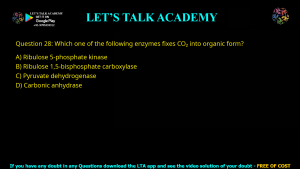
Q.56 Rubisco catalyzes conversion of ribulose 1,5–bisphosphate toP. two molecules of stable 3–phosphoglycerateQ. one molecule of 3–phosphoglycerate and one molecule of phosphoglycolateR. one molecule of ribulose 5–phosphophateS. one molecule of […]

Q.55 If a species has 2n = 16 chromosomes, the number of chromosomes per cell in a doublemonosomic individual would be_________ Understanding the Question A species with 2n = 16 […]

Q.54 Glyphosate is a broad spectrum herbicide. Upon application to leaves, it is translocated tomeristematic areas and underground rhizomes by(A) phloem (B) xylem (C) border pits (D) tracheids Glyphosate translocates […]

Q.53 The plant cells are considered totipotent. The phenomenon of a mature cell reverting to themeristematic state and forming undifferentiated callus tissue is called(A) redifferentiation (B) dedifferentiation(C) organogenesis (D) recalcitrancy […]

Q.52 Which one of the following statements is INCORRECT with respect to cyclicphotophosphorylation?(A) ATP is generated without concomitant formation of NADPH(B) Electron flows from Photosystem I to cytochrome bf complex(C) […]

Q.51 Which one of the following statements is INCORRECT?(A) Nitrogen fixation is aerobic process(B) Dinitrogenase catalyzes reduction of nitrogen to ammonia(C) Root nodules are found in Glycine max(D) Nitrogen fixation […]

Q. 50 Which one of the following combinations of polysaccharides is present in plant cell wall? (A) Only cellulose, hemicellulose and fibroin (B) Only cellulose, hemicellulose and lignin (C) Only […]

Q. 49 Arbuscules are highly branched structures, formed by (A) ectomycorrhizae (B) endomycorrhizae (C) arbutoid mycorrhizae (D) monotropoid mycorrhizae Arbuscules are specialized, highly branched fungal structures vital for nutrient exchange […]

Q.48 Which one of the following families shows bicollateral vascular bundle in the transverse section of the stem? (A) Rutaceae (B) Asteraceae (C) Cucurbitaceae (D) Malvaceae Bicollateral vascular bundles feature […]

Q.47 Raphides are deposits of (A) calcium oxalate (B) calcium carbonate (C) silica bodies (D) protein bodies Raphides represent needle-like crystal deposits commonly found in plant tissues, playing key roles […]


