



































































































Q.51 Which of the following summarizes the role of Casparian strip in transport of water in the root? (A) Symplast to Apoplast (B) Apoplast to Symplast (C) Phloem to Xylem […]

Q.51 Which of the following summarizes the role of Casparian strip in transport of water in the root? (A) Symplast to Apoplast (B) Apoplast to Symplast (C) Phloem to Xylem […]

Q.50 The uptake of nitrogen (N) and phosphorus (P) by plant roots often involves interaction between root and some symbiotic organisms. Which of the following associations is most commonly found […]

Q.49 4′,6 diamidino 2-phenylindole (DAPI) is a fluorescent dye used to stain the nucleus. Which of the following plant cells, when mature, cannot be stained by DAPI? (A) Trichomes (B) […]

Q.48 Which of the following is the closest ancestor of all land plants? (A) Blue green algae (B) Red algae (C) Chara (D) Coleochaeteae The correct answer is: (D) Coleochaeteae. In […]

Q.47 Which of the following does NOT use xylem to transport water? (A) Miscanthus (B) Marchantia (C) Selaginella (D) Magnolia The correct answer is: (B) Marchantia. Marchantia is a non‑vascular bryophyte […]

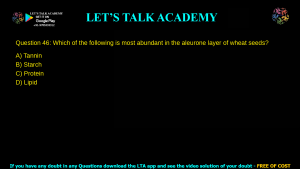
Q.46 Which of the following is most abundant in the aleurone layer of wheat seeds? (A) Tannin (B) Starch (C) Protein (D) Lipid The correct answer is: (C) Protein. The aleurone layer […]

Q.45 The sequence of a polypeptide that forms a transmembrane helix is shown below. Which one of the following segments of the peptide is most likely to span the membrane? […]

Q.44 An N-terminal His-tagged protein of molecular weight 40 kDa was purified using Ni-NTA column. This protein sample was subjected to SDS-PAGE. A western blot of the same using anti-His […]

Q.43 A polypeptide with the amino acid sequence ‘AGKPDHEKAHL’ was dissolved in a buffer of pH 1.8. The predominant form of the polypeptide will have a net charge of (A) […]

Q.42 Kinetic parameters for the enzyme fumarase with three different substrates are given below. Substrate […]


