



















































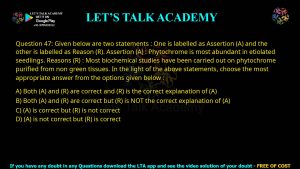































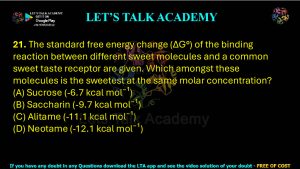
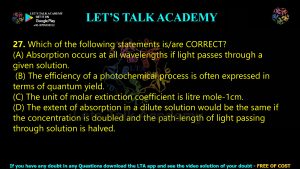














1. An enzyme catalyzes a reaction by (a) decreasing the energy of the substrate. (b) deveasing the activation energy of the reaction. (c) decreasing product stability. (d) increasing the activation […]


1. An enzyme catalyzes a reaction by (a) decreasing the energy of the substrate. (b) deveasing the activation energy of the reaction. (c) decreasing product stability. (d) increasing the activation […]

Q.65 A rod shaped bacterium has a length of 2 µm, diameter of 1 µm and density the same as that of water. If proteins constitute 15% of the cell […]

Q.64 The product of complete digestion of the plasmid shown below with EcoRI and HaeIII was purified and used as a template in a reaction containing Klenow fragment of DNA […]

Q.63 Consider a simple uni-substrate enzyme that follows Michaelis-Menten kinetics. When the enzyme catalyzed reaction was carried out in the presence of 10 nM concentration of an inhibitor, there was […]

Q.62 First order deactivation rate constants for soluble and immobilized amyloglucosidase enzyme are 0.03 min-1 and 0.005 min-1, respectively. The ratio of half-life of the immobilized enzyme to that of […]

Q.61 Consider the following alignment of two DNA sequences: AGTAAC AA—-AC Assuming an affine gap scoring scheme of an identity matrix for substitution, a gap initiation penalty of 1 and […]

Q.60 At the end of a batch culture, glucose solution is added at a flow rate of 200 ml/h. If the culture volume after 2 h of glucose addition is […]

Q.59 Yeast converts glucose to ethanol and carbon dioxide by glycolysis as per the following reaction: C6H12O6 → 2C2H5OH + 2CO2 Assuming complete conversion, the amount of ethanol produced (in […]
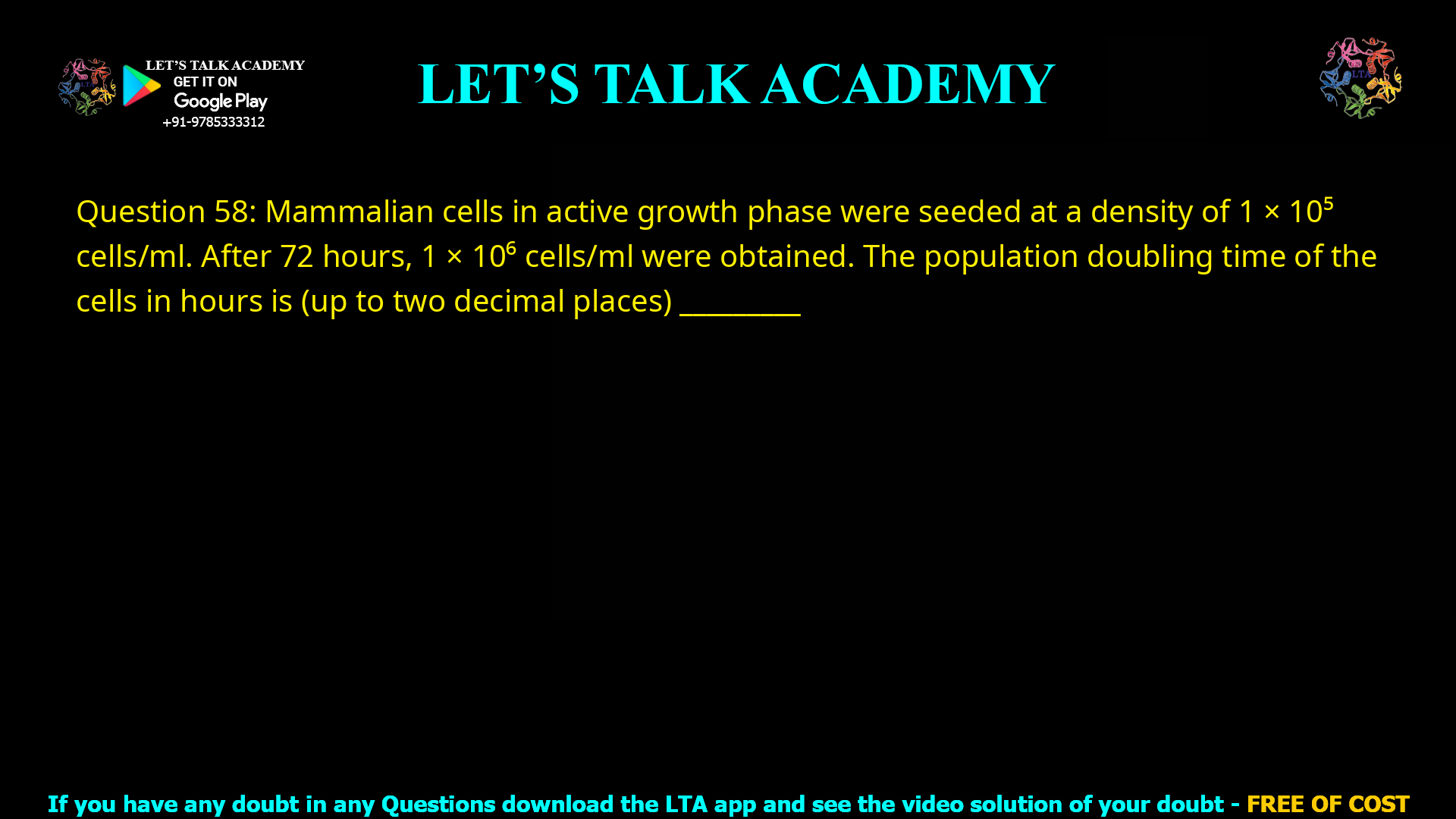
Q.58 Mammalian cells in active growth phase were seeded at a density of 1×10⁵ cells/ml. After 72 hours, 1×10⁶ cells/ml were obtained. The population doubling time of the cells in […]
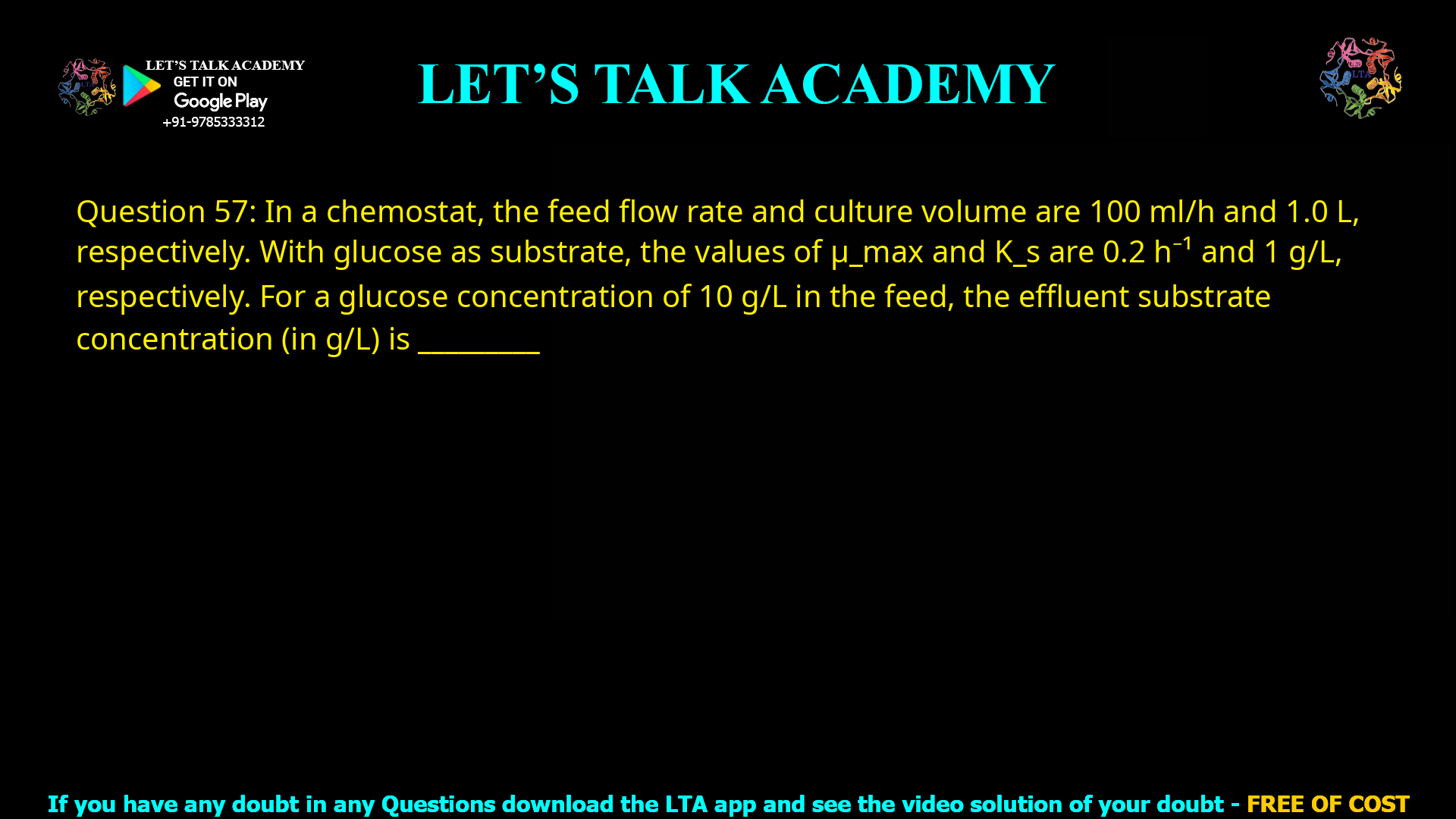
Q.57 In a chemostat, the feed flow rate and culture volume are 100 mL/h and 1.0 L, respectively. With glucose as substrate, the values of μmax and Ks are 0.2 […]


