















































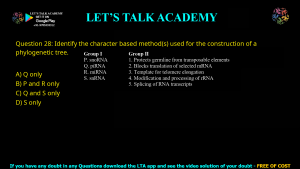



















Q.17 The study of evolutionary relationships is known as (A) genomics (B) proteomics (C) phylogenetics (D) genetics The study of evolutionary relationships is known as phylogenetics, which reconstructs organismal histories […]


Q.17 The study of evolutionary relationships is known as (A) genomics (B) proteomics (C) phylogenetics (D) genetics The study of evolutionary relationships is known as phylogenetics, which reconstructs organismal histories […]

Q.16 Wash out (as defined by D = μmax) of a continuous stirred tank fermenter is characterized by (X = biomass, S = substrate concentration in bioreactor, S0 = substrate […]

Q.15 Substrate consumption in lag phase of microbial growth is primarily used for P. turn over of the cell material Q. maintenance of intracellular pH R. motility S. increase in […]

Q.14 Restriction endonucleases which recognize and cut same recognition sequences are known as (A) isoschizomers (B) isozymes (C) isoaccepting endonucleases (D) abzymes Restriction endonucleases that recognize and cut the same […]

Q.13 In N-linked glycosylation, the oligosaccharide chain is attached to protein by (A) asparagine (B) arginine (C) serine (D) threonine In N-linked glycosylation, the oligosaccharide chain attaches to the asparagine […]

Q.12 In balanced growth phase of a cell P. all components of a cell grow at the same rate Q. specific growth determined by cell number or cell mass would […]

Q.11 ‘Hairy roots’ induced in vitro by the infection of Agrobacterium rhizogenes, are characterized by P. a high degree of lateral branching Q. genetic instability of culture R. an absence […]

Q.10 Shoot organogenesis by tissue culture results into (A) a bipolar structure that has no vascular connection with the explant (B) a monopolar structure that has a strong connection with […]

Q.9 Hydrated synthetic seeds which are produced by ion exchange reaction involve mixing the somatic embryos in a solution of (A) sodium alginate and dropping it in a solution of […]

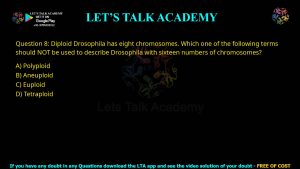
Q.8 Diploid Drosophila has eight chromosomes. Which one of the following terms should NOT be used to describe Drosophila with sixteen numbers of chromosomes? (A) Polyploid (B) Aneuploid (C) Euploid […]


