




















































































































































Q.84 Match items in Group I with sterilization methods in Group II. Group I (P) Ampicillin (Q) 1% glucose in phosphate buffer (R) Plastic syringe (S) Luria broth Group II […]


Q.84 Match items in Group I with sterilization methods in Group II. Group I (P) Ampicillin (Q) 1% glucose in phosphate buffer (R) Plastic syringe (S) Luria broth Group II […]

Q.83 Lethal dose curves of different microorganisms (1, 2, 3 and 4) are shown below. Which of these microorganisms are the most lethal? (A) 1 & 3 only (B) 1 […]

Q.82 Match organisms in Group I with shapes in Group II and flagellar arrangements in Group III. Group I (P) Salmonella typhi (Q) Saccharomyces cerevisiae (R) Aquaspirillum serpens (S) Vibrio […]

Q.81 The concentration of sodium chloride in the cytoplasm of a Halobacterium sp. was found to be 250 ng/nl. The molarity (in M) of sodium chloride is __________. Halobacterium Cytoplasm […]

Q.80 During a bacterial growth experiment, the total viable cell count at 2 h and 6 h was 1 × 10⁴ cells/ml and 1 × 10⁹ cells/ml, respectively. The specific […]

Q.79 Match the media in Group I for screening microbial isolates in Group II. Group I (P) Blood agar media (Q) Minimal media (R) Skimmed milk agar media (S) Bile […]

Q.78 The length of a coding region in an mRNA is 897 bases. How many amino acids will be there in the polypeptide synthesized using this mRNA? (A) 297 (B) […]

Q.77 Match the organisms with the appropriate growth curves. (P) Bacteria (Q) Extracellular virus (R) Intracellular virus (A) P-iii, Q-i, R-ii (B) P-ii, Q-i, R-iii (C) P-ii, Q-iii, R-i (D) […]

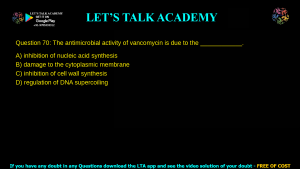
Q.76 Match compounds in Group I with inhibitory activities in Group II. Group I (P) Vancomycin (Q) Rifampin (R) Puromycin (S) Ciprofloxacin Group II (i) Folate metabolism (ii) DNA synthesis […]

Q.75 Which one of the following microscopic techniques can be used to study the contour of proteins? (A) SEM (B) TEM (C) AFM (D) Confocal microscopy Atomic Force Microscopy (AFM) […]


