

























































































Q.19 In a chemostat operating under steady state, a bacterial culture can be grown at dilution rate higher than maximum growth rate by (A) Partial cell recycling (B) Using sub-optimal […]

Q.19 In a chemostat operating under steady state, a bacterial culture can be grown at dilution rate higher than maximum growth rate by (A) Partial cell recycling (B) Using sub-optimal […]

Q.18 Expressed Sequence Tag is defined as (A) A partial sequence of a cDNA randomly selected from cDNA library (B) The characteristic gene expressed in the cell (C) The protein […]

Q.17 Accession number is a unique identification assigned to a (A) Single database entry for DNA/Protein (B) Single database entry for DNA only (C) Single database entry for Protein only […]

Q.16 Somatic cell gene transfer is used for P. Transgenic animal production Q. Transgenic diploid cell production R. In-vitro fertilization S. Classical breeding of farm animals (A) P, R and […]

Q.15 Lymphocytes interact with foreign antigens in (A) Bone marrow (B) Peripheral blood (C) Thymus (D) Lymph nodes Lymphocytes (B and T cells) patrol the body to detect foreign antigens […]

Q.14 A neonatally thymectomized mouse, immunized with protein antigen shows (A) Both primary and secondary responses to the antigen (B) Only primary response to the antigen (C) Delayed type hypersensitive […]

Q.13 A culture of bacteria is infected with bacteriophage at a multiplicity of 0.3. The probability of a single cell infected with 3 phages is (A) 0.9 (B) 0.27 (C) […]

Q.12 Interferon-β is produced by (A) Bacteria infected cells (B) Virus infected cells (C) Both virus and bacteria infected cells (D) Fungi infected cells Interferon-β (IFN-β), a type I interferon, […]

Q.11 Which one of the following DOES NOT belong to the domain of Bacteria? (A) Cyanobacteria (B) Proteobacteria (C) Bacteroids (D) Methanobacterium The three-domain system classifies life into Bacteria, Archaea, […]

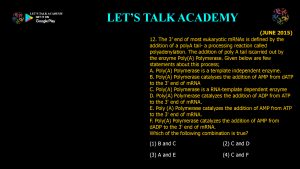
Q.10 An example for template independent DNA polymerase is (A) DNA Polymerase I (B) RNA polymerase (C) Terminal deoxynucleotidyl transferase (D) DNA polymerase III Template-independent DNA polymerases add nucleotides without […]


