



































































Q.16 Teak is a dominant tree species of which of the following types of forests in India? 1. Tropical moist deciduous forest 2. Tropical thorn deciduous forest 3. Tropical Rain […]

Q.16 Teak is a dominant tree species of which of the following types of forests in India? 1. Tropical moist deciduous forest 2. Tropical thorn deciduous forest 3. Tropical Rain […]

Q.15 In the course of evolution, first horses appeared in which period? 1. Eocene 2. Oligocene 3. Miocene 4. Pliocene First Horses Appeared in Eocene Epoch The earliest horse ancestors, […]

Q.14 Calculate the value of median from the given data: 2.90, 3.57, 3.73, 2.98, 3.64, 3.75 3.30, 3.62, 3.76, 3.38, 3.66, 3.76 1. 3.505 2. 3.62 3. 3.63 4. 3.65 […]

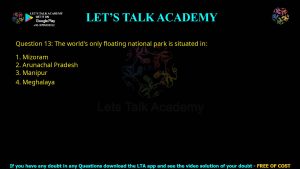
Q.13 The world’s only floating national park is situated in: 1. Mizoram 2. Arunachal Pradesh 3. Manipur 4. Meghalaya World’s Only Floating National Park: Manipur’s Keibul Lamjao Keibul Lamjao National […]

Q.12 A lizard like reptile which is considered as a “Living fossil” is: 1. Komado dragon 2. Varonus 3. Sphenodon 4. Gekko Living Fossil Lizard-Like Reptile: Sphenodon (Tuatara) Sphenodon, commonly […]

Q.11 Separation of two different alleles from each other during gamete formation in a heterozygote follows: 1. Law of unit factors 2. Law of segregation 3. Law of dominance 4. […]

Q.10 Hyaluronic acid is composed of: 1. D-Galactose and N-acetyl D-glucosamine 2. L-Iduronie acid and N-acetyl-D-galactosamine 3. D-Glucuronic acid and N-acetyl-D-galactosamine 4. D-Glucuronic acid and N-acetyl-D-glucosamine Hyaluronic Acid Composition: D-Glucuronic […]

Q.9 Neuroglia found in peripheral nervous system (PNS) contains the following cells: 1. Astrocytes 2. Schwann cells 3. Oligodendrocytes 4. Ependymal cells PNS Neuroglia Include Schwann Cells Schwann cells are […]

Q.8 The drug Aspirin inhibits the synthesis of: 1. Leukotrienes 2. Prostaglandins 3. Arachidonic acid 4. 17-eicosapentanoic Acid (EPA) Aspirin Inhibits Prostaglandin Synthesis Aspirin, a widely used non-steroidal anti-inflammatory drug […]

Q.7 All human antibody types possess a proline-rich flexible ‘hinge region’ except: 1. IgA 2. IgG 3. IgE 4. IgD Human antibodies (immunoglobulins) feature a Y-shaped structure with Fab and […]


