
































































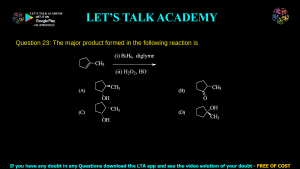
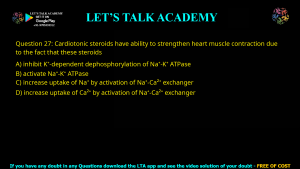
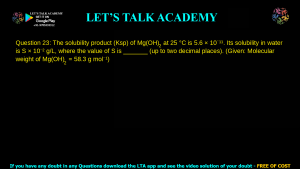
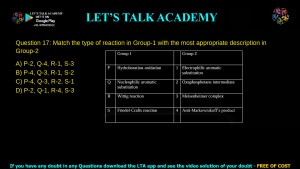



















Single stranded DNA can be separated from double stranded DNA efficiently using 1. hydrophobic interaction chromatography 2. RP-HPLC 3. hydroxyapatite chromatography 4. urea PAGE How to Separate Single-Stranded DNA […]


Single stranded DNA can be separated from double stranded DNA efficiently using 1. hydrophobic interaction chromatography 2. RP-HPLC 3. hydroxyapatite chromatography 4. urea PAGE How to Separate Single-Stranded DNA […]

A, B, C, and D are to be seated in a row, But C and D cannot be together. Also B cannot be at the third place. Which of the […]

Trypsin cleaves a protein at the 1. C – terminus side of Arg/Lys residues 2. N – terminus side of Arg/Lys residues 3. C – terminus side of Val/lle residues […]

Which of the following is NOT true ? 1. prokaryotes are unicellular organisms 2. eukaryotes can be either multicellular or unicellular organisms 3. prokaryotic cells lack nucleus whereas eukaryotic cells […]

Primary cilia biogenesis typically starts at the 1. S phase of the cell cycle 2. S and G2 phase of the cell cycle 3. G2 phase of the cell cycle […]
The Freund’s complete adjuvant is a mixture of 1. oil, water, dried bacterial spores 2. oil, water and dried Mycobacterium cells 3. amino acids, detergent and dried S. aureus cells […]

Synthesis of majority of lipids in a cellular system occurs in the 1. mitochondria 2. lysosomes 3. nucleus 4. endoplasmic reticulum Where Does Lipid Synthesis Occur in Cells? The Role […]

With reference to protein precipitation by organic solvents, which one of the following statements is correct? (1) It is not influenced by pH. (2) It is dependent on the change […]

Histones 1. contain high amount of basic amino acids 2. contain both 𝛼 − ℎ𝑒𝑙𝑖𝑥 and 𝛽 − 𝑝𝑙𝑒𝑎𝑡𝑒𝑑 sheet 3. have molecular weights in excess of 100,000 Da 4. […]

47. Conversion of UDP-Galactose to UDP-Glucose occurs by: (a)Dehydration and hydration (b)Oxidation and reduction (c)Oxidative addition (d)Reductive elimination Biochemical Conversion of UDP-Galactose to UDP-Glucose The conversion of UDP-Galactose to […]


