
1. Introduction
Developmental biology is the study of how a single fertilized egg develops into a complex multicellular organism containing many specialized cells, tissues, and organs.
During development, cells undergo:
- cell division,
- growth,
- differentiation,
- migration,
- communication,
- specialization,
- programmed cell death,
- tissue organization.
Although cells in an organism may contain essentially the same genetic information, they can develop into very different cell types.
For example:
Fertilized egg
→ embryonic cells
→ specialized cells
→ neurons, muscle cells, blood cells, epithelial cells, etc.
The ability of a cell to develop into different types of cells is called its potency.
2. Definition of Potency
Potency is the developmental potential of a cell—the range of different cell types that the cell can produce under appropriate conditions.
In simple words:
Potency tells us how many different cell types a cell has the potential to become.
A cell with very high potency can generate many different cell types, whereas a cell with restricted potency can produce only a limited number of cell types.
3. Potency and Cell Differentiation
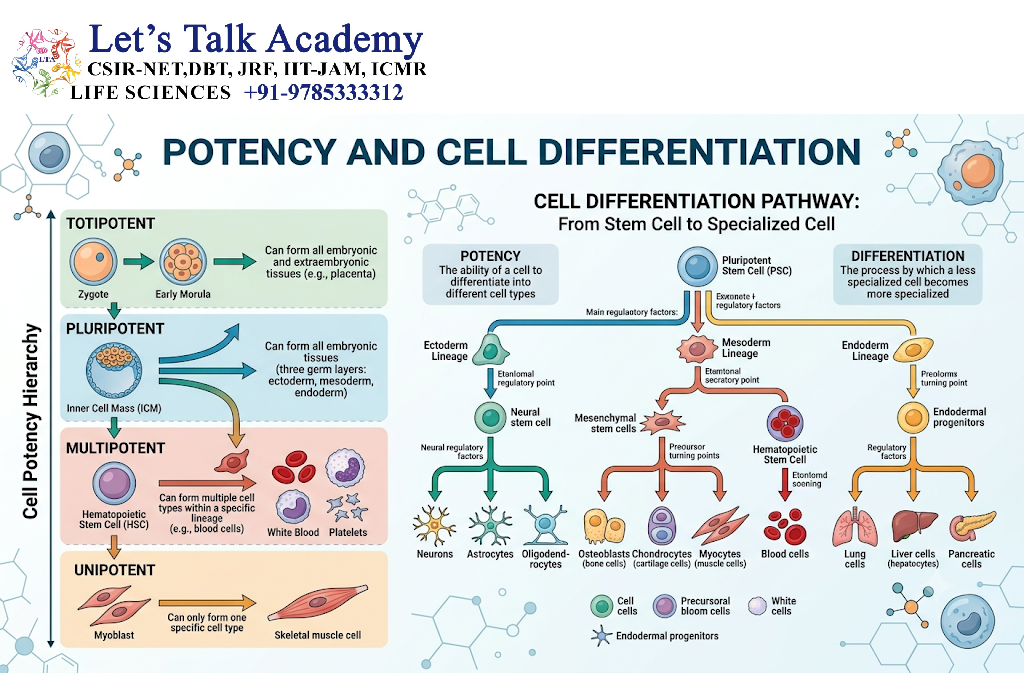
Potency is closely related to cell differentiation.
Differentiation
Differentiation is the process through which an unspecialized cell becomes a specialized cell with a particular structure and function.
For example:
Stem cell
→ differentiation
→ muscle cell
or
→ nerve cell
or
→ blood cell.
As cells differentiate, their developmental potential generally becomes more restricted.
General relationship
High developmental potential
↓
Cell differentiation
↓
Increasing specialization
↓
Reduced developmental potential
This means that a highly potent early embryonic cell can give rise to many cell types, while a specialized mature cell generally has much more limited potential.
4. Why Potency Is Important
Potency helps explain:
- embryonic development,
- formation of different tissues,
- stem-cell biology,
- cell differentiation,
- tissue regeneration,
- organ development,
- developmental plasticity,
- regenerative medicine.
It also helps scientists understand how an early embryonic cell can eventually contribute to the formation of the entire organism.
5. Levels of Cellular Potency
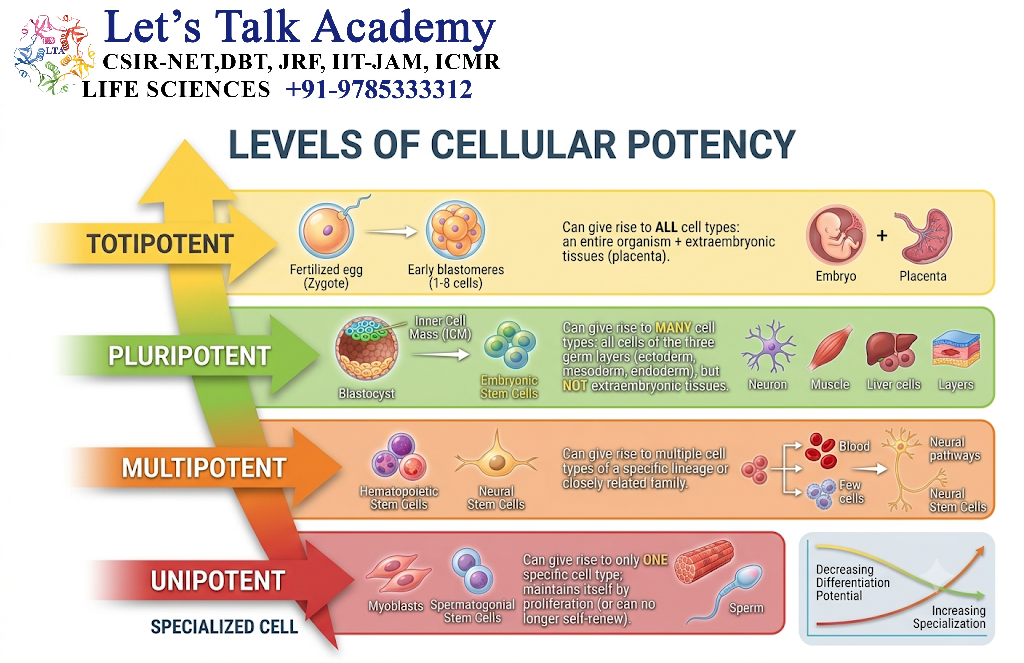
Cellular potency is commonly classified into several levels:
- Totipotency
- Pluripotency
- Multipotency
- Oligopotency
- Unipotency
These levels represent progressively more restricted developmental potential.
General hierarchy
Totipotent
↓
Pluripotent
↓
Multipotent
↓
Oligopotent
↓
Unipotent
As we move downward, the range of possible cell fates becomes narrower.
6. Totipotency
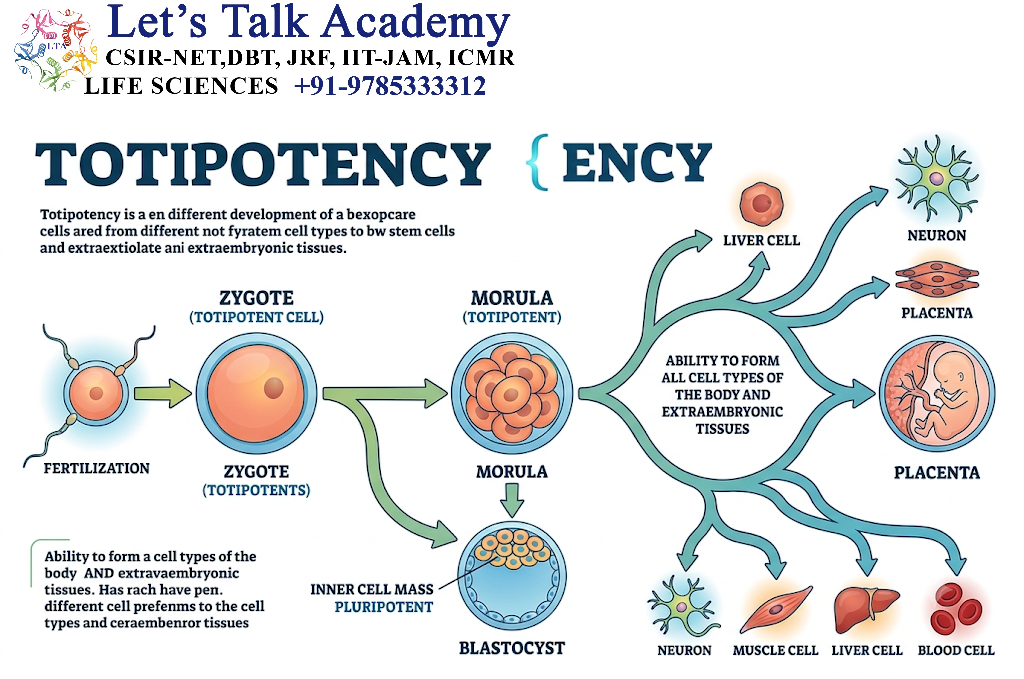
Totipotency is the highest level of developmental potential.
A totipotent cell has the potential to generate all cell types required to form an entire organism, including embryonic and extraembryonic tissues, under appropriate developmental conditions.
Example
The fertilized egg, or zygote, is the classic example of a totipotent cell.
Very early embryonic cells can also retain totipotent potential for a limited developmental period.
What can a totipotent cell produce?
It can contribute to:
- embryonic tissues,
- extraembryonic tissues,
- all major cell lineages of the organism.
Simplified flow
Zygote
↓
Early embryonic divisions
↓
Embryonic + extraembryonic potential
↓
Complete organism
7. Importance of Totipotency
Totipotency explains how an entire organism can originate from a single fertilized egg.
The zygote divides repeatedly through mitosis.
The resulting cells eventually undergo:
- specification,
- differentiation,
- morphogenesis,
- tissue organization.
Thus, totipotency provides the developmental foundation for the formation of the complete organism.
8. Pluripotency
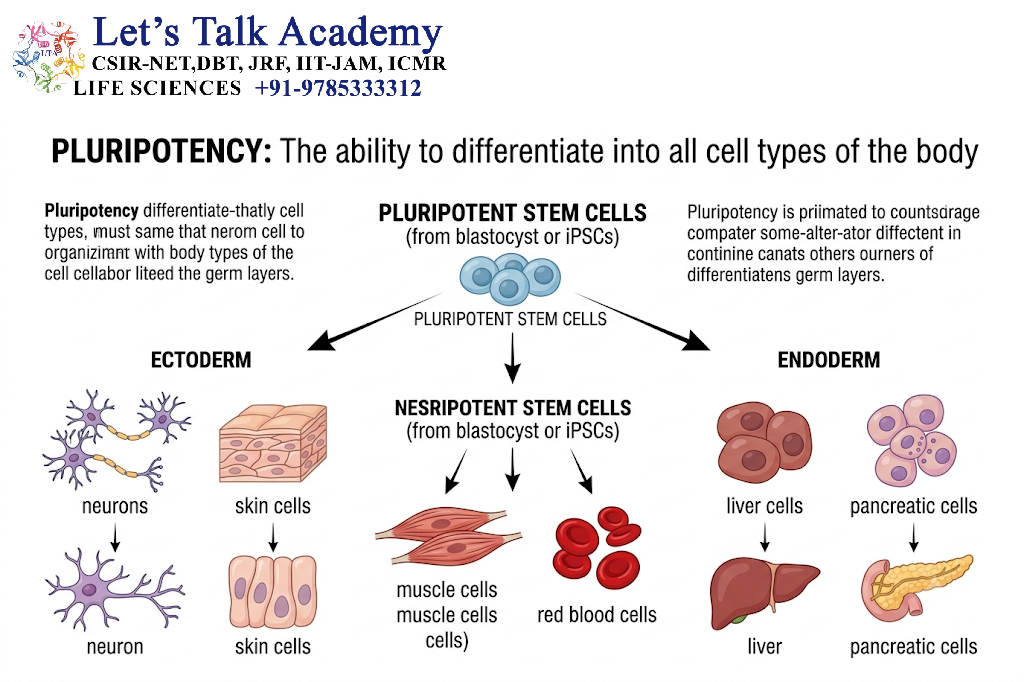
Pluripotency refers to the ability of a cell to differentiate into cells representing the three primary embryonic germ layers:
- ectoderm,
- mesoderm,
- endoderm.
However, pluripotent cells generally cannot independently generate all extraembryonic tissues needed to form a complete organism.
Examples
- Embryonic stem cells
- Induced pluripotent stem cells
Three germ layers
| Germ layer | Examples of derivatives |
|---|---|
| Ectoderm | Nervous system, epidermis |
| Mesoderm | Muscle, bone, blood, connective tissues |
| Endoderm | Gut epithelium, liver and pancreas lineages |
Thus:
Pluripotent cell
→ ectoderm
→ mesoderm
→ endoderm
→ many specialized cell types.
9. Pluripotent Stem Cells
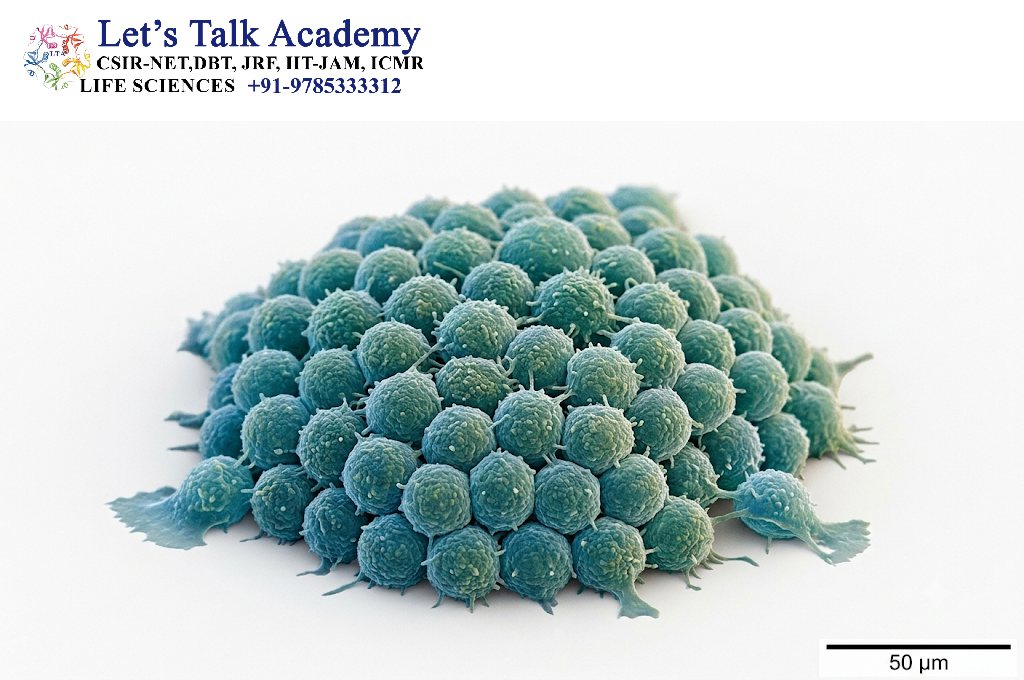
Pluripotent stem cells can self-renew and can differentiate into many specialized cell types.
Two major examples are:
A. Embryonic stem cells
These are derived from the early embryo and possess pluripotent developmental potential.
B. Induced pluripotent stem cells
These are mature somatic cells that have been experimentally reprogrammed to a pluripotent state.
For example:
Adult somatic cell
→ reprogramming
→ induced pluripotent stem cell
→ different specialized cell types.
10. Multipotency
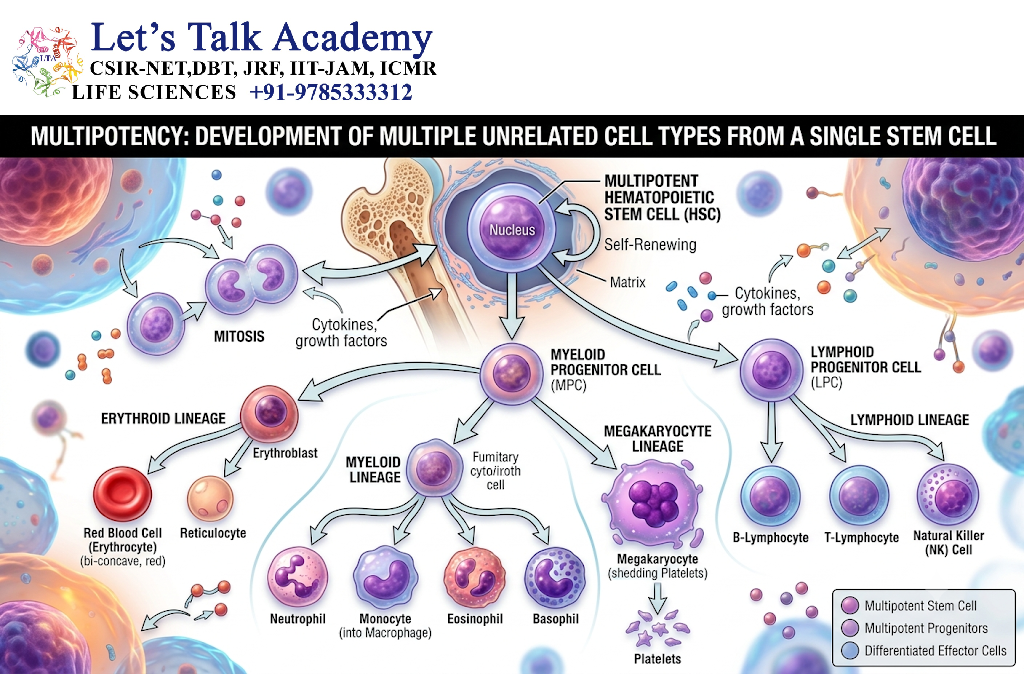
Multipotency is a more restricted form of potency.
A multipotent cell can produce multiple related cell types, usually within a particular tissue or developmental lineage.
Example: Hematopoietic stem cell
A hematopoietic stem cell can generate several blood-cell lineages.
For example:
Hematopoietic stem cell
→ red blood cells
→ platelets
→ B cells
→ T cells
→ natural killer cells
→ myeloid cells.
Therefore, hematopoietic stem cells are considered multipotent.
11. Oligopotency
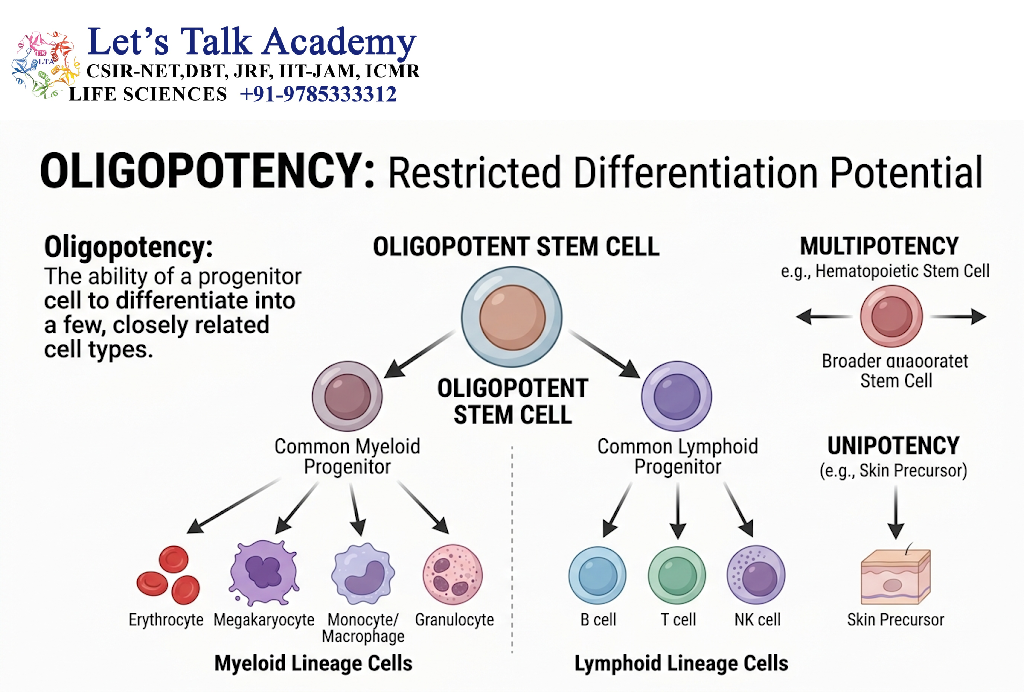
Oligopotency refers to the ability of a progenitor cell to produce a small number of closely related cell types.
It is more restricted than multipotency.
Example
A lymphoid progenitor can generate several related lymphoid cell types.
Another example is a myeloid progenitor that can produce several related myeloid cell lineages.
General pattern
Multipotent stem cell
↓
Oligopotent progenitor
↓
A smaller group of related cell types.
12. Unipotency
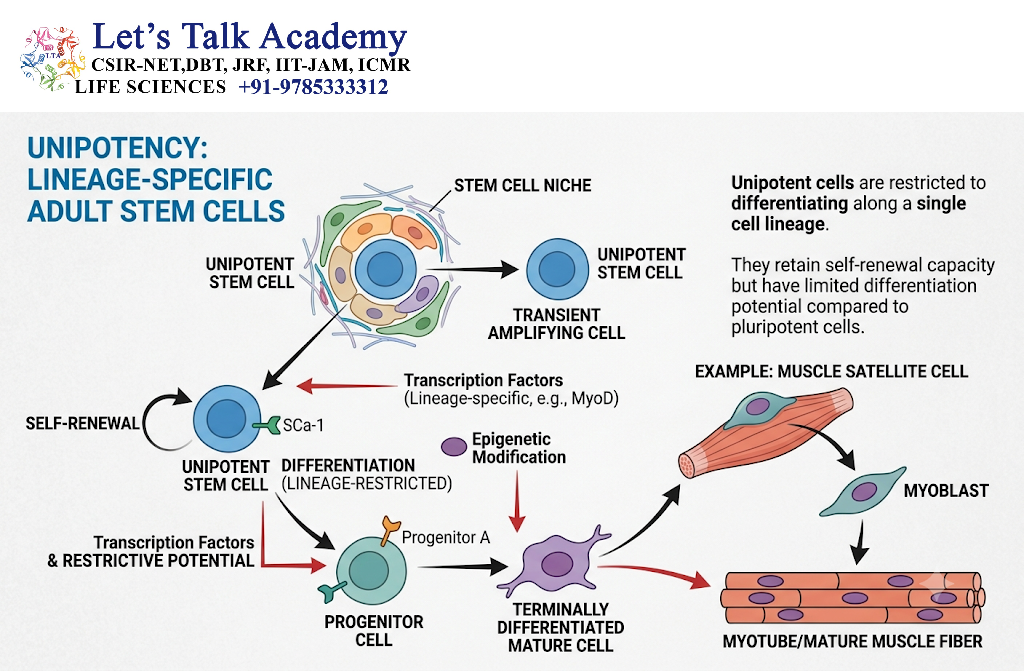
Unipotency refers to the ability of a cell or progenitor population to produce essentially one mature cell type while retaining some capacity for self-renewal.
Example
Certain tissue-specific stem/progenitor cells can mainly produce one mature cell type.
For example, some muscle satellite-cell populations primarily generate skeletal muscle cells.
Therefore:
Unipotent cell
→ one major differentiated cell type.
13. Comparison of Potency Levels
| Potency | Developmental potential | Example |
|---|---|---|
| Totipotent | Entire organism, including embryonic and extraembryonic tissues | Zygote |
| Pluripotent | Many cell types from three germ layers | Embryonic stem cell |
| Multipotent | Multiple related cell types | Hematopoietic stem cell |
| Oligopotent | Small group of related cell types | Myeloid/lymphoid progenitors |
| Unipotent | Mainly one mature cell type | Certain tissue-specific progenitors |
14. Potency vs Differentiation
These two terms are related but not identical.
Potency
Describes what a cell can potentially become.
Differentiation
Describes the process by which a cell becomes specialized.
For example:
A pluripotent stem cell has the potential to form many cell types.
When it receives appropriate developmental signals, it may differentiate into a specific lineage.
Example
Pluripotent cell
→ developmental signals
→ lineage specification
→ differentiation
→ specialized cell.
15. Potency and Cell Fate
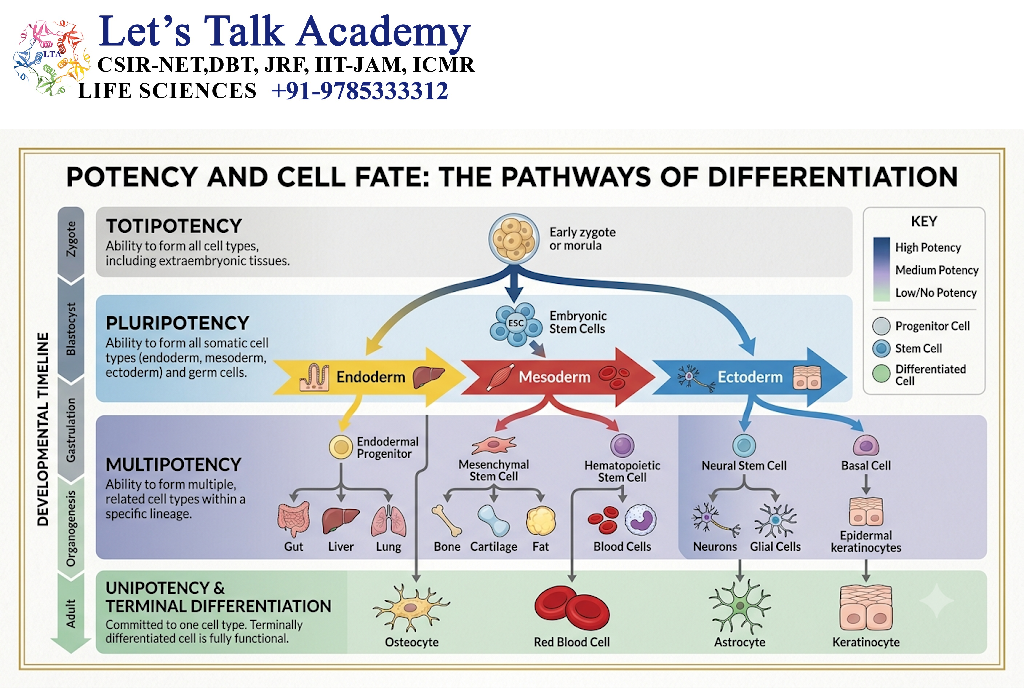
Cell fate refers to the developmental outcome that a cell is destined or specified to follow under particular conditions.
Potency describes the range of possible outcomes.
For example:
A cell may initially have the potential to become several cell types.
After receiving specific signals:
Cell
→ signal A
→ fate A
or
→ signal B
→ fate B.
Thus, cell fate is influenced by:
- gene expression,
- signaling molecules,
- neighboring cells,
- extracellular environment,
- transcription factors,
- developmental timing.
16. Potency and Gene Expression
Different cell types generally contain similar genomic information, but they express different sets of genes.
For example:
Neuron
Expresses genes important for:
- neurotransmission,
- axonal growth,
- synaptic function.
Muscle cell
Expresses genes involved in:
- contraction,
- muscle structure,
- energy metabolism.
The difference is largely due to differential gene expression.
Basic mechanism
Same genome
↓
Different transcription-factor activity
↓
Different genes expressed
↓
Different proteins produced
↓
Different cell structure and function
↓
Cell differentiation.
17. Transcription Factors and Potency
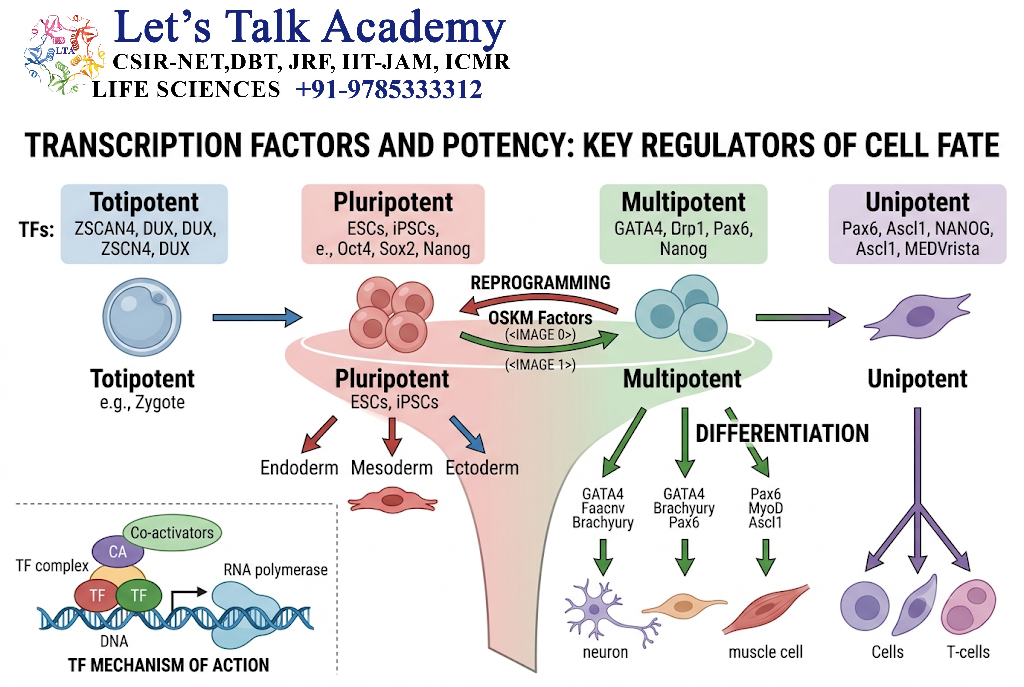
Transcription factors are proteins that regulate gene expression.
They play a major role in maintaining or changing cellular identity.
Important pluripotency-associated transcription factors include:
- OCT4
- SOX2
- NANOG
These factors form regulatory networks that help maintain pluripotent cell states.
Changes in these regulatory networks can promote differentiation.
18. OCT4
OCT4 is an important transcription factor involved in maintaining pluripotency.
Appropriate levels of OCT4 contribute to maintaining pluripotent cell identity.
Changes in its expression can influence lineage differentiation.
19. SOX2
SOX2 is another important transcription factor associated with pluripotency and stem-cell maintenance.
It works together with other regulatory factors to maintain appropriate gene-expression patterns.
20. NANOG
NANOG is a transcription factor involved in maintaining the pluripotent state.
Together with factors such as OCT4 and SOX2, it participates in the regulatory network controlling pluripotency.
Simplified network
OCT4 + SOX2 + NANOG
↓
Pluripotency-associated gene expression
↓
Maintenance of pluripotent state
When developmental signals alter this network:
↓
Lineage specification
↓
Differentiation.
21. Potency and Signaling
Cell potency is not controlled only by internal genes.
Cells also respond to signals from their surroundings.
Important developmental signaling pathways include:
- WNT,
- Notch,
- Hedgehog,
- TGF-β/BMP,
- FGF.
These pathways can influence:
- proliferation,
- cell fate,
- differentiation,
- tissue patterning,
- stem-cell maintenance.
22. Cell-Cell Interaction
Developing cells communicate with neighboring cells.
Signals may be transmitted through:
- direct cell contact,
- secreted signaling molecules,
- extracellular matrix,
- cell-surface receptors.
For example:
Signal-producing cell
→ signaling molecule
→ receptor on neighboring cell
→ intracellular signaling
→ changes in gene expression
→ altered cell fate.
Thus, potency is influenced by the developmental environment.
23. Extrinsic and Intrinsic Factors
Cell fate is influenced by both intrinsic and extrinsic factors.
Intrinsic factors
These originate within the cell.
Examples:
- transcription factors,
- gene expression,
- epigenetic state,
- cytoplasmic components.
Extrinsic factors
These originate from the cellular environment.
Examples:
- growth factors,
- morphogens,
- neighboring cells,
- extracellular matrix,
- mechanical signals.
| Intrinsic factors | Extrinsic factors |
|---|---|
| Transcription factors | Growth factors |
| Gene expression | Morphogens |
| Epigenetic state | Cell-cell signals |
| Cytoplasmic determinants | ECM signals |
24. Potency and Stem Cells
Stem cells are characterized by two major properties:
1. Self-renewal
The ability to produce daughter cells that retain stem-cell characteristics.
2. Differentiation potential
The ability to produce specialized cell types.
Different stem cells possess different levels of potency.
Example
Pluripotent stem cell
→ many cell types
Multipotent stem cell
→ several related cell types
Unipotent stem/progenitor cell
→ mainly one cell type.
25. Potency and Developmental Restriction
During development, cells generally undergo progressive restriction.
Example
Totipotent
↓
Pluripotent
↓
Multipotent
↓
Oligopotent
↓
Unipotent
↓
Differentiated cell
This is called progressive restriction of developmental potential.
However, modern developmental biology shows that cell identity can sometimes be experimentally altered or reprogrammed.
26. Cellular Reprogramming
Cellular reprogramming is the process of changing a differentiated cell into a more developmentally flexible state.
A major example is the generation of induced pluripotent stem cells (iPSCs).
A mature somatic cell can be experimentally reprogrammed using specific transcription factors.
Simplified process
Differentiated somatic cell
↓
Introduction of reprogramming factors
↓
Epigenetic and transcriptional remodeling
↓
Pluripotent-like state
↓
Induced pluripotent stem cell
↓
Differentiation into specialized cells.
27. Potency and Epigenetics
Epigenetic regulation influences which genes are active or inactive without changing the DNA sequence itself.
Important mechanisms include:
- DNA methylation,
- histone modifications,
- chromatin remodeling,
- non-coding RNAs.
During differentiation, the epigenetic landscape changes.
This helps establish and maintain cell-specific gene-expression patterns.
28. Potency and Morphogens
Morphogens are signaling molecules that can provide positional information during development.
Different concentrations of a morphogen can activate different genetic programs in cells.
General example
High concentration
→ gene program A
Intermediate concentration
→ gene program B
Low concentration
→ gene program C.
Thus, extracellular signals can influence the developmental fate of cells with appropriate potency.
29. Potency and Lineage Commitment
Lineage commitment is the process by which a cell becomes progressively restricted toward a particular developmental pathway.
For example:
Hematopoietic stem cell
↓
Blood-cell progenitor
↓
Myeloid or lymphoid lineage
↓
Specific progenitor
↓
Mature blood cell.
As lineage commitment increases, developmental options become more limited.
30. Potency vs Plasticity
These terms should not be confused.
Potency
The range of cell types a cell can potentially generate.
Plasticity
The ability of a cell to change its state or characteristics in response to environmental or experimental conditions.
A cell may show plasticity without being broadly pluripotent.
31. Potency vs Stemness
Stemness refers to properties associated with stem cells, particularly:
- self-renewal,
- maintenance of an undifferentiated state,
- capacity for differentiation.
Potency specifically describes the range of developmental possibilities.
Therefore:
Stemness ≠ potency
although they are closely related concepts.
32. Importance of Potency in Regenerative Medicine
Understanding potency is important for regenerative medicine.
Scientists study different stem-cell types for potential applications such as:
- replacement of damaged cells,
- tissue engineering,
- disease modeling,
- drug testing,
- studying developmental disorders.
For example, pluripotent stem cells can potentially be differentiated into specialized cells for research and regenerative applications.
33. Potency in Disease Research
Potency and cellular differentiation are important in understanding diseases such as:
- cancer,
- developmental disorders,
- congenital abnormalities,
- degenerative diseases.
Cancer cells may sometimes acquire abnormal stem-like properties, including increased self-renewal and altered differentiation.
34. Potency and Cancer
Cancer development can involve abnormal regulation of:
- cell proliferation,
- differentiation,
- self-renewal,
- apoptosis.
Some cancers contain populations of cells described as cancer stem-like cells.
These cells have been studied for their possible roles in:
- tumor initiation,
- recurrence,
- treatment resistance,
- metastasis.


