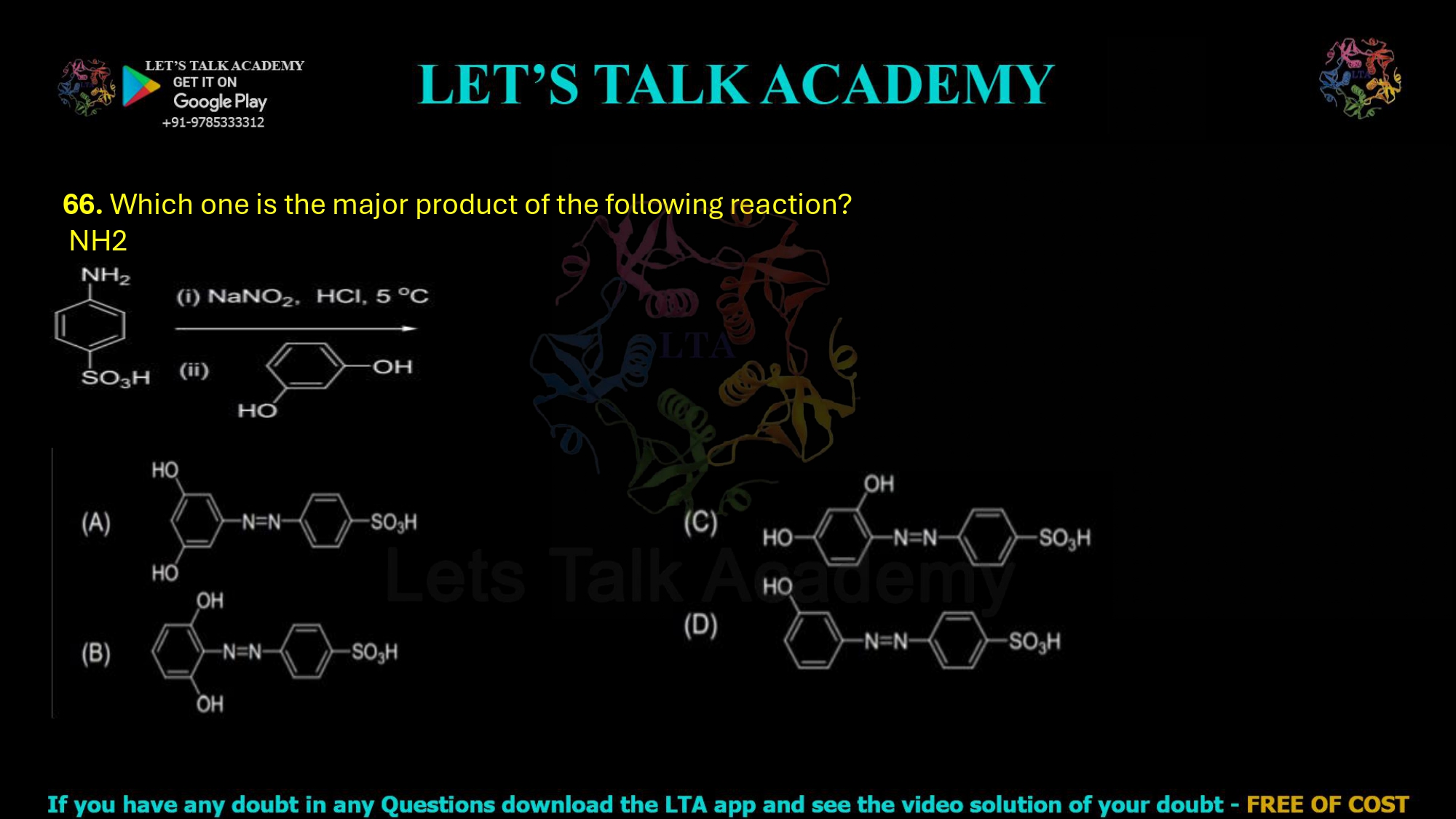
66. Which one is the major product of the following reaction?
NH2
Major Product of Diazotization and Azo Coupling Reaction with Sulfanilic Acid and Resorcinol
Understanding the reaction mechanism, directing effects of substituents, and the stability of intermediates is essential for correctly predicting the final product. In this question, sulfanilic acid is first converted into an aromatic diazonium salt, which subsequently reacts with resorcinol to produce an azo dye. The objective is to identify the major product formed after the coupling reaction.
Step 1: Sulfanilic acid is treated with sodium nitrite (NaNO₂) and hydrochloric acid (HCl) at 0–5°C to form the corresponding diazonium salt.
Step 2: The diazonium salt undergoes azo coupling with resorcinol (1,3-dihydroxybenzene), producing an aromatic azo compound.
Correct Answer
✅ Correct Option: (A)
Understanding the Reaction
The first stage of the reaction is known as diazotization. Sulfanilic acid contains a primary aromatic amino group (-NH₂), which reacts with nitrous acid generated in situ from sodium nitrite and hydrochloric acid. Under low-temperature conditions (0–5°C), the amino group is converted into a highly reactive aromatic diazonium salt. Maintaining a low temperature is extremely important because aromatic diazonium salts become unstable at higher temperatures and may decompose before participating in further reactions.
The diazonium ion formed during this reaction behaves as an excellent electrophile. In the next step, it reacts with resorcinol through an electrophilic aromatic substitution known as an azo coupling reaction. During this process, a new azo linkage (-N=N-) is formed between the diazonium ion and the aromatic ring of resorcinol, resulting in the formation of an intensely colored azo dye.
Why Resorcinol is Highly Reactive Towards Azo Coupling
Resorcinol contains two hydroxyl (-OH) groups attached to the benzene ring. Hydroxyl groups are among the strongest electron-donating substituents in aromatic chemistry because they donate electron density into the benzene ring through resonance. As a result, the aromatic ring becomes highly activated toward electrophilic substitution reactions.
The electron-donating effect of both hydroxyl groups increases the electron density mainly at the ortho and para positions. In resorcinol, the carbon located at the 4-position receives resonance stabilization from both hydroxyl groups simultaneously. This makes the 4-position the most electron-rich and therefore the preferred site for electrophilic attack by the diazonium ion.
Consequently, azo coupling predominantly occurs at this position, giving the major product represented in Option (A).
Reaction Mechanism
Step 1: Formation of the Diazonium Salt
When sulfanilic acid reacts with sodium nitrite and hydrochloric acid at low temperature, nitrous acid is generated in situ. The amino group undergoes diazotization, replacing the hydrogen atoms of the amino group with a diazonium functional group (-N₂⁺). The resulting aromatic diazonium salt acts as a powerful electrophile in subsequent reactions.
Step 2: Electrophilic Aromatic Substitution
The activated aromatic ring of resorcinol attacks the positively charged diazonium ion. Since the 4-position possesses the highest electron density due to resonance contributions from both hydroxyl groups, coupling occurs predominantly at this carbon. Aromaticity is restored after deprotonation, producing the stable azo dye. The hydroxyl groups remain unchanged during the reaction.
Why Option (A) is Correct
Option (A) correctly represents the azo dye formed by coupling at the most activated carbon atom of resorcinol. The azo linkage occupies the position that is para to one hydroxyl group and ortho to the other hydroxyl group. This arrangement provides maximum resonance stabilization, making the product both kinetically and thermodynamically favorable. Since electrophilic aromatic substitution always favors the most electron-rich position, Option (A) is the major product obtained under the given reaction conditions.
Explanation of All Options
Option (A)
This option correctly depicts the coupling of the diazonium ion at the most activated carbon atom of resorcinol. Both hydroxyl groups remain intact, and the azo bond forms at the position receiving maximum resonance stabilization. Therefore, this is the major product of the reaction and the correct answer.
Option (B)
In this structure, the azo linkage forms at a less favorable position of the aromatic ring. Although electrophilic substitution is theoretically possible, the intermediate formed during this pathway is less stabilized by resonance. Because of its lower stability, this product is formed only in negligible amounts and cannot be considered the major product.
Option (C)
This structure shows azo coupling at a carbon atom that is not the most activated site on resorcinol. The directing influence of the hydroxyl groups is not fully satisfied, making this substitution considerably less favorable than that observed in Option (A). Consequently, this structure does not represent the principal reaction product.
Option (D)
The coupling pattern shown in this option also occurs at a position that lacks maximum resonance stabilization. Since electrophilic aromatic substitution strongly favors the most electron-rich carbon atom, the product represented by Option (D) is not expected to form as the major product under normal azo coupling conditions.
Concept Behind the Question
This problem primarily tests the understanding of directing effects in electrophilic aromatic substitution. Hydroxyl groups strongly activate aromatic rings by donating electron density through resonance and direct incoming electrophiles toward ortho and para positions. When more than one hydroxyl group is present, resonance effects combine to identify the most activated carbon atom. During azo coupling, the aromatic diazonium ion behaves as the electrophile, while the activated aromatic compound serves as the nucleophilic partner. Predicting the major product therefore requires identifying the carbon atom with the greatest resonance stabilization.
Final Answer
After diazotization of sulfanilic acid, the resulting aromatic diazonium salt undergoes electrophilic azo coupling with resorcinol at its most activated 4-position. The resulting azo dye corresponds to Option (A), making it the major product of the reaction.
✅ Correct Answer: Option (A)


