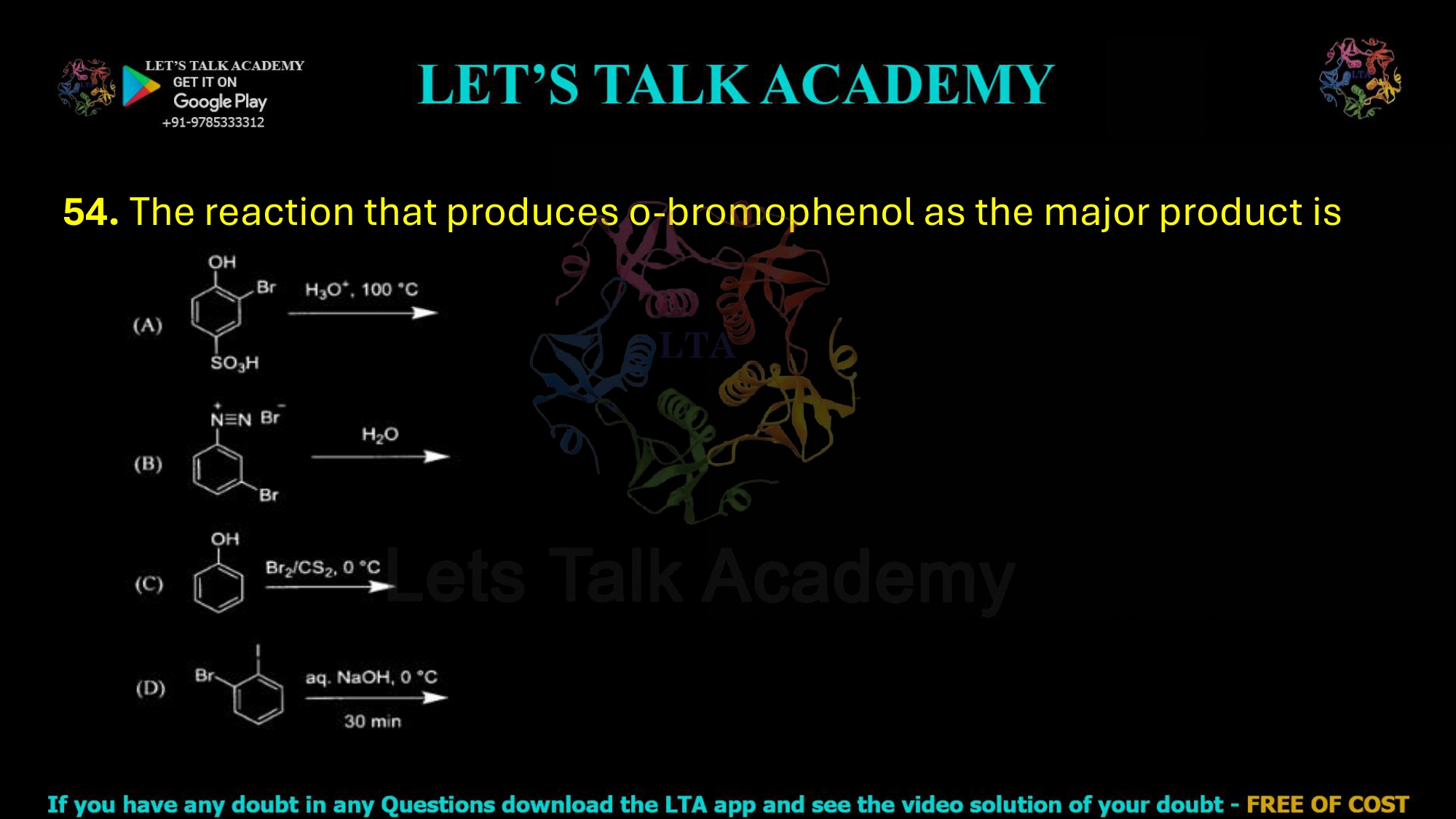
54. The reaction that produces o-bromophenol as the major product is
Which Reaction Produces o-Bromophenol as the Major Product? Complete Explanation with Reaction Mechanism
In the present question, four different reactions are given, and we have to identify the one that produces o-bromophenol (2-bromophenol) as the major product. Solving this question requires knowledge of sulfonation and desulfonation, diazonium salt chemistry, electrophilic aromatic substitution, and nucleophilic aromatic substitution.
Correct Answer
Correct Option: (A)
Why Option (A) is Correct
Option (A) involves a bromophenol containing a sulfonic acid (-SO3H) substituent. When aromatic sulfonic acids are heated with dilute acid, they undergo desulfonation, which is simply the reverse of sulfonation.
In the given molecule, the sulfonic acid group occupies the para position with respect to the hydroxyl group, while bromine is already present at the ortho position. During desulfonation, only the -SO3H group is removed; the bromine substituent remains unchanged.
Therefore, the product obtained after removal of the sulfonic acid group is o-bromophenol.
This reaction is widely used in aromatic chemistry because sulfonic acid groups can act as temporary blocking groups, allowing selective substitution at desired positions before being removed.
Detailed Explanation of Every Option
Option (A): Desulfonation of Bromophenol
This is the correct answer. Acidic hydrolysis at elevated temperature removes only the sulfonic acid group from the aromatic ring. Since bromine already occupies the ortho position relative to the hydroxyl group, the final product is 2-bromophenol (o-bromophenol).
Option (B): Hydrolysis of a Bromobenzenediazonium Salt
This option is incorrect. Diazonium salts react with water to replace the diazonium group by a hydroxyl group. However, the position of bromine in the starting compound determines the position of bromine in the product. In the given structure, bromine is not located ortho to the diazonium group, so hydrolysis produces a different bromophenol isomer rather than o-bromophenol.
Option (C): Bromination of Phenol Using Br2/CS2
This option is incorrect because phenol strongly activates the aromatic ring toward electrophilic substitution. Under non-polar conditions such as Br2/CS2, bromination mainly gives a mixture of ortho- and para-bromophenols, with the para isomer generally predominating because steric hindrance is lower at the para position. Therefore, o-bromophenol is not the major product.
Option (D): Reaction of Bromoiodobenzene with Aqueous NaOH
This option is also incorrect. Under these conditions, nucleophilic aromatic substitution does not selectively generate o-bromophenol. If substitution occurs through benzyne or related mechanisms, mixtures of products are expected rather than selective formation of the ortho bromophenol.
Concept Behind the Reaction
Desulfonation is the reverse of aromatic sulfonation and occurs under acidic conditions at elevated temperature. Since the sulfonic acid group is removable, it is frequently used as a temporary directing or blocking group in multistep aromatic synthesis. This strategy allows chemists to control substitution patterns and subsequently remove the blocking group to obtain the desired product.
In this problem, the bromine atom is already positioned correctly. The reaction simply removes the sulfonic acid substituent without disturbing the bromine or hydroxyl groups, producing o-bromophenol directly.
Final Answer
Correct Option: (A)
The reaction involving acid-catalyzed desulfonation produces o-bromophenol as the major product.


