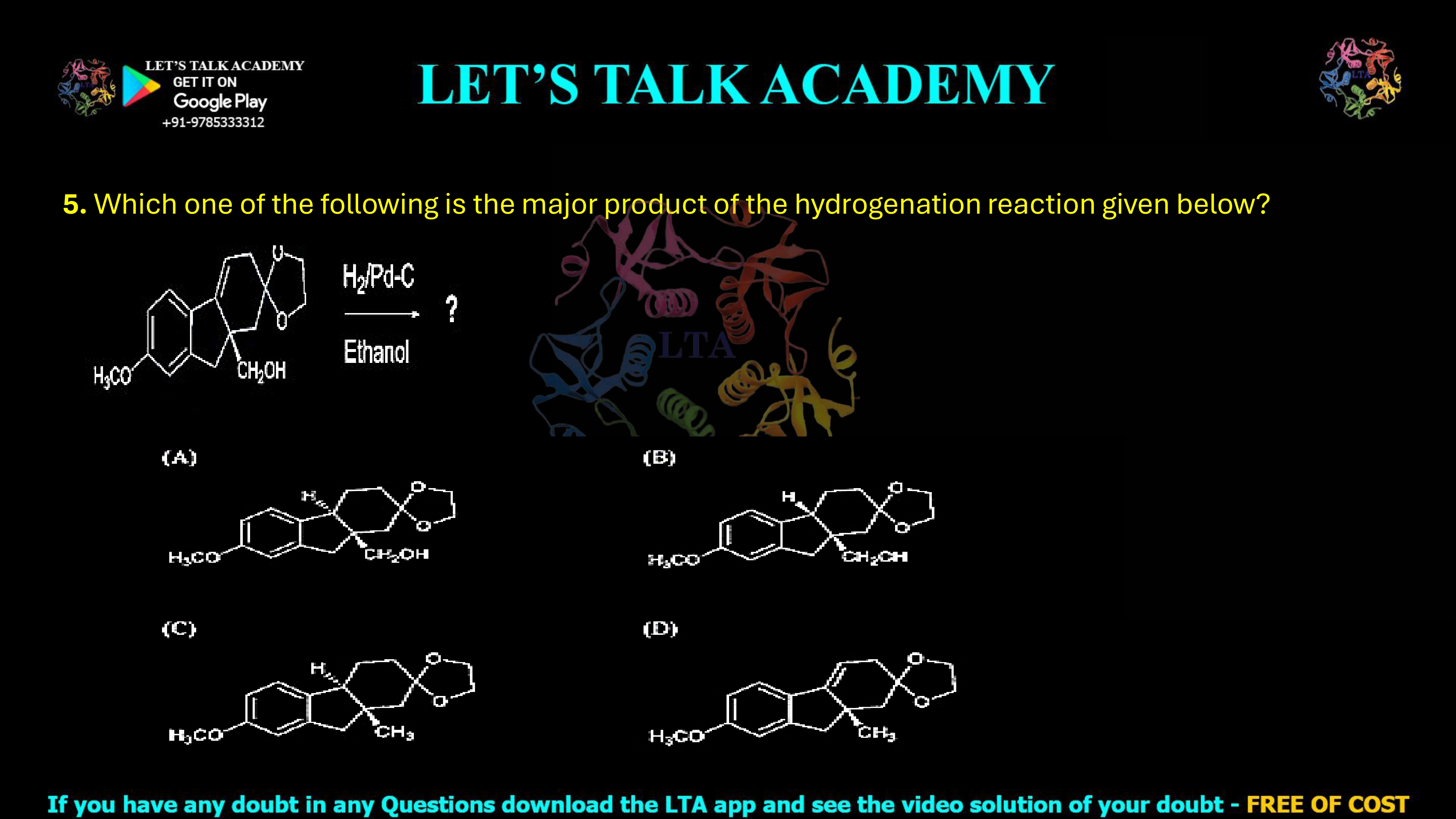
5. Which one of the following is the major product of the hydrogenation reaction given below?
Which Is the Major Product of the Given H₂/Pd-C Hydrogenation Reaction?
Correct Answer: Option (C)
Detailed Explanation of the H₂/Pd-C Hydrogenation Reaction
The given reaction uses hydrogen gas (H2) in the presence of palladium on carbon (Pd-C) with ethanol as the solvent. This is a standard catalytic hydrogenation reaction. The most important step in solving this question is to identify which part of the starting molecule is susceptible to reduction under these reaction conditions and then determine the structure and stereochemistry of the resulting major product.
The starting compound contains a reducible carbon-carbon double bond in a complex fused-ring system. When molecular hydrogen is used with a heterogeneous metal catalyst such as Pd-C, the alkene undergoes catalytic hydrogenation. The two carbon atoms of the double bond receive hydrogen atoms, converting the C=C double bond into a C–C single bond.
The key transformation can be represented in a general form as:
R–CH=CH–R′ + H2 → R–CH2–CH2–R′
However, this question is more challenging than a simple alkene reduction because the substrate has a rigid polycyclic structure. Therefore, the direction from which hydrogen approaches the double bond and the stereochemistry of the product must also be considered carefully.
Role of H₂ and Pd-C in the Given Reaction
Palladium on carbon is a heterogeneous catalyst that provides a metal surface for the hydrogenation process. Molecular hydrogen is adsorbed onto the palladium surface and is activated. At the same time, the carbon-carbon double bond of the substrate interacts with the catalyst surface. The activated hydrogen atoms are then transferred to the two carbon atoms that originally formed the double bond.
Because the starting molecule contains several other functional groups, it is important to consider chemoselectivity. Under the given conditions, the carbon-carbon double bond is the principal site of catalytic hydrogenation. The methoxy group and the oxygen-containing cyclic acetal or ether portion of the molecule remain intact in the major product.
Why Does the Alkene Undergo Hydrogenation?
A carbon-carbon double bond consists of one strong sigma bond and one relatively weaker pi bond. During catalytic hydrogenation, the pi bond interacts with the palladium surface and is broken as hydrogen atoms are added to the two alkene carbon atoms. As a result, the unsaturated region becomes saturated.
Therefore, the correct product must show the disappearance of the relevant carbon-carbon double bond while preserving the main carbon skeleton and the other functional groups that are not reduced under these conditions.
Stereochemical Control in the Hydrogenation Reaction
The stereochemical outcome is crucial for selecting the correct answer. Catalytic hydrogenation on a metal surface generally occurs through the addition of hydrogen atoms from the same face of the double bond, which is commonly described as syn addition. In a flexible molecule, both faces of an alkene may be relatively accessible, but the substrate shown in the question is a rigid fused-ring compound with significant steric crowding.
One face of the reactive double bond is more hindered by the surrounding ring system and substituents. Consequently, the molecule approaches the palladium catalyst through the less sterically hindered face. Hydrogen is delivered preferentially from this accessible side, producing the stereochemical arrangement represented in Option (C).
Why Is Option (C) the Correct Answer?
Option (C) represents the product formed by catalytic hydrogenation of the appropriate carbon-carbon double bond under H2/Pd-C conditions. It shows the required saturation of the reactive alkene while retaining the methoxy substituent, the hydroxymethyl-containing portion, and the oxygen-containing ring system.
More importantly, Option (C) displays the correct stereochemical relationship generated by hydrogen addition from the less hindered face of the rigid molecule. The newly introduced hydrogen and the resulting substituent orientation are consistent with the steric environment of the polycyclic substrate. Therefore, Option (C) is the major product.
Explanation of All Options
Option (A)
Option (A) does not represent the preferred stereochemical outcome of the catalytic hydrogenation. Although its basic carbon framework may appear closely related to the expected product, the orientation of the newly generated stereochemical features is not consistent with hydrogen delivery from the less hindered face of the substrate. In a rigid fused-ring system, steric accessibility strongly influences the major product, making Option (A) unfavorable.
Option (B)
Option (B) also fails to show the correct combination of hydrogenation and stereochemical arrangement expected under H2/Pd-C conditions. The relative orientation of the groups formed or retained around the hydrogenated region does not correspond to the favored approach of the substrate to the palladium surface. Therefore, Option (B) is not the major product.
Option (C)
Option (C) correctly represents the major hydrogenation product. The reactive carbon-carbon double bond undergoes reduction, the remaining functional groups are preserved, and the stereochemical arrangement corresponds to hydrogen addition from the less sterically hindered face. These structural features make Option (C) the correct answer.
Option (D)
Option (D) does not correctly represent the expected product of the given catalytic hydrogenation. The structural and stereochemical arrangement shown in this option is inconsistent with the selective reduction and facial preference expected for the rigid starting molecule. Therefore, Option (D) can be eliminated.
Understanding Chemoselectivity in H₂/Pd-C Reduction
Chemoselectivity refers to the preferential reaction of one functional group in the presence of other functional groups. The starting molecule in this question contains several oxygen-containing groups in addition to the carbon-carbon double bond. Under the specified catalytic hydrogenation conditions, the alkene is the primary reducible functional group.
The methoxy group does not undergo ordinary catalytic hydrogenation, and the cyclic oxygen-containing portion remains unchanged. Therefore, an option that unnecessarily alters these groups would not represent the expected major product. The correct approach is to focus on the hydrogenation of the reactive unsaturation and then determine the correct stereochemistry.
Importance of Steric Hindrance in Predicting the Major Product
In complex organic molecules, hydrogenation cannot always be predicted simply by replacing a double bond with a single bond. The three-dimensional shape of the molecule must also be examined. Bulky rings and substituents can block one face of the alkene, forcing the catalyst and hydrogen to interact preferentially with the opposite, less crowded face.
This facial selectivity is especially important in fused and bridged cyclic systems. The major product is generally formed through the pathway with lower steric repulsion. In the given reaction, this stereochemical preference leads to the product shown in Option (C).
Final Answer
The correct answer is Option (C). In the presence of H2 and Pd-C, the reactive carbon-carbon double bond undergoes catalytic hydrogenation. Hydrogen addition occurs preferentially from the less sterically hindered face of the rigid polycyclic molecule, while the other functional groups remain unchanged. The resulting structure and stereochemistry are correctly represented by Option (C).


