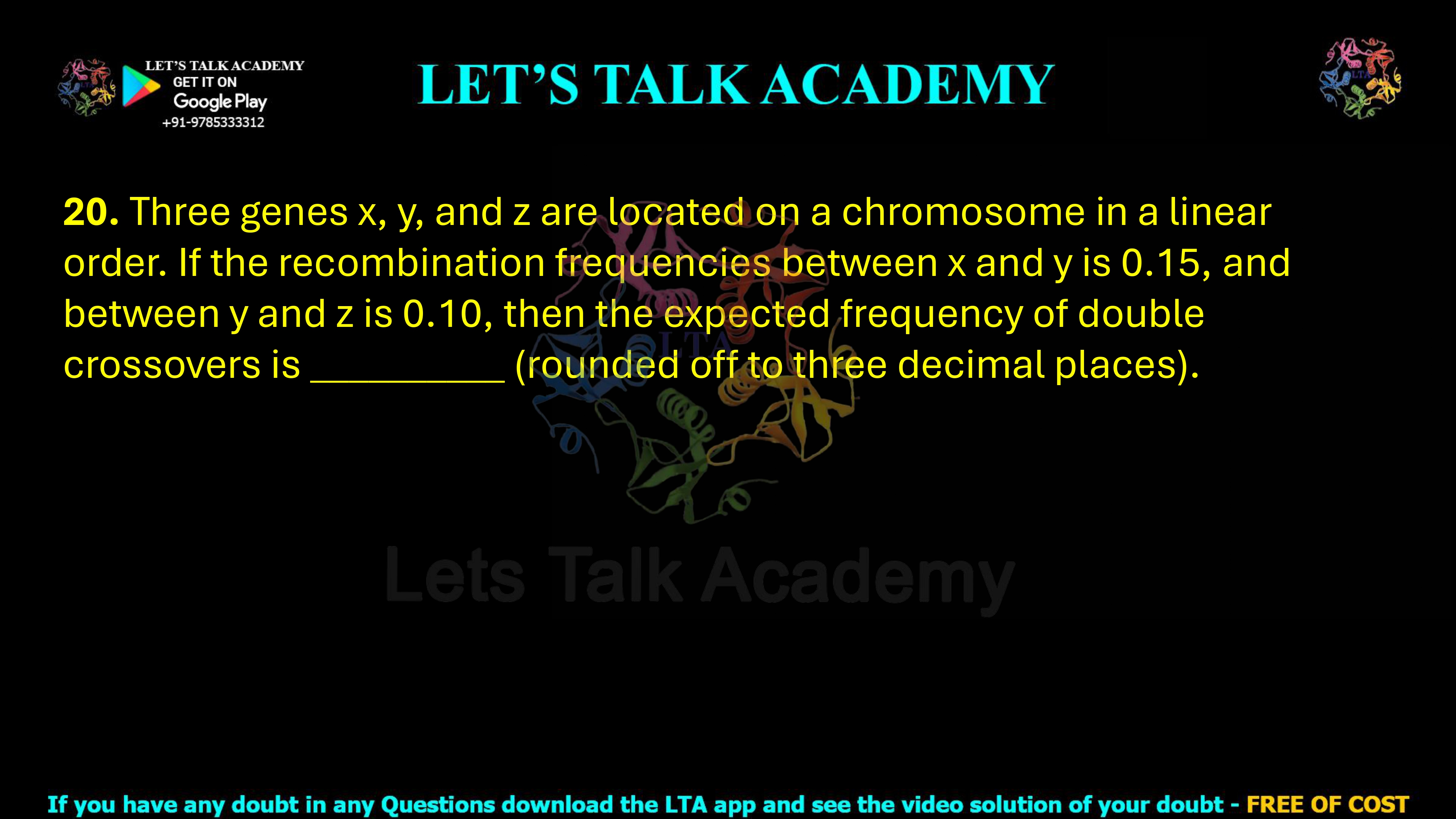
20. Three genes x, y, and z are located on a chromosome in a linear order. If the recombination frequencies between x and y is 0.15, and between y and z is 0.10, then the expected frequency of double crossovers is __________ (rounded off to three decimal places).
Double Crossover Frequency Calculation Using Recombination Frequencies
Introduction
Genetic linkage is one of the most important concepts in classical genetics because it explains why genes located on the same chromosome tend to be inherited together. During meiosis, homologous chromosomes exchange segments through a process known as crossing over. This exchange generates recombinant chromosomes and provides the basis for constructing genetic linkage maps. The frequency with which recombination occurs between two genes reflects the distance separating them on the chromosome.
When three genes are arranged linearly on the same chromosome, two independent crossover events may occur simultaneously in adjacent chromosomal regions. Such an event is known as a double crossover (DCO). Estimating the expected frequency of double crossovers is a fundamental step in three-point linkage analysis because it helps determine gene order, calculate interference, and evaluate chromosome behavior during meiosis.
Correct Answer
Correct Answer: 0.015
Detailed Explanation
Since the genes are arranged in the order x — y — z, two chromosomal intervals are present:
- x–y with recombination frequency = 0.15
- y–z with recombination frequency = 0.10
If crossover events in these two intervals occur independently and there is no interference, the probability of a double crossover equals the product of the probabilities of crossing over in each interval.
The formula is:
Expected Double Crossover Frequency = (Recombination Frequency between x–y) × (Recombination Frequency between y–z)
Substituting the given values:
= 0.15 × 0.10
= 0.015
Therefore, the expected frequency of double crossovers is 0.015, or 1.5%.
Step-by-Step Calculation
Step 1: Write the Recombination Frequencies
Recombination frequency (x–y) = 0.15
Recombination frequency (y–z) = 0.10
Step 2: Apply the Formula
Expected DCO = RF(x–y) × RF(y–z)
Step 3: Substitute the Values
Expected DCO = 0.15 × 0.10
= 0.015
Step 4: Round the Answer
Expected Double Crossover Frequency = 0.015
Calculation Summary
| Parameter | Value |
|---|---|
| Recombination Frequency (x–y) | 0.15 |
| Recombination Frequency (y–z) | 0.10 |
| Formula | 0.15 × 0.10 |
| Expected Double Crossover Frequency | 0.015 |
Why the Multiplication Rule is Used
In probability theory, when two independent events occur together, their joint probability is calculated by multiplying the probabilities of the individual events. Assuming that crossover events in adjacent chromosome intervals occur independently and that there is no interference, the expected frequency of a double crossover is simply the product of the two recombination frequencies.
Understanding Double Crossovers
| Term | Meaning |
|---|---|
| Single Crossover | One crossover in a chromosomal interval |
| Double Crossover | Two independent crossovers in adjacent intervals |
| Triple Crossover | Three crossover events in the same chromosome |
| Recombination Frequency | Probability of crossover between two genes |
Relationship Between Genetic Distance and Recombination
| Recombination Frequency | Genetic Distance |
|---|---|
| 1% | 1 centimorgan (cM) |
| 10% | 10 cM |
| 15% | 15 cM |
| 20% | 20 cM |
In this question, the map distances are:
- x–y = 15 cM
- y–z = 10 cM
Expected vs Observed Double Crossovers
| Type | Calculation |
|---|---|
| Expected Double Crossovers | RF₁ × RF₂ |
| Observed Double Crossovers | Actual experimental value |
| Coefficient of Coincidence | Observed DCO ÷ Expected DCO |
| Interference | 1 − Coefficient of Coincidence |
Biological Significance
Double crossover analysis is essential for determining the correct order of genes on chromosomes. It allows geneticists to construct accurate linkage maps, identify recombination hotspots, estimate interference, and understand chromosome behavior during meiosis. These principles are widely applied in plant breeding, animal genetics, human disease gene mapping, quantitative trait locus (QTL) analysis, and genome research.
Final Answer
Given:
Recombination frequency (x–y) = 0.15
Recombination frequency (y–z) = 0.10
Expected double crossover frequency:
= 0.15 × 0.10
= 0.015
Correct Answer: 0.015


