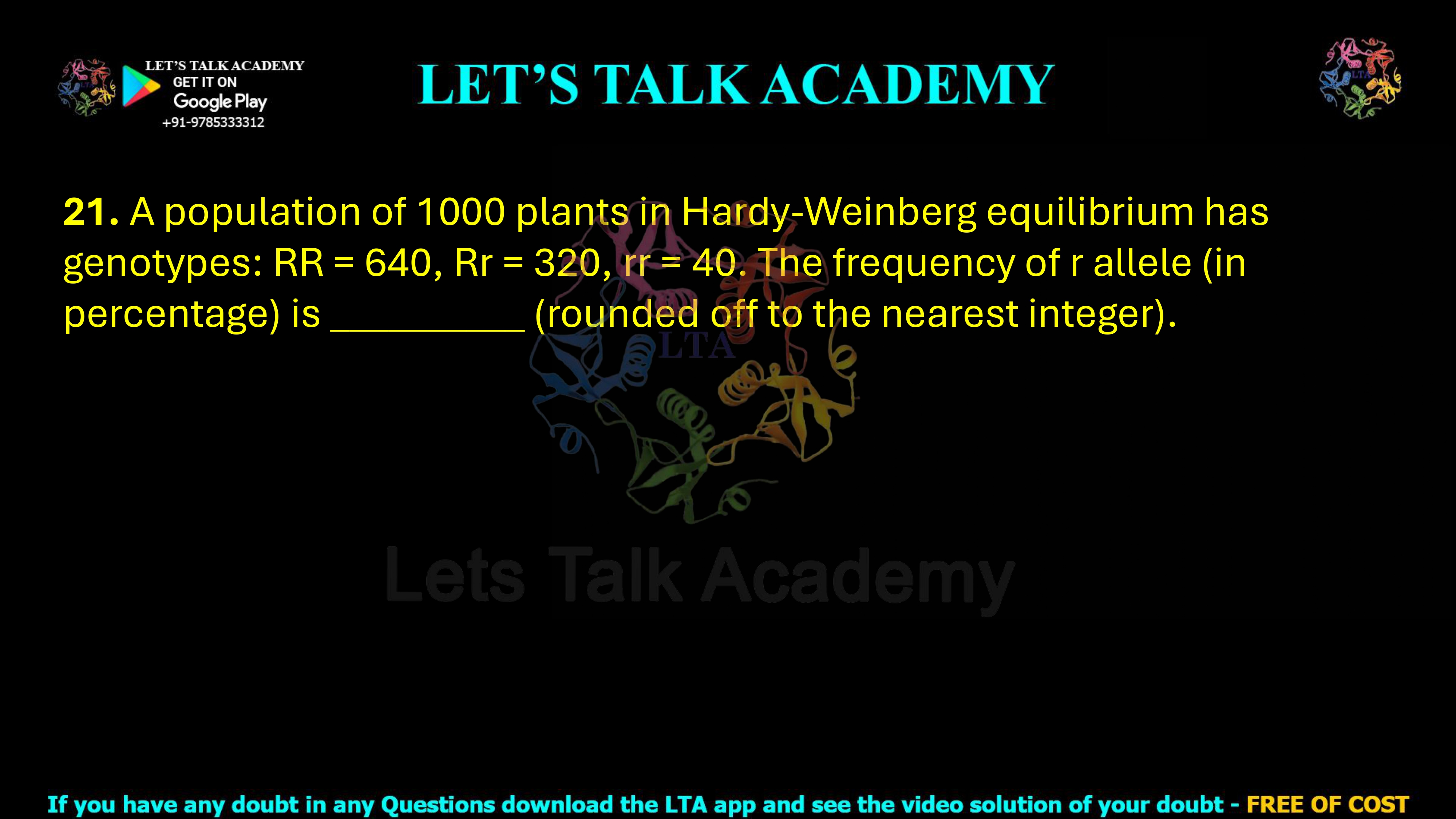
21. A population of 1000 plants in Hardy-Weinberg equilibrium has genotypes: RR = 640, Rr = 320, rr = 40. The frequency of r allele (in percentage) is __________ (rounded off to the nearest integer).
Hardy-Weinberg Equilibrium: Calculating the Frequency of the Recessive (r) Allele
Introduction
The Hardy-Weinberg equilibrium is one of the most fundamental principles in population genetics. It explains how allele frequencies and genotype frequencies remain constant from generation to generation in an ideal population where no evolutionary forces such as mutation, migration, natural selection, genetic drift, or non-random mating are acting. This principle serves as the mathematical foundation for studying inheritance, evolution, disease genetics, and genetic variation within populations.
In many competitive examinations, students are asked to determine allele frequencies directly from the observed genotype numbers. Unlike questions where allele frequencies are provided, these problems require calculating the total number of alleles present in the population and determining how many of those alleles are dominant or recessive.
Correct Answer
Correct Answer: 20%
Detailed Explanation
Each diploid individual carries two alleles for every gene. Therefore, a population of 1000 plants possesses:
Total alleles = 1000 × 2 = 2000 alleles
To calculate the frequency of the recessive allele (r), we count every r allele contributed by each genotype.
- RR contributes 0 r alleles.
- Rr contributes 1 r allele per individual.
- rr contributes 2 r alleles per individual.
Therefore,
Total r alleles = (320 × 1) + (40 × 2)
= 320 + 80
= 400
The frequency of allele r is therefore:
q = 400 / 2000 = 0.20
Converting to percentage:
0.20 × 100 = 20%
Step-by-Step Calculation
Step 1: Calculate Total Number of Alleles
Total individuals = 1000
Total alleles = 1000 × 2 = 2000
Step 2: Calculate Total Number of r Alleles
| Genotype | Individuals | r Alleles per Individual | Total r Alleles |
|---|---|---|---|
| RR | 640 | 0 | 0 |
| Rr | 320 | 1 | 320 |
| rr | 40 | 2 | 80 |
| Total r Alleles | 400 | ||
Step 3: Calculate Allele Frequency
Frequency of r allele = Total r alleles / Total alleles
= 400 / 2000
= 0.20
Step 4: Convert into Percentage
0.20 × 100 = 20%
Alternative Solution Using Hardy-Weinberg Equation
The genotype frequencies can also be expressed as proportions:
| Genotype | Frequency |
|---|---|
| RR | 640/1000 = 0.64 |
| Rr | 320/1000 = 0.32 |
| rr | 40/1000 = 0.04 |
Since:
q² = 0.04
q = √0.04 = 0.20
Thus,
Frequency of r allele = 20%
Calculation Summary
| Parameter | Value |
|---|---|
| Total Population | 1000 |
| Total Alleles | 2000 |
| Total r Alleles | 400 |
| Allele Frequency (q) | 0.20 |
| Frequency in Percentage | 20% |
Hardy-Weinberg Formula
| Expression | Meaning |
|---|---|
| p + q = 1 | Total allele frequency |
| p² | Frequency of RR genotype |
| 2pq | Frequency of Rr genotype |
| q² | Frequency of rr genotype |
| p² + 2pq + q² = 1 | Total genotype frequency |
Biological Significance
Allele frequency is a key parameter in population genetics because it describes the proportion of a particular allele present in a population. Monitoring allele frequencies allows scientists to study evolutionary change, estimate carrier frequencies for inherited diseases, evaluate the effects of natural selection, and assess genetic diversity within populations. Hardy-Weinberg equilibrium provides the reference model against which real populations are compared to determine whether evolution is occurring.
Final Answer
Given:
RR = 640
Rr = 320
rr = 40
Total r alleles = (320 × 1) + (40 × 2) = 400
Total alleles = 2000
Frequency of r allele = 400 / 2000 = 0.20 = 20%
Correct Answer: 20%


