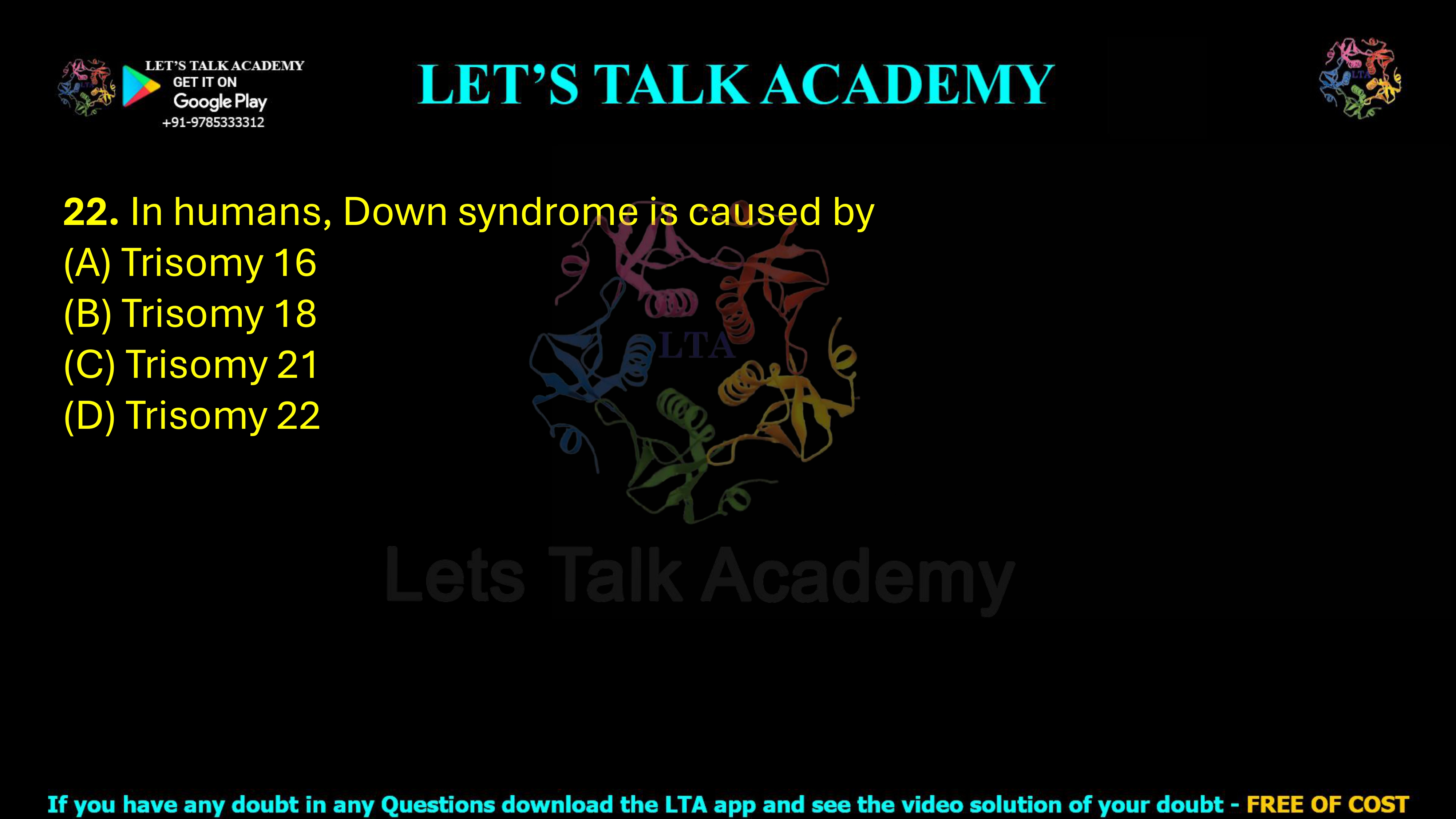
22. In humans, Down syndrome is caused by
(A) Trisomy 16
(B) Trisomy 18
(C) Trisomy 21
(D) Trisomy 22
Down Syndrome Explained: Why Trisomy 21 Causes Down Syndrome
Introduction
Down syndrome is the most common chromosomal disorder compatible with long-term survival in humans. It is caused by the presence of an additional copy of chromosome 21, resulting in a total of 47 chromosomes instead of the normal 46. This condition is a classic example of aneuploidy, in which the chromosome number is altered due to the gain or loss of one or more individual chromosomes.
The syndrome was first described by the English physician John Langdon Down in 1866. Later, in 1959, the French geneticist Jérôme Lejeune demonstrated that the disorder results from an extra chromosome 21. Today, Down syndrome is recognized as one of the most extensively studied chromosomal disorders because it provides valuable insights into chromosome behavior, gene dosage effects, prenatal diagnosis, developmental biology, and human genetics.
Correct Answer
Correct Option: (C) Trisomy 21
Detailed Explanation
Down syndrome occurs because an individual possesses three copies of chromosome 21 instead of the normal two copies. Consequently, affected individuals have 47 chromosomes rather than the normal human chromosome number of 46.
The most common cause of Down syndrome is meiotic nondisjunction, a chromosomal segregation error that occurs during meiosis. During normal meiosis, homologous chromosomes or sister chromatids separate equally into gametes. However, if chromosome 21 fails to separate properly, one gamete receives two copies of chromosome 21 while another receives none. Fertilization of the abnormal gamete with a normal gamete produces a zygote containing three copies of chromosome 21, resulting in Trisomy 21.
Approximately 95% of Down syndrome cases result from meiotic nondisjunction. Smaller proportions arise from Robertsonian translocations or mosaicism, but all forms ultimately involve extra chromosome 21 genetic material.
Human Karyotype in Down Syndrome
The normal human chromosome number is:
46 chromosomes (44 autosomes + XX or XY)
Individuals with Down syndrome have:
47 chromosomes (45 autosomes + one extra chromosome 21 + XX or XY)
Karyotype examples include:
- 47,XX,+21 (Female)
- 47,XY,+21 (Male)
Types of Down Syndrome
| Type | Cause | Approximate Frequency |
|---|---|---|
| Trisomy 21 | Meiotic nondisjunction | ~95% |
| Robertsonian Translocation | Translocation involving chromosome 21 | ~3–4% |
| Mosaic Down Syndrome | Mitotic nondisjunction after fertilization | ~1–2% |
Clinical Features of Down Syndrome
Individuals with Down syndrome commonly exhibit characteristic facial features, mild to moderate intellectual disability, hypotonia, short stature, a single transverse palmar crease, upward slanting eyes, epicanthic folds, and congenital heart defects. Some individuals may also develop gastrointestinal abnormalities, thyroid disorders, hearing impairment, and an increased risk of leukemia and early-onset Alzheimer’s disease.
Explanation of Each Option
Option (A): Trisomy 16
This option is incorrect. Trisomy 16 is usually incompatible with life and is one of the most common chromosomal abnormalities observed in spontaneous miscarriages. It is not the cause of Down syndrome.
Option (B): Trisomy 18
This option is incorrect. Trisomy 18 causes Edwards syndrome, a severe chromosomal disorder characterized by growth retardation, clenched fists, rocker-bottom feet, and multiple congenital anomalies.
Option (C): Trisomy 21
This option is correct. Down syndrome is caused by the presence of an additional chromosome 21, making Trisomy 21 the defining chromosomal abnormality.
Option (D): Trisomy 22
This option is incorrect. Complete Trisomy 22 is generally lethal during embryonic development and is not responsible for Down syndrome.
Why Option (C) is Correct
Down syndrome results from the presence of an extra copy of chromosome 21. This additional chromosome increases the dosage of hundreds of genes located on chromosome 21, leading to the characteristic developmental and clinical features associated with the syndrome. Therefore, Down syndrome is correctly identified as Trisomy 21.
Comparison of Common Human Trisomies
| Chromosomal Abnormality | Associated Syndrome |
|---|---|
| Trisomy 13 | Patau Syndrome |
| Trisomy 18 | Edwards Syndrome |
| Trisomy 21 | Down Syndrome |
Down Syndrome vs Other Chromosomal Disorders
| Disorder | Chromosomal Change | Chromosome Number |
|---|---|---|
| Down Syndrome | Trisomy 21 | 47 |
| Edwards Syndrome | Trisomy 18 | 47 |
| Patau Syndrome | Trisomy 13 | 47 |
| Turner Syndrome | Monosomy X (45,X) | 45 |
| Klinefelter Syndrome | 47,XXY | 47 |
Biological Significance
Down syndrome illustrates the importance of correct chromosome segregation during meiosis. Even a single extra chromosome alters the expression of hundreds of genes, demonstrating the profound effects of gene dosage on human development. The study of Down syndrome has significantly advanced our understanding of chromosome biology, prenatal diagnosis, developmental genetics, and the molecular basis of chromosomal disorders.
Final Answer
Down syndrome is caused by the presence of an extra copy of chromosome 21, usually resulting from meiotic nondisjunction. Therefore, the chromosomal abnormality responsible for Down syndrome is Trisomy 21.
Correct Option: (C) Trisomy 21


