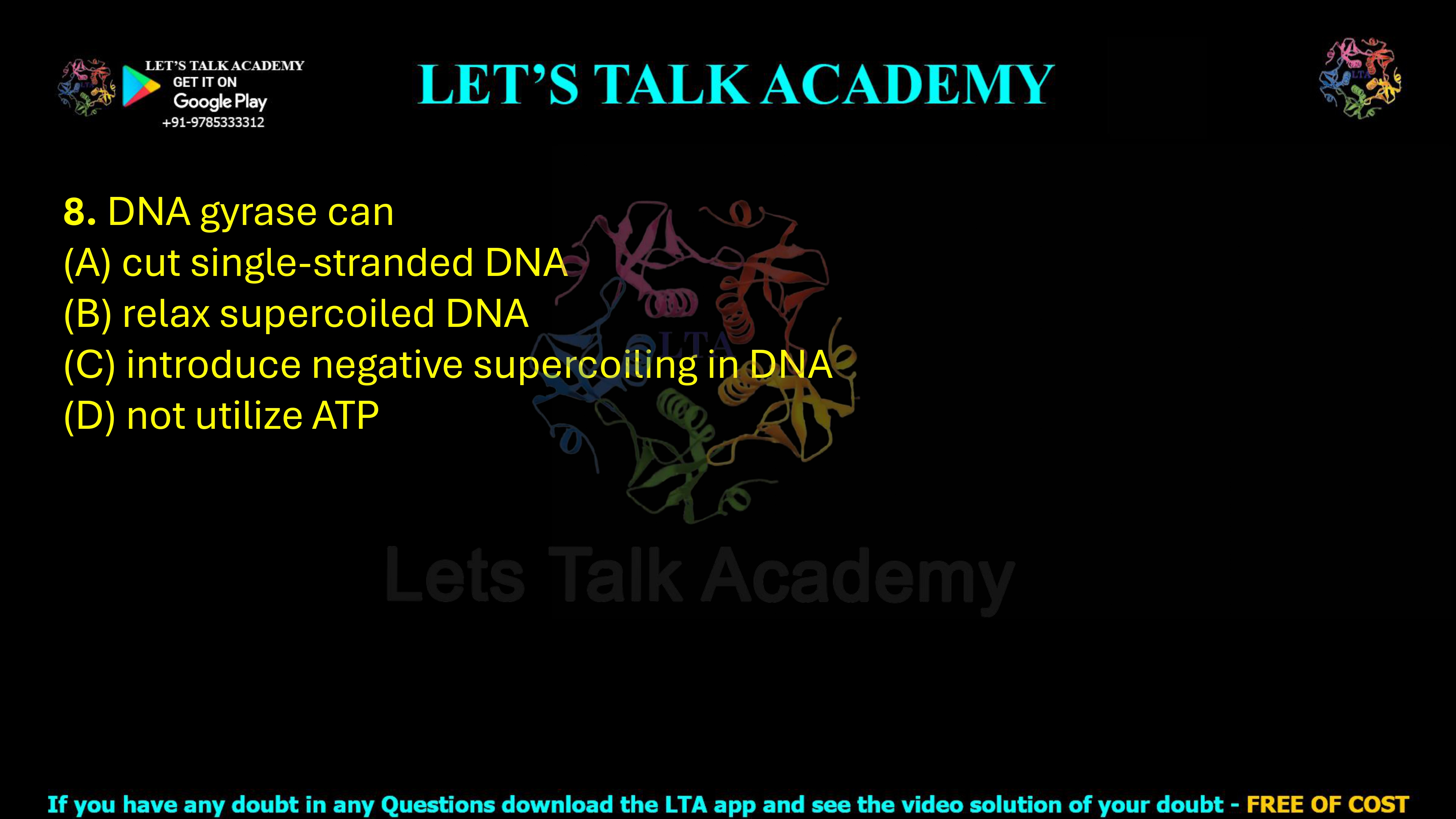
8. DNA gyrase can
(A) cut single-stranded DNA
(B) relax supercoiled DNA
(C) introduce negative supercoiling in DNA
(D) not utilize ATP
DNA Gyrase: Structure, Functions, Negative Supercoiling, and Role in DNA Replication
Introduction
DNA inside every living cell is an extremely long molecule that must be compactly packaged while still remaining accessible for essential biological processes such as DNA replication, transcription, recombination, and DNA repair. During these processes, the DNA double helix becomes overwound ahead of the replication fork, creating positive supercoils that can block the progression of DNA and RNA polymerases. To overcome this problem, cells employ specialized enzymes known as topoisomerases, which regulate DNA topology by introducing or removing supercoils.
Among bacterial topoisomerases, DNA gyrase is unique because it is the only enzyme capable of introducing negative supercoils into DNA in an ATP-dependent manner. This activity is essential for bacterial chromosome replication and transcription, making DNA gyrase one of the most important enzymes in prokaryotic molecular biology. It is also a major target of clinically important antibiotics such as quinolones and fluoroquinolones.
Correct Answer
Correct Answer: (C) Introduce negative supercoiling in DNA
Detailed Explanation
DNA gyrase is a bacterial Type II topoisomerase. Unlike most other topoisomerases, DNA gyrase has the unique ability to introduce negative supercoils into double-stranded DNA. During DNA replication and transcription, the movement of polymerases generates positive supercoils ahead of the replication fork. DNA gyrase removes this torsional stress by introducing negative supercoils, allowing DNA replication and transcription to proceed efficiently.
This reaction requires the hydrolysis of ATP. Therefore, DNA gyrase is an ATP-dependent enzyme and plays a critical role in maintaining the proper topology of the bacterial chromosome.
Explanation of Option (A): Cut Single-Stranded DNA
This option is incorrect.
DNA gyrase does not act on single-stranded DNA. It binds to double-stranded DNA and transiently breaks both strands to pass another segment of DNA through the break before resealing it.
Thus, DNA gyrase is involved in transient double-stranded DNA cleavage rather than single-stranded DNA cleavage.
Explanation of Option (B): Relax Supercoiled DNA
This option is incorrect.
Although some topoisomerases relax supercoiled DNA, the defining characteristic of bacterial DNA gyrase is its ability to introduce negative supercoils. While DNA gyrase can indirectly relieve positive supercoiling generated during replication, the standard textbook function and the characteristic activity tested in competitive examinations is the introduction of negative supercoils.
Explanation of Option (C): Introduce Negative Supercoiling in DNA
This option is correct.
DNA gyrase is unique among topoisomerases because it introduces negative supercoils into DNA using the energy derived from ATP hydrolysis. Negative supercoiling facilitates DNA strand separation during replication, transcription, and recombination while maintaining chromosome compaction.
This property distinguishes DNA gyrase from many other topoisomerases and makes it an essential enzyme for bacterial survival.
Explanation of Option (D): Not Utilize ATP
This option is incorrect.
DNA gyrase belongs to the family of Type II topoisomerases, all of which require ATP hydrolysis for their catalytic activity. ATP provides the energy necessary for introducing negative supercoils into DNA.
Therefore, DNA gyrase absolutely requires ATP and cannot function without it.
Summary of Each Option
| Option | Correct/Incorrect | Reason |
|---|---|---|
| (A) Cut single-stranded DNA | Incorrect | DNA gyrase acts on double-stranded DNA. |
| (B) Relax supercoiled DNA | Incorrect | Its characteristic function is introducing negative supercoils. |
| (C) Introduce negative supercoiling in DNA | Correct | Unique ATP-dependent activity of bacterial DNA gyrase. |
| (D) Not utilize ATP | Incorrect | DNA gyrase requires ATP hydrolysis. |
DNA Gyrase vs Other Topoisomerases
| Feature | DNA Gyrase | Topoisomerase I |
|---|---|---|
| Type | Type II | Type I |
| DNA Cleavage | Double-stranded | Single-stranded |
| ATP Requirement | Yes | No |
| Negative Supercoiling | Introduces negative supercoils | Does not introduce negative supercoils |
| Main Function | Controls DNA topology during replication | Relieves torsional stress |
Functions of DNA Gyrase
| Function | Biological Importance |
|---|---|
| Introduces negative supercoils | Maintains proper DNA topology. |
| Removes positive supercoils | Allows replication fork progression. |
| Facilitates DNA replication | Prevents DNA overwinding. |
| Supports transcription | Enables RNA polymerase movement. |
| Chromosome organization | Maintains bacterial chromosome structure. |
DNA Gyrase as an Antibiotic Target
DNA gyrase is absent in humans but essential in bacteria, making it an excellent target for antibacterial drugs. Fluoroquinolone antibiotics, such as ciprofloxacin and levofloxacin, inhibit DNA gyrase by preventing the resealing of DNA strands after cleavage. This results in DNA fragmentation, inhibition of DNA replication, and ultimately bacterial cell death. Because of its unique function, DNA gyrase remains one of the most important molecular targets in antimicrobial therapy.
Biological Significance
Without DNA gyrase, bacterial chromosomes would rapidly accumulate excessive positive supercoils during DNA replication and transcription. This torsional stress would prevent DNA strand separation and halt essential cellular processes. By introducing negative supercoils in an ATP-dependent manner, DNA gyrase ensures efficient chromosome replication, gene expression, recombination, and maintenance of chromosome architecture.
Final Answer
DNA gyrase is an ATP-dependent bacterial Type II topoisomerase whose characteristic function is to introduce negative supercoils into double-stranded DNA.
Correct Answer: (C) Introduce negative supercoiling in DNA


