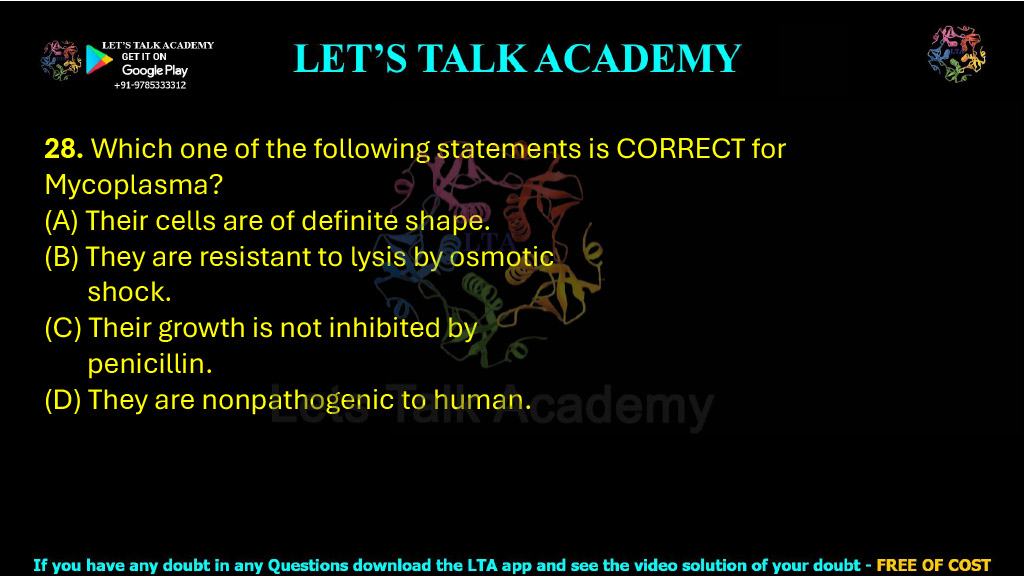
28. Which one of the following statements is CORRECT for Mycoplasma?
(A) Their cells are of definite shape.
(B) They are resistant to lysis by osmotic shock.
(C) Their growth is not inhibited by penicillin.
(D) They are nonpathogenic to human.
Mycoplasma Characteristics: Why Penicillin Does Not Inhibit Their Growth
Introduction
Mycoplasma represents one of the most unique groups of bacteria known in microbiology. These organisms belong to the class Mollicutes and are recognized as the smallest free-living prokaryotes capable of independent growth. Unlike almost all other bacteria, Mycoplasma completely lacks a rigid peptidoglycan cell wall. Instead, its cell is surrounded only by a flexible plasma membrane containing sterols, which provides structural stability while allowing remarkable flexibility in shape.
The absence of a cell wall makes Mycoplasma biologically and medically important. Since β-lactam antibiotics such as penicillin specifically inhibit peptidoglycan synthesis, they have no target in Mycoplasma cells and therefore are ineffective. In addition, these organisms exhibit pleomorphism, meaning they can assume different shapes rather than maintaining a fixed morphology. Several species are important human pathogens, especially Mycoplasma pneumoniae, which causes atypical or walking pneumonia.
Correct Answer
Correct Option: (C) Their growth is not inhibited by penicillin.
Detailed Explanation
Mycoplasma lacks a peptidoglycan cell wall, making it fundamentally different from most bacterial species. Because penicillin and other β-lactam antibiotics act by inhibiting enzymes involved in peptidoglycan synthesis, these drugs are ineffective against organisms that do not possess a cell wall. Consequently, the growth of Mycoplasma is not inhibited by penicillin, making option (C) correct.
The absence of a rigid cell wall also makes Mycoplasma highly pleomorphic. Instead of maintaining a fixed rod, coccal, or spiral shape, the cells can adopt variable morphologies depending on environmental conditions. Therefore, they do not possess a definite shape.
Unlike bacteria with rigid cell walls, Mycoplasma cells are relatively fragile and susceptible to osmotic stress despite the presence of sterols in their plasma membrane. Hence, they are not considered resistant to osmotic lysis.
Several Mycoplasma species are medically important pathogens. Mycoplasma pneumoniae causes atypical pneumonia, while Mycoplasma genitalium and Mycoplasma hominis are associated with urogenital infections. Therefore, Mycoplasma cannot be considered nonpathogenic to humans.
Explanation of Each Option
Option (A): Their Cells are of Definite Shape
This statement is incorrect. Because Mycoplasma lacks a rigid cell wall, it is highly pleomorphic and exhibits variable cell shapes rather than a fixed morphology.
Option (B): They are Resistant to Lysis by Osmotic Shock
This statement is incorrect. The absence of a strong peptidoglycan cell wall makes Mycoplasma relatively sensitive to osmotic changes. Although membrane sterols provide some stability, they do not make the cells resistant to osmotic lysis.
Option (C): Their Growth is Not Inhibited by Penicillin
This statement is correct. Penicillin inhibits peptidoglycan synthesis, but Mycoplasma has no cell wall. Therefore, β-lactam antibiotics such as penicillin have no effect on its growth.
Option (D): They are Nonpathogenic to Human
This statement is incorrect. Several Mycoplasma species cause human diseases, including respiratory infections, atypical pneumonia, and urogenital infections.
Why Option (C) is Correct
Since Mycoplasma completely lacks peptidoglycan, penicillin cannot inhibit cell wall synthesis. Consequently, these bacteria are naturally resistant to penicillin and other β-lactam antibiotics.
Why the Other Options are Incorrect
Why Option (A) is Incorrect
Mycoplasma exhibits pleomorphism because the absence of a cell wall allows cells to change shape freely.
Why Option (B) is Incorrect
The lack of a rigid peptidoglycan layer makes the organism more vulnerable to osmotic stress rather than resistant to it.
Why Option (D) is Incorrect
Species such as Mycoplasma pneumoniae are well-known human pathogens responsible for respiratory tract infections.
Comparison of All Options
| Option | Statement | Status |
|---|---|---|
| A | Cells have definite shape | Incorrect |
| B | Resistant to osmotic lysis | Incorrect |
| C | Growth is not inhibited by penicillin | Correct |
| D | Nonpathogenic to humans | Incorrect |
Important Characteristics of Mycoplasma
| Characteristic | Description |
|---|---|
| Cell Wall | Absent |
| Cell Shape | Pleomorphic |
| Cell Membrane | Contains sterols |
| Gram Staining | Does not stain reliably because of absent cell wall |
| Size | Smallest free-living bacteria |
| β-lactam Sensitivity | Naturally resistant |
Common Human Pathogenic Mycoplasma Species
| Species | Disease |
|---|---|
| Mycoplasma pneumoniae | Atypical (walking) pneumonia |
| Mycoplasma genitalium | Urogenital infections |
| Mycoplasma hominis | Pelvic inflammatory disease and urinary tract infections |
Comparison of Mycoplasma with Typical Bacteria
| Feature | Mycoplasma | Typical Bacteria |
|---|---|---|
| Cell Wall | Absent | Present |
| Peptidoglycan | Absent | Present |
| Sterols in Membrane | Present | Usually absent |
| Penicillin Sensitivity | Resistant | Usually sensitive |
| Cell Shape | Pleomorphic | Generally fixed |
Biological Significance
Mycoplasma demonstrates how bacteria can survive without a cell wall by relying on a sterol-rich plasma membrane for structural integrity. Their intrinsic resistance to β-lactam antibiotics has important clinical implications because alternative drugs such as tetracyclines, macrolides, or fluoroquinolones must be used for treatment. Their minimal genome has also made Mycoplasma an important model organism in studies of synthetic biology and minimal cellular life.
Final Answer
Correct Option: (C)
Mycoplasma lacks a peptidoglycan cell wall; therefore, penicillin and other β-lactam antibiotics cannot inhibit its growth. This natural resistance makes option (C) the correct answer.


