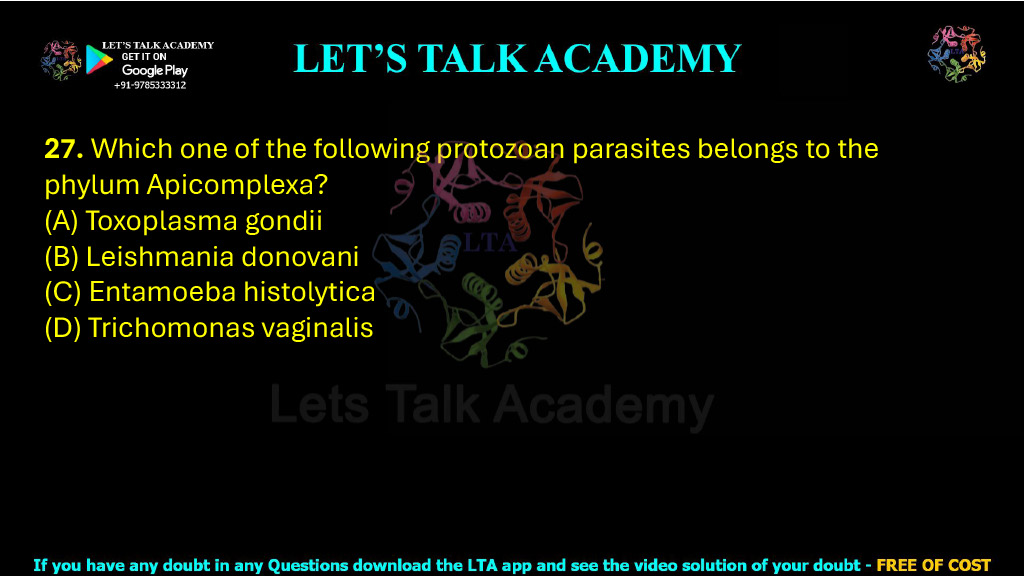
27. Which one of the following protozoan parasites belongs to the phylum Apicomplexa?
(A) Toxoplasma gondii
(B) Leishmania donovani
(C) Entamoeba histolytica
(D) Trichomonas vaginalis
Protozoan Parasites of Phylum Apicomplexa: Toxoplasma gondii Explained
Introduction
Protozoan parasites are unicellular eukaryotic microorganisms responsible for numerous human diseases worldwide. They are classified into different phyla based on their morphology, locomotory organelles, cellular organization, and life cycle characteristics. One of the most medically important groups is the phylum Apicomplexa, whose members are obligate intracellular parasites possessing a specialized structure known as the apical complex. This organelle enables these parasites to invade host cells efficiently and establish infection.
Several clinically important pathogens belong to Apicomplexa, including Toxoplasma gondii, Plasmodium species, Cryptosporidium, and Babesia. Other protozoan parasites such as Leishmania, Entamoeba, and Trichomonas belong to completely different taxonomic groups and differ significantly in morphology, locomotion, and disease mechanisms.
Correct Answer
Correct Option: (A) Toxoplasma gondii
Detailed Explanation
Toxoplasma gondii is an obligate intracellular protozoan parasite belonging to the phylum Apicomplexa. Members of this phylum possess a characteristic apical complex, which contains specialized secretory organelles such as rhoptries, micronemes, and dense granules that facilitate attachment, invasion, and survival within host cells. Unlike many other protozoa, Apicomplexans generally lack locomotory organelles such as cilia or flagella during most stages of their life cycle.
Toxoplasma gondii causes toxoplasmosis, a zoonotic disease that infects humans and numerous warm-blooded animals. Cats serve as the definitive hosts, while humans become infected by consuming undercooked meat containing tissue cysts, ingesting food or water contaminated with oocysts, or through congenital transmission from mother to fetus. Although infection is often asymptomatic in healthy individuals, it can cause severe neurological disease in immunocompromised patients and congenital abnormalities in newborns.
The remaining organisms belong to entirely different protozoan groups. Leishmania donovani is a kinetoplastid flagellate, Entamoeba histolytica is an amoeboid protozoan, and Trichomonas vaginalis is a flagellated parabasalid. Therefore, only Toxoplasma gondii belongs to the phylum Apicomplexa.
Explanation of Each Option
Option (A): Toxoplasma gondii
This option is correct. Toxoplasma gondii belongs to the phylum Apicomplexa and causes toxoplasmosis. It possesses an apical complex that enables invasion of host cells.
Option (B): Leishmania donovani
This option is incorrect. Leishmania donovani belongs to the class Kinetoplastea (phylum Euglenozoa). It is transmitted by sandflies and causes visceral leishmaniasis (kala-azar).
Option (C): Entamoeba histolytica
This option is incorrect. Entamoeba histolytica is an amoeboid protozoan that causes amoebic dysentery. It moves by pseudopodia and does not possess an apical complex.
Option (D): Trichomonas vaginalis
This option is incorrect. Trichomonas vaginalis is a flagellated protozoan belonging to the parabasalids and causes trichomoniasis, a sexually transmitted infection.
Why Option (A) is Correct
Toxoplasma gondii is classified under the phylum Apicomplexa because it possesses an apical complex and is an obligate intracellular parasite. These are defining characteristics of Apicomplexan protozoa.
Why the Other Options are Incorrect
Why Option (B) is Incorrect
Leishmania donovani is a kinetoplastid protozoan characterized by a kinetoplast and flagellum. It does not belong to Apicomplexa.
Why Option (C) is Incorrect
Entamoeba histolytica belongs to the amoebozoans and exhibits amoeboid movement using pseudopodia rather than an apical complex.
Why Option (D) is Incorrect
Trichomonas vaginalis is a flagellated protozoan of the parabasalids and lacks the defining structural features of Apicomplexan parasites.
Comparison of All Options
| Option | Organism | Phylum/Group | Disease | Status |
|---|---|---|---|---|
| A | Toxoplasma gondii | Apicomplexa | Toxoplasmosis | Correct |
| B | Leishmania donovani | Kinetoplastida | Visceral leishmaniasis | Incorrect |
| C | Entamoeba histolytica | Amoebozoa | Amoebiasis | Incorrect |
| D | Trichomonas vaginalis | Parabasalia | Trichomoniasis | Incorrect |
Important Characteristics of Apicomplexa
| Characteristic | Description |
|---|---|
| Cell Type | Unicellular eukaryotic parasite |
| Lifestyle | Obligate intracellular parasite |
| Special Structure | Apical complex |
| Locomotion | No cilia or flagella in most stages |
| Examples | Plasmodium, Toxoplasma, Cryptosporidium, Babesia |
Comparison of Important Human Protozoan Parasites
| Parasite | Disease | Transmission |
|---|---|---|
| Toxoplasma gondii | Toxoplasmosis | Cat feces, undercooked meat, congenital |
| Leishmania donovani | Kala-azar | Sandfly bite |
| Entamoeba histolytica | Amoebic dysentery | Contaminated food and water |
| Trichomonas vaginalis | Trichomoniasis | Sexual transmission |
Biological Significance
Apicomplexan parasites are among the most medically significant protozoa because they infect millions of people worldwide. Their unique apical complex enables efficient invasion of host cells, making them highly successful intracellular pathogens. Research on these organisms has contributed significantly to understanding host-pathogen interactions, immune evasion, vaccine development, and antiparasitic drug discovery.
Final Answer
Correct Option: (A) Toxoplasma gondii
Toxoplasma gondii is an obligate intracellular protozoan parasite belonging to the phylum Apicomplexa. It possesses a characteristic apical complex used for host cell invasion and is the causative agent of toxoplasmosis.


