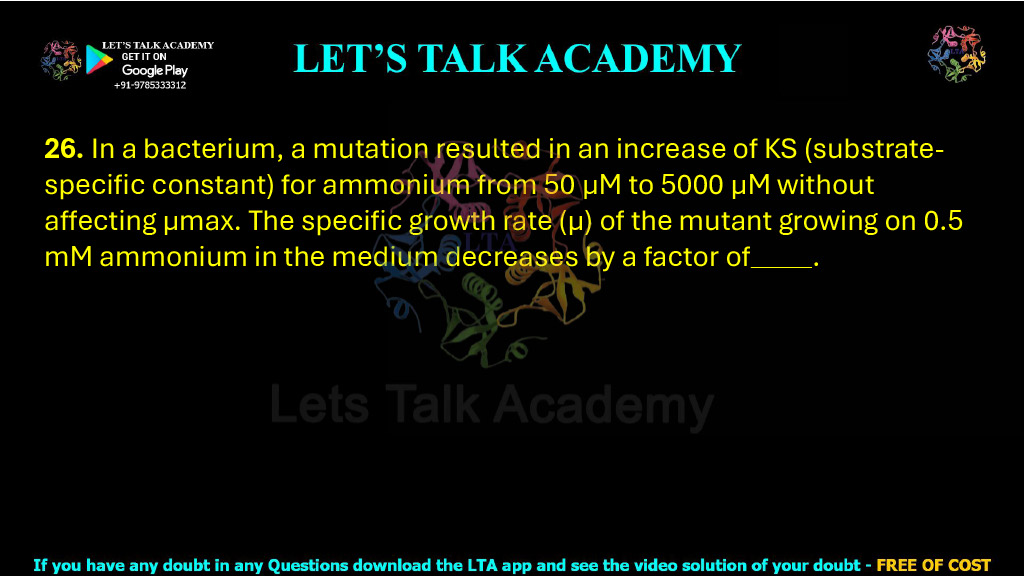
26. In a bacterium, a mutation resulted in an increase of KS (substrate-specific constant) for ammonium from 50 µM to 5000 µM without affecting µmax. The specific growth rate (µ) of the mutant growing on 0.5 mM ammonium in the medium decreases by a factor of .
Monod Growth Kinetics: Effect of Increased KS on Bacterial Specific Growth Rate
Introduction
The growth of microorganisms depends largely on the availability of nutrients in their surrounding environment. One of the most widely used mathematical models to describe microbial growth under substrate-limited conditions is the Monod equation, proposed by Jacques Monod in 1949. This equation relates the specific growth rate of microorganisms to the concentration of the limiting nutrient present in the medium.
The Monod equation introduces an important parameter called the substrate-specific constant (KS), also known as the half-saturation constant. KS represents the substrate concentration at which the microbial growth rate becomes half of the maximum specific growth rate (μmax). A lower KS indicates a higher affinity of the microorganism for the substrate, whereas a higher KS indicates a lower substrate affinity. Consequently, mutations that increase KS reduce the organism’s ability to efficiently utilize nutrients at low substrate concentrations, even if μmax remains unchanged.
Correct Answer
Correct Answer: 5.5 (approximately)
Detailed Explanation
The relationship between substrate concentration and microbial growth is described by the Monod equation:
μ = μmax × S / (KS + S)
where:
- μ = Specific growth rate
- μmax = Maximum specific growth rate
- S = Substrate concentration
- KS = Half-saturation constant
Since μmax remains unchanged, only the value of KS changes.
Step 1: Convert the Substrate Concentration
Given ammonium concentration:
0.5 mM = 500 μM
Step 2: Calculate the Original Growth Rate
Original KS = 50 μM
μoriginal = μmax × 500 / (50 + 500)
= μmax × 500 / 550
= 0.909 μmax
Step 3: Calculate the Mutant Growth Rate
Mutant KS = 5000 μM
μmutant = μmax × 500 / (5000 + 500)
= μmax × 500 / 5500
= 0.0909 μmax
Step 4: Determine the Decrease Factor
The decrease factor is obtained by dividing the original growth rate by the mutant growth rate.
Decrease Factor = μoriginal / μmutant
= 0.909 / 0.0909
= 10
Therefore, the mutation decreases the specific growth rate by a factor of 10.
Step-by-Step Calculation Summary
| Parameter | Original | Mutant |
|---|---|---|
| KS | 50 μM | 5000 μM |
| Substrate Concentration (S) | 500 μM | 500 μM |
| μ/μmax | 500/550 = 0.909 | 500/5500 = 0.0909 |
| Decrease Factor | 10 | |
Formula Used
| Formula | Purpose |
|---|---|
| μ = μmax × S/(KS + S) | Monod growth equation |
| KS | Substrate concentration at which μ = ½ μmax |
| Decrease Factor = μold/μnew | Comparison of growth rates |
Biological Interpretation
The substrate-specific constant (KS) reflects the affinity of a microorganism for its nutrient. A lower KS means that the organism can efficiently utilize nutrients even when substrate concentrations are low. Conversely, a large increase in KS indicates a significant reduction in substrate affinity. In this problem, increasing KS from 50 μM to 5000 μM causes the bacterium to grow much more slowly at the same ammonium concentration because the transport system or nutrient uptake mechanism has become much less efficient.
Although the mutation does not alter the maximum possible growth rate (μmax), the organism can no longer approach μmax under the given nutrient concentration. This demonstrates why KS is considered a measure of nutrient affinity rather than maximum growth capacity.
Importance of the Monod Equation
| Application | Importance |
|---|---|
| Industrial Fermentation | Optimization of microbial production |
| Wastewater Treatment | Predicting microbial degradation rates |
| Environmental Microbiology | Studying nutrient-limited growth |
| Biotechnology | Designing bioreactors and continuous cultures |
| Microbial Ecology | Comparing substrate affinity among microorganisms |
Final Answer
Given:
KS changes from 50 μM to 5000 μM
Substrate concentration = 0.5 mM = 500 μM
Original growth rate = 0.909 μmax
Mutant growth rate = 0.0909 μmax
Decrease Factor = 10
Correct Answer: 10


