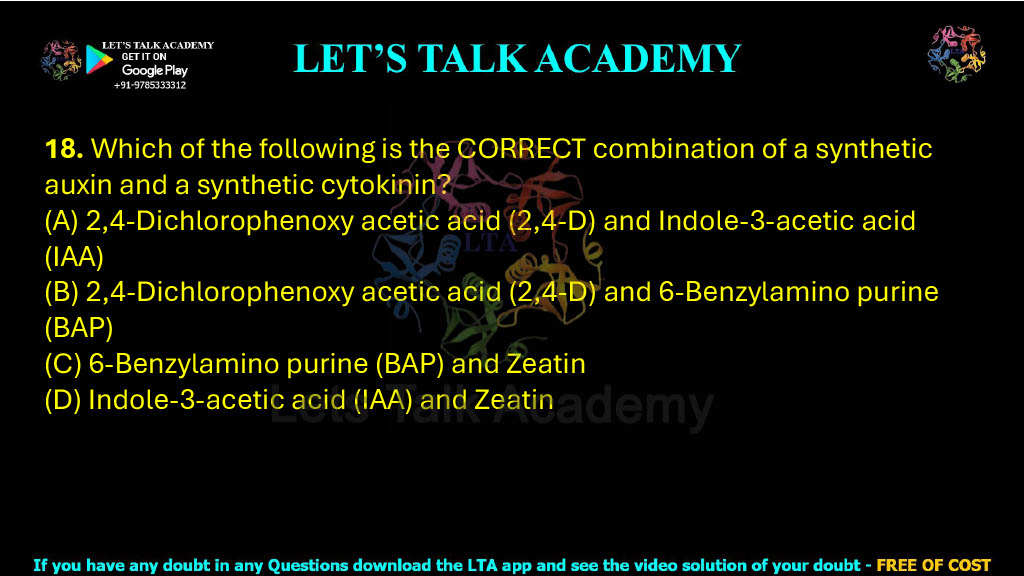
18. Which of the following is the CORRECT combination of a synthetic auxin and a synthetic cytokinin?
(A) 2,4-Dichlorophenoxy acetic acid (2,4-D) and Indole-3-acetic acid (IAA)
(B) 2,4-Dichlorophenoxy acetic acid (2,4-D) and 6-Benzylamino purine (BAP)
(C) 6-Benzylamino purine (BAP) and Zeatin
(D) Indole-3-acetic acid (IAA) and Zeatin
Synthetic Auxin and Synthetic Cytokinin Explained | 2,4-D and BAP
Introduction
Plant growth and development are regulated by a group of naturally occurring chemical messengers known as plant growth regulators (PGRs) or phytohormones. Among these, auxins and cytokinins play a central role in controlling cell division, cell elongation, differentiation, organ formation, apical dominance, vascular differentiation, and tissue regeneration. In addition to naturally occurring hormones, scientists have developed several synthetic compounds that mimic the biological activity of auxins and cytokinins. These synthetic plant growth regulators are widely used in agriculture, horticulture, and plant tissue culture because of their stability, efficiency, and predictable physiological effects.
One of the most commonly used synthetic auxins is 2,4-Dichlorophenoxy acetic acid (2,4-D), while one of the most widely used synthetic cytokinins is 6-Benzylaminopurine (BAP). These compounds are extensively employed in plant biotechnology for callus induction, organogenesis, micropropagation, and crop improvement.
Correct Answer
Correct Option: (B) 2,4-Dichlorophenoxy acetic acid (2,4-D) and 6-Benzylamino purine (BAP)
Detailed Explanation
2,4-Dichlorophenoxy acetic acid (2,4-D) is a synthetic auxin that mimics the physiological activity of the natural auxin Indole-3-acetic acid (IAA). It promotes cell elongation, stimulates cell division in tissue culture, induces callus formation, and is widely used as a selective herbicide against broadleaf weeds.
6-Benzylaminopurine (BAP), also known as benzyl adenine (BA), is a synthetic cytokinin. It promotes cell division, shoot initiation, axillary bud proliferation, delay of leaf senescence, and regeneration of complete plants during tissue culture. BAP is one of the most frequently used cytokinins in plant micropropagation because of its high effectiveness and stability.
In contrast, Indole-3-acetic acid (IAA) is the principal natural auxin produced by plants, whereas Zeatin is the major natural cytokinin first isolated from maize (Zea mays). Since the question specifically asks for a combination of a synthetic auxin and a synthetic cytokinin, only Option (B) satisfies both conditions.
Explanation of Each Option
Option (A): 2,4-D and Indole-3-acetic Acid (IAA)
This option is incorrect. Although 2,4-D is a synthetic auxin, IAA is a naturally occurring auxin rather than a synthetic cytokinin.
Option (B): 2,4-D and 6-Benzylaminopurine (BAP)
This option is correct. 2,4-D is a synthetic auxin, while BAP is a synthetic cytokinin. This combination is extensively used in plant tissue culture for regulating callus formation and organ development.
Option (C): 6-Benzylaminopurine (BAP) and Zeatin
This option is incorrect. BAP is a synthetic cytokinin, but Zeatin is a natural cytokinin. There is no auxin in this combination.
Option (D): Indole-3-acetic Acid (IAA) and Zeatin
This option is incorrect. Both IAA and Zeatin are naturally occurring plant hormones. IAA is a natural auxin and Zeatin is a natural cytokinin.
Why Option (B) is Correct
Option (B) correctly combines 2,4-D, a synthetic auxin, with BAP, a synthetic cytokinin. These two compounds are routinely used together in plant tissue culture because varying their concentration ratio determines whether cultured cells form roots, shoots, or undifferentiated callus.
Why the Other Options are Incorrect
Why Option (A) is Incorrect
IAA is a natural auxin rather than a synthetic cytokinin.
Why Option (C) is Incorrect
This combination contains two cytokinins, one synthetic (BAP) and one natural (Zeatin), but no auxin.
Why Option (D) is Incorrect
Both hormones are naturally occurring and therefore do not satisfy the requirement of identifying synthetic plant growth regulators.
Comparison of All Options
| Option | Hormone Combination | Correct or Incorrect |
|---|---|---|
| A | Synthetic Auxin + Natural Auxin | Incorrect |
| B | Synthetic Auxin + Synthetic Cytokinin | Correct |
| C | Synthetic Cytokinin + Natural Cytokinin | Incorrect |
| D | Natural Auxin + Natural Cytokinin | Incorrect |
Natural and Synthetic Plant Hormones
| Hormone Class | Natural Example | Synthetic Example |
|---|---|---|
| Auxin | Indole-3-acetic acid (IAA) | 2,4-D, NAA |
| Cytokinin | Zeatin | 6-Benzylaminopurine (BAP), Kinetin |
Major Functions of Auxins and Cytokinins
| Hormone | Major Functions |
|---|---|
| Auxins | Cell elongation, apical dominance, root initiation, vascular differentiation |
| Cytokinins | Cell division, shoot initiation, delay of senescence, bud proliferation |
Applications in Plant Tissue Culture
| Growth Regulator | Major Application |
|---|---|
| 2,4-D | Callus induction and somatic embryogenesis |
| BAP | Shoot multiplication and regeneration |
| IAA | Root development |
| Zeatin | Natural cytokinin for shoot development |
Auxin-Cytokinin Ratio in Tissue Culture
| Auxin : Cytokinin Ratio | Developmental Response |
|---|---|
| High Auxin, Low Cytokinin | Root formation |
| Low Auxin, High Cytokinin | Shoot formation |
| Balanced Ratio | Callus formation |
Biological Significance
Synthetic auxins and cytokinins have revolutionized plant biotechnology by enabling rapid propagation of disease-free plants, conservation of endangered species, production of genetically transformed plants, and large-scale commercial micropropagation. The coordinated action of auxins and cytokinins regulates cell division and differentiation, making them indispensable tools in tissue culture laboratories and modern agriculture.
Final Answer
Correct Option: (B) 2,4-Dichlorophenoxy acetic acid (2,4-D) and 6-Benzylamino purine (BAP)
2,4-D is a synthetic auxin, while 6-Benzylaminopurine (BAP) is a synthetic cytokinin. Together, they are widely used in plant tissue culture to regulate callus formation, shoot regeneration, and overall plant development.


