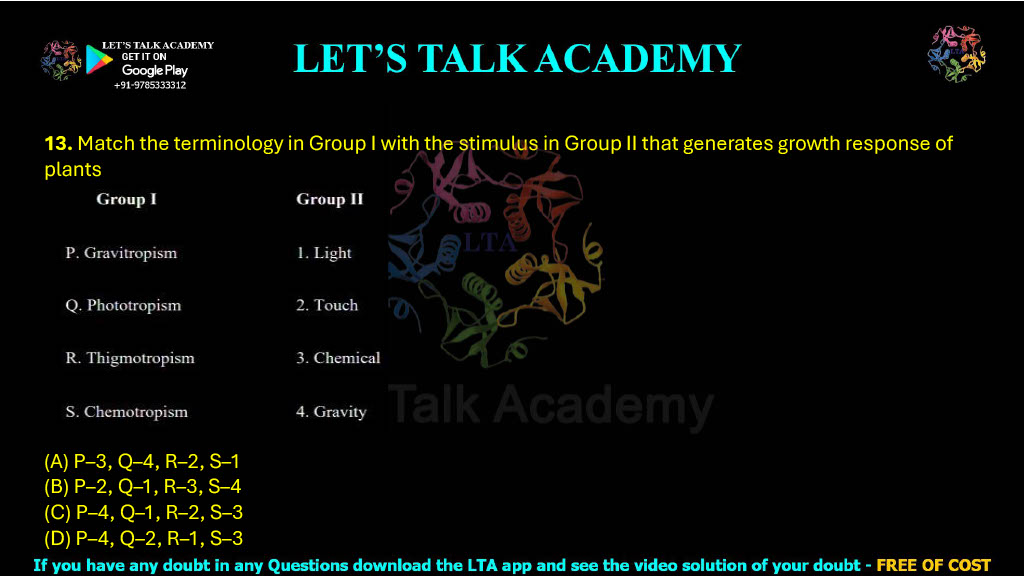
13. Match the terminology in Group I with the stimulus in Group II that generates growth response of plants
| Group I | Group II | |
|---|---|---|
| P. Gravitropism | 1. Light | |
| Q. Phototropism | 2. Touch | |
| R. Thigmotropism | 3. Chemical | |
| S. Chemotropism | 4. Gravity |
(A) P–3, Q–4, R–2, S–1
(B) P–2, Q–1, R–3, S–4
(C) P–4, Q–1, R–2, S–3
(D) P–4, Q–2, R–1, S–3
Plant Tropisms Explained: Gravitropism, Phototropism, Thigmotropism and Chemotropism
Introduction
Plants continuously experience changes in their surrounding environment. Since they are sessile organisms and cannot move from one place to another, they respond to external environmental stimuli by altering the direction of their growth. These directional growth responses are known as tropisms. Tropic movements enable plants to optimize light capture, absorb water and minerals efficiently, climb supporting structures, and ensure successful reproduction. Unlike nastic movements, which are independent of the direction of the stimulus, tropic movements are always directed either toward or away from the stimulus.
The major tropic responses observed in plants include gravitropism, phototropism, thigmotropism, and chemotropism. Each of these responses is regulated by differential growth, primarily mediated by the plant hormone auxin. Roots and shoots respond differently because auxin stimulates shoot elongation while inhibiting root elongation at higher concentrations.
Correct Answer
Correct Option: (C) P–4, Q–1, R–2, S–3
Detailed Explanation
Tropisms are directional growth responses produced by plants in response to external environmental stimuli. Each type of tropism is named according to the stimulus responsible for the growth response.
Gravitropism, also known as geotropism, is the directional growth response to gravity. Roots exhibit positive gravitropism because they grow toward gravity, whereas shoots exhibit negative gravitropism because they grow away from gravity.
Phototropism is the growth response toward or away from light. Young shoots generally exhibit positive phototropism by bending toward the light source. This response results from unequal distribution of auxin, causing greater cell elongation on the shaded side of the stem.
Thigmotropism is the directional growth response to physical touch or mechanical contact. Tendrils of climbing plants such as pea, grapevine, cucumber, and passionflower coil around supporting objects after touching them.
Chemotropism is the growth response to chemical substances. One of the best-known examples is the growth of the pollen tube toward the ovule, guided by chemical attractants released from the synergid cells.
Therefore, the correct matching is:
- P. Gravitropism → 4. Gravity
- Q. Phototropism → 1. Light
- R. Thigmotropism → 2. Touch
- S. Chemotropism → 3. Chemical
Hence, the correct answer is Option (C).
Explanation of Each Option
Option (A): P–3, Q–4, R–2, S–1
This option is incorrect. Gravitropism is not a response to chemicals, and phototropism is not generated by gravity.
Option (B): P–2, Q–1, R–3, S–4
This option is incorrect. Gravitropism is not caused by touch, while chemotropism is not a response to gravity.
Option (C): P–4, Q–1, R–2, S–3
This option is correct. Every tropic response is accurately matched with its corresponding environmental stimulus.
Option (D): P–4, Q–2, R–1, S–3
This option is incorrect. Phototropism is induced by light rather than touch, while thigmotropism responds to touch rather than light.
Why Option (C) is Correct
The four major tropic responses are directly associated with specific environmental stimuli. Gravitropism is controlled by gravity, phototropism by light, thigmotropism by touch, and chemotropism by chemical signals. These relationships are well-established concepts in plant physiology.
Why the Other Options are Incorrect
Why Option (A) is Incorrect
Gravitropism is incorrectly matched with chemicals, and phototropism is incorrectly matched with gravity.
Why Option (B) is Incorrect
Gravitropism does not occur in response to touch, and chemotropism is not triggered by gravity.
Why Option (D) is Incorrect
Phototropism always responds to light, whereas thigmotropism specifically responds to touch.
Correct Matching Table
| Group I | Stimulus | Correct Match |
|---|---|---|
| Gravitropism | Gravity | P–4 |
| Phototropism | Light | Q–1 |
| Thigmotropism | Touch | R–2 |
| Chemotropism | Chemical | S–3 |
Major Types of Plant Tropisms
| Tropism | Stimulus | Example |
|---|---|---|
| Phototropism | Light | Shoot bends toward sunlight |
| Gravitropism | Gravity | Roots grow downward |
| Thigmotropism | Touch | Tendrils coil around support |
| Chemotropism | Chemicals | Pollen tube grows toward ovule |
| Hydrotropism | Water | Roots grow toward moisture |
Positive and Negative Tropisms
| Plant Organ | Response |
|---|---|
| Root | Positive gravitropism |
| Shoot | Negative gravitropism |
| Shoot | Positive phototropism |
| Tendrils | Positive thigmotropism |
| Pollen Tube | Positive chemotropism |
Role of Auxin in Tropic Responses
| Tropism | Role of Auxin |
|---|---|
| Phototropism | Auxin accumulates on the shaded side, promoting unequal stem elongation |
| Gravitropism | Auxin redistributes due to gravity, producing differential growth |
| Thigmotropism | Auxin redistribution helps tendrils coil around supports |
| Chemotropism | Chemical signals guide pollen tube growth along with hormonal regulation |
Biological Significance
Tropic movements enable plants to maximize survival and reproductive success. Phototropism ensures efficient light capture for photosynthesis, gravitropism establishes proper orientation of roots and shoots, thigmotropism allows climbing plants to secure mechanical support, and chemotropism ensures successful fertilization by directing pollen tubes toward ovules. These responses demonstrate how plants integrate environmental signals with hormonal regulation to optimize growth under changing conditions.
Final Answer
Correct Option: (C) P–4, Q–1, R–2, S–3
The correct matching is Gravitropism → Gravity, Phototropism → Light, Thigmotropism → Touch, and Chemotropism → Chemical. These four tropic responses enable plants to grow directionally in response to important environmental stimuli, thereby improving survival, growth, and reproduction.


