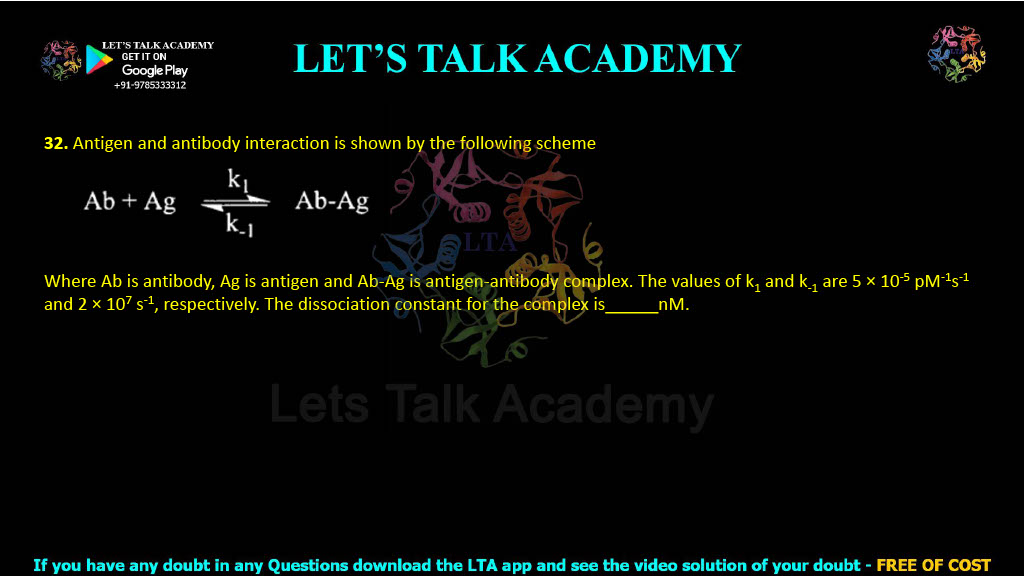
32. Antigen and antibody interaction is shown by the following scheme
Ab + Ag ⇌ Ab–Ag
Where Ab is antibody, Ag is antigen and Ab-Ag is antigen-antibody complex. The values of k1 and k-1 are 5 × 10⁻⁵ pM-1s-1 and 2 × 10⁷ s-1, respectively. The dissociation constant for the complex is nM.
Antigen-Antibody Dissociation Constant (Kd) Calculation E
Introduction
Antigen-antibody interactions are among the most fundamental molecular recognition events in immunology. The strength of binding between an antibody and its specific antigen determines how effectively the immune system can neutralize pathogens, activate complement proteins, and eliminate infectious agents. This binding is highly specific and depends on reversible, non-covalent interactions such as hydrogen bonds, ionic interactions, hydrophobic interactions, and van der Waals forces.
To quantify the strength of antigen-antibody binding, immunologists use the dissociation constant (Kd). A lower Kd value indicates stronger binding because very little antigen-antibody complex dissociates at equilibrium. Conversely, a higher Kd value indicates weaker binding.
Correct Answer
Correct Answer: 0.4 pM = 0.0004 nM
Detailed Explanation
The antigen-antibody reaction is a reversible process. During the forward reaction, antibodies bind antigens with an association rate constant (k1). During the reverse reaction, the antigen-antibody complex dissociates with a dissociation rate constant (k-1).
The equilibrium dissociation constant is given by the formula:
Kd = k-1 / k1
Substituting the given values:
Kd = (2 × 10⁻⁷) / (5 × 10⁵)
= (2/5) × 10-12
= 0.4 × 10⁻¹² M
= 4 × 10-13 M
Conversion into nM
Since
1 nM = 10-9 M
Therefore,
4 × 10-13 M = 4 × 10⁻⁴ nM
= 0.0004 nM
It may also be expressed as:
0.4 pM
Thus, the dissociation constant of the antigen-antibody complex is
Kd = 0.0004 nM.
Step-by-Step Numerical Solution
| Parameter | Value |
|---|---|
| Association rate constant (k1) | 5 × 10⁵ M-1 s-1 |
| Dissociation rate constant (k-1) | 2 × 10⁻⁷ s-1 |
| Formula | Kd = k-1 / k1 |
| Kd | 4 × 10-13 M |
| In nM | 0.0004 nM |
Understanding the Dissociation Constant (Kd)
The dissociation constant represents the concentration of antigen at which half of the available antibody binding sites are occupied at equilibrium. It is one of the most important parameters used to measure antibody affinity.
A smaller Kd means that the antibody binds the antigen more tightly, while a larger Kd indicates weaker antigen-antibody binding.
Relationship Between Kd and Antibody Affinity
| Kd Value | Binding Affinity |
|---|---|
| Very Low | Very High Affinity |
| Low | High Affinity |
| Moderate | Moderate Affinity |
| High | Weak Affinity |
Association Constant and Dissociation Constant
| Parameter | Formula | Meaning |
|---|---|---|
| Association Constant (Ka) | k1 / k-1 | Measures binding strength |
| Dissociation Constant (Kd) | k-1 / k1 | Measures tendency of complex to dissociate |
Factors Affecting Antigen-Antibody Affinity
| Factor | Effect |
|---|---|
| Shape Complementarity | Increases affinity |
| Hydrogen Bonds | Stabilize binding |
| Hydrophobic Interactions | Increase complex stability |
| Ionic Interactions | Strengthen antigen recognition |
| Van der Waals Forces | Provide close molecular fit |
Biological Significance of the Dissociation Constant
The dissociation constant is widely used in immunology, molecular biology, structural biology, and pharmaceutical research. Therapeutic monoclonal antibodies used to treat cancer, autoimmune diseases, and infectious diseases are selected based on extremely low Kd values because tighter antigen binding generally improves therapeutic effectiveness. Kd measurements are also fundamental in ELISA, biosensor technology, surface plasmon resonance (SPR), immunoprecipitation, and drug discovery.
Final Answer
Dissociation Constant (Kd) = 4 × 10-13 M
= 0.0004 nM
= 0.4 pM
Thus, the dissociation constant of the antigen-antibody complex is 0.0004 nM.


