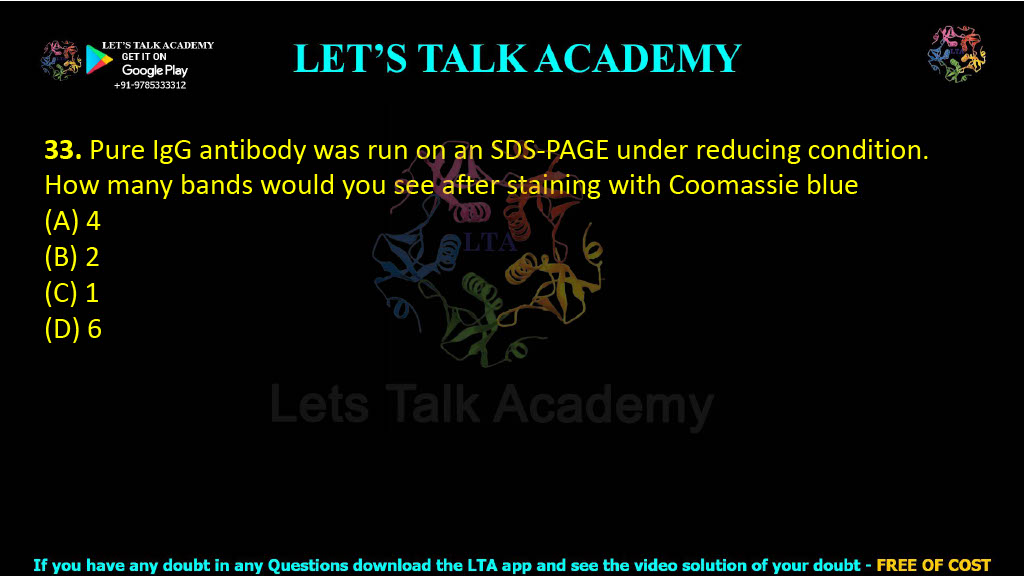
33. Pure IgG antibody was run on an SDS-PAGE under reducing condition. How many bands would you see after staining with Coomassie blue
(A) 4
(B) 2
(C) 1
(D) 6
Pure IgG on SDS-PAGE Under Reducing Conditions
Introduction
Sodium dodecyl sulfate-polyacrylamide gel electrophoresis (SDS-PAGE) is one of the most widely used laboratory techniques for separating proteins according to their molecular weight. It is an essential analytical tool in molecular biology, biochemistry, immunology, and biotechnology. SDS denatures proteins and provides a uniform negative charge, allowing proteins to migrate through the polyacrylamide gel based primarily on size rather than their native shape or charge.
When SDS-PAGE is performed under reducing conditions, reducing agents such as β-mercaptoethanol (β-ME) or dithiothreitol (DTT) break the disulfide bonds that connect different protein subunits. Immunoglobulin G (IgG) consists of two identical heavy chains and two identical light chains linked by disulfide bonds. Under reducing conditions, these chains separate into individual polypeptides. Since the two heavy chains are identical and the two light chains are identical, only two distinct protein bands appear on the gel after Coomassie Brilliant Blue staining.
Correct Answer
Correct Option: (B) 2
Detailed Explanation
An IgG molecule consists of four polypeptide chains:
- Two identical heavy (H) chains
- Two identical light (L) chains
These chains are connected by interchain and intrachain disulfide bonds. During SDS-PAGE under reducing conditions, SDS unfolds the protein while β-mercaptoethanol or DTT reduces the disulfide bonds, causing the heavy and light chains to separate completely.
Although there are four individual chains in an IgG molecule, the two heavy chains are identical in molecular weight (approximately 50 kDa each), and the two light chains are also identical (approximately 25 kDa each). Identical proteins migrate to the same position in the gel, producing a single band for heavy chains and a single band for light chains.
Therefore, after Coomassie Blue staining, only two distinct bands are observed:
- Heavy chain band (~50 kDa)
- Light chain band (~25 kDa)
Hence, the correct answer is Option (B).
Explanation of Each Option
Option (A): 4 Bands
This option is incorrect. Although IgG contains four polypeptide chains, the two heavy chains are identical and migrate together, and the two light chains are also identical and migrate together. Therefore, four separate bands are not observed.
Option (B): 2 Bands
This option is correct. Under reducing conditions, IgG dissociates into identical heavy and light chains, producing two distinct protein bands.
Option (C): 1 Band
This option is incorrect. A single band would be expected only if the antibody remained intact under non-reducing conditions or if the heavy and light chains were not separated.
Option (D): 6 Bands
This option is incorrect. IgG contains only four polypeptide chains and therefore cannot produce six distinct bands.
Why Option (B) is Correct
Reducing agents cleave the disulfide bonds joining the heavy and light chains. Since all heavy chains have identical molecular weight and all light chains have identical molecular weight, electrophoresis separates them into only two groups, resulting in two Coomassie-stained bands.
Why the Other Options are Incorrect
Why Option (A) is Incorrect
Four chains do not produce four bands because identical chains co-migrate during electrophoresis.
Why Option (C) is Incorrect
Reducing conditions separate heavy and light chains, preventing the appearance of a single intact IgG band.
Why Option (D) is Incorrect
An IgG molecule contains only two heavy chains and two light chains, making six bands impossible.
Structure of IgG Antibody
| Component | Number | Approximate Molecular Weight |
|---|---|---|
| Heavy Chains | 2 | 50 kDa each |
| Light Chains | 2 | 25 kDa each |
| Total IgG | 4 Chains | Approximately 150 kDa |
SDS-PAGE Under Different Conditions
| Condition | Disulfide Bonds | Expected Bands for Pure IgG |
|---|---|---|
| Reducing SDS-PAGE | Broken | 2 Bands |
| Non-Reducing SDS-PAGE | Intact | 1 Band (~150 kDa) |
Role of Reagents in SDS-PAGE
| Reagent | Function |
|---|---|
| SDS | Denatures proteins and provides uniform negative charge |
| β-Mercaptoethanol | Breaks disulfide bonds |
| DTT | Alternative reducing agent for disulfide bond reduction |
| Coomassie Brilliant Blue | Stains separated proteins |
Reducing versus Non-Reducing SDS-PAGE
| Feature | Reducing SDS-PAGE | Non-Reducing SDS-PAGE |
|---|---|---|
| Disulfide Bonds | Broken | Remain Intact |
| Protein Subunits | Separated | Remain Associated |
| IgG Appearance | Heavy and Light Chains | Whole IgG Molecule |
| Number of Bands | 2 | 1 |
Biological Significance of Reducing SDS-PAGE
Reducing SDS-PAGE allows researchers to determine the subunit composition of proteins by separating individual polypeptide chains connected through disulfide bonds. This technique is extensively used to verify antibody purity, characterize recombinant proteins, study protein complexes, identify disulfide-linked subunits, and evaluate monoclonal antibodies in research, diagnostics, and pharmaceutical development.
Final Answer
Correct Option: (B) 2
Pure IgG analyzed by SDS-PAGE under reducing conditions produces two distinct bands after Coomassie Blue staining because the reducing agent separates the antibody into identical heavy chains (~50 kDa) and identical light chains (~25 kDa), each migrating as a single band.


