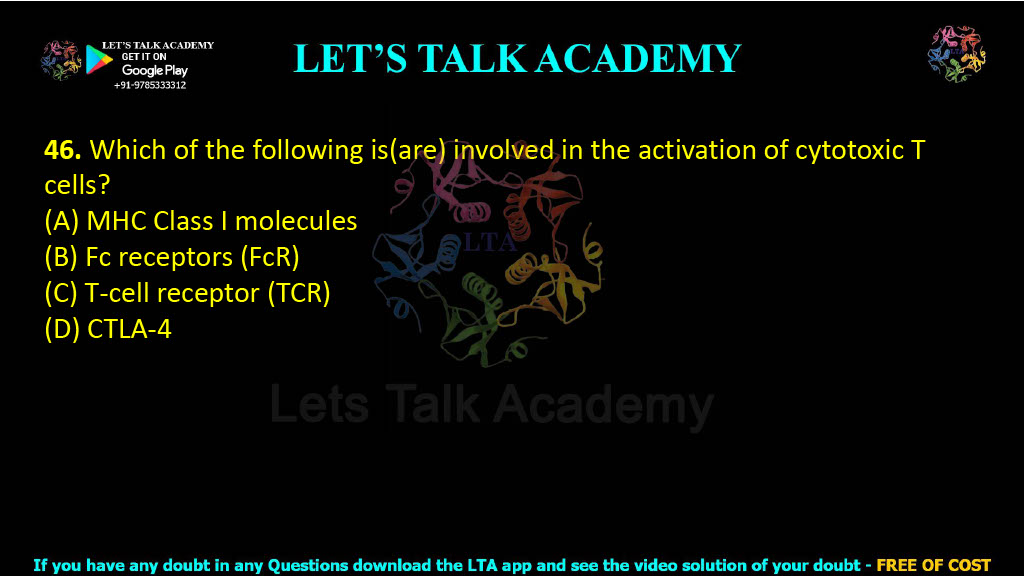
46. Which of the following is(are) involved in the activation of cytotoxic T cells?
(A) MHC Class I molecules
(B) Fc receptors (FcR)
(C) T-cell receptor (TCR)
(D) CTLA-4
Activation of Cytotoxic T Cells
Introduction
Cytotoxic T lymphocytes (CTLs), also known as CD8+ T cells, are one of the most important effector cells of the adaptive immune system. Their primary function is to recognize and destroy virus-infected cells, tumor cells, and cells infected by intracellular pathogens. Unlike antibodies, which neutralize pathogens circulating outside cells, cytotoxic T cells eliminate infected host cells directly, thereby preventing further pathogen replication.
The activation of cytotoxic T cells is a highly regulated process requiring antigen recognition, co-stimulatory signals, and cytokine-mediated differentiation. The most critical interaction occurs between the T-cell receptor (TCR) present on CD8+ T cells and antigenic peptides presented by Major Histocompatibility Complex (MHC) Class I molecules on antigen-presenting cells or infected cells. Additional molecules either enhance or inhibit this activation.
Correct Answer
Correct Options: (A) MHC Class I molecules and (C) T-cell receptor (TCR)
Detailed Explanation
Cytotoxic T-cell activation begins when antigen-presenting cells display intracellular antigenic peptides on MHC Class I molecules. These peptide-MHC Class I complexes are recognized specifically by the T-cell receptor (TCR) present on naïve CD8+ T cells. This interaction provides the first and most essential activation signal.
The TCR itself cannot recognize free antigen. Instead, it recognizes only peptide fragments bound to MHC Class I molecules. The CD8 co-receptor stabilizes this interaction by binding to the non-polymorphic region of MHC Class I, ensuring efficient antigen recognition.
After antigen recognition, additional co-stimulatory signals, especially the interaction between CD28 on T cells and B7 molecules (CD80/CD86) on antigen-presenting cells, promote complete activation. Activated cytotoxic T cells proliferate and differentiate into effector cells capable of killing infected cells through perforin-granzyme release or Fas-mediated apoptosis.
Fc receptors (FcRs) are receptors that bind the Fc portion of antibodies and are mainly expressed on macrophages, neutrophils, natural killer (NK) cells, eosinophils, dendritic cells, and mast cells. They participate in antibody-dependent cellular cytotoxicity (ADCC), phagocytosis, and immune complex clearance but are not directly involved in activating cytotoxic T cells.
CTLA-4 (Cytotoxic T-Lymphocyte Antigen-4) is an inhibitory immune checkpoint receptor expressed on activated T cells. Rather than activating cytotoxic T cells, CTLA-4 competes with CD28 for binding to B7 molecules and suppresses T-cell activation, thereby maintaining immune tolerance and preventing excessive immune responses.
Explanation of Each Option
Option (A): MHC Class I Molecules
This statement is correct. MHC Class I molecules present intracellular antigenic peptides to CD8+ T cells. Recognition of peptide-MHC Class I complexes is the first step in cytotoxic T-cell activation.
Option (B): Fc Receptors (FcR)
This statement is incorrect. Fc receptors bind antibodies and participate in antibody-mediated immune mechanisms but do not activate cytotoxic T cells.
Option (C): T-Cell Receptor (TCR)
This statement is correct. The T-cell receptor specifically recognizes antigenic peptides presented by MHC Class I molecules and initiates intracellular signaling required for T-cell activation.
Option (D): CTLA-4
This statement is incorrect. CTLA-4 functions as an inhibitory checkpoint molecule that suppresses T-cell activation rather than promoting it.
Why Options (A) and (C) are Correct
Activation of cytotoxic T cells depends on antigen recognition through the interaction between the T-cell receptor (TCR) and peptide-loaded MHC Class I molecules. Without these two components, antigen-specific activation cannot occur.
Why the Other Options are Incorrect
Why Option (B) is Incorrect
Fc receptors mediate antibody-dependent immune responses involving macrophages, neutrophils, and NK cells but are not components of T-cell receptor signaling.
Why Option (D) is Incorrect
CTLA-4 delivers inhibitory signals that reduce T-cell proliferation and cytokine production. It functions as a negative regulator rather than an activator of cytotoxic T cells.
Comparison of All Options
| Option | Molecule | Role in Cytotoxic T-Cell Activation | Correct or Incorrect |
|---|---|---|---|
| A | MHC Class I | Presents antigen to CD8 T cells | Correct |
| B | Fc Receptor | Antibody-mediated immune functions | Incorrect |
| C | T-cell Receptor (TCR) | Recognizes peptide-MHC Class I complex | Correct |
| D | CTLA-4 | Inhibits T-cell activation | Incorrect |
Steps in Cytotoxic T-Cell Activation
| Step | Event |
|---|---|
| 1 | Intracellular antigen is processed into peptides |
| 2 | Peptides bind to MHC Class I molecules |
| 3 | Peptide-MHC Class I complex is recognized by TCR |
| 4 | Co-stimulatory signals activate CD8 T cells |
| 5 | Activated cytotoxic T cells proliferate and differentiate |
| 6 | Effector CTLs destroy infected or abnormal cells |
Important Molecules in Cytotoxic T-Cell Activation
| Molecule | Function |
|---|---|
| MHC Class I | Presents intracellular peptides |
| TCR | Recognizes peptide-MHC complex |
| CD8 | Stabilizes interaction with MHC Class I |
| CD28 | Provides co-stimulatory signal |
| B7 (CD80/CD86) | Binds CD28 on T cells |
| IL-2 | Promotes proliferation of activated T cells |
| CTLA-4 | Suppresses T-cell activation |
Differences Between TCR and Fc Receptor
| Feature | T-cell Receptor | Fc Receptor |
|---|---|---|
| Recognizes | Peptide-MHC complex | Fc region of antibodies |
| Found On | T lymphocytes | Macrophages, NK cells, Neutrophils, Mast cells |
| Main Function | T-cell activation | Antibody-dependent immune responses |
Biological Significance
Activation of cytotoxic T cells is essential for eliminating virus-infected cells and malignant cells while preserving healthy tissues. Proper recognition through MHC Class I and TCR ensures antigen specificity, whereas inhibitory molecules such as CTLA-4 prevent excessive immune activation and autoimmunity. Modern cancer immunotherapy exploits this mechanism by blocking CTLA-4 with immune checkpoint inhibitors, thereby enhancing cytotoxic T-cell responses against tumors.
Final Answer
Correct Options: (A) MHC Class I molecules and (C) T-cell receptor (TCR)
Cytotoxic T-cell activation requires recognition of antigenic peptides presented by MHC Class I molecules through the T-cell receptor (TCR). Fc receptors are involved in antibody-mediated immune responses, while CTLA-4 functions as an inhibitory immune checkpoint that suppresses T-cell activation.


