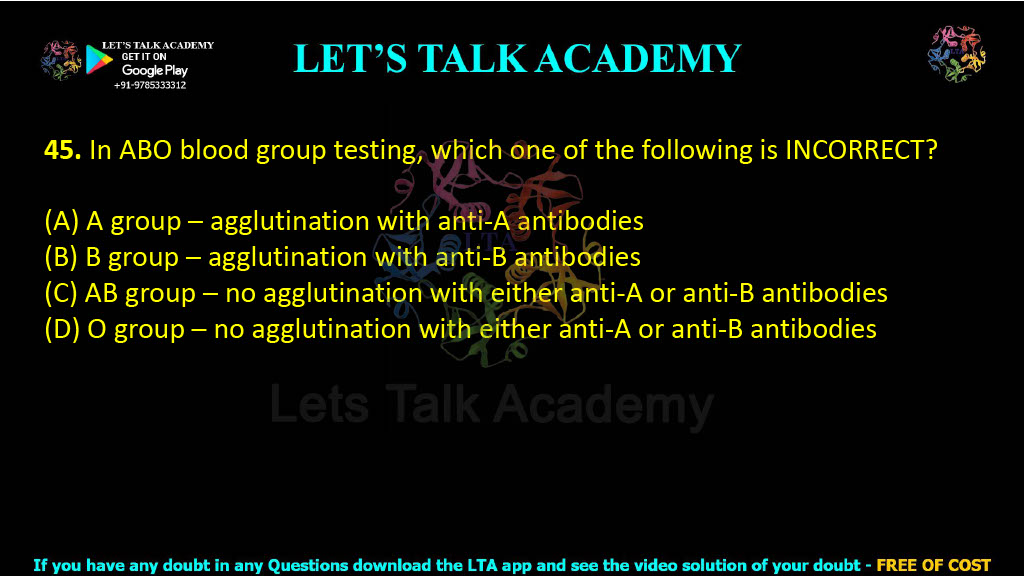
45. In ABO blood group testing, which one of the following is INCORRECT?
(A) A group – agglutination with anti-A antibodies
(B) B group – agglutination with anti-B antibodies
(C) AB group – no agglutination with either anti-A or anti-B antibodies
(D) O group – no agglutination with either anti-A or anti-B antibodies
Incorrect Statement About ABO Blood Group Testing
Introduction
The ABO blood group system is the most important blood group classification in humans and forms the basis of safe blood transfusion practices worldwide. It was discovered by Karl Landsteiner in 1901 and remains one of the greatest milestones in immunology and transfusion medicine. The ABO blood group is determined by the presence or absence of two carbohydrate antigens, namely A antigen and B antigen, on the surface of red blood cells (RBCs). Correspondingly, plasma contains naturally occurring antibodies against the antigen that is absent on an individual’s red blood cells.
Blood grouping is performed by mixing a person’s red blood cells separately with commercially prepared anti-A and anti-B antisera. If the corresponding antigen is present on the RBC surface, antigen-antibody binding causes visible agglutination (clumping). This reaction allows rapid identification of an individual’s ABO blood group and is essential before blood transfusion, organ transplantation, and many clinical diagnostic procedures.
Correct Answer
Correct Option: (C) AB group – no agglutination with either anti-A or anti-B antibodies
Detailed Explanation
The principle of ABO blood grouping depends on the specific interaction between antigens present on red blood cells and corresponding antibodies present in the testing antisera. When an antibody recognizes its corresponding antigen, antigen-antibody complexes form rapidly, producing visible clumping known as agglutination.
Individuals with blood group A possess A antigens on their erythrocytes. Therefore, when their blood is mixed with anti-A serum, agglutination occurs. Similarly, individuals with blood group B possess B antigens and show agglutination only with anti-B serum.
Individuals with blood group AB express both A and B antigens on their red blood cells. Consequently, their blood agglutinates with both anti-A and anti-B antisera. Therefore, the statement that AB blood shows no agglutination with either antiserum is incorrect.
Individuals with blood group O lack both A and B antigens on their erythrocytes. Since neither antigen is present, no agglutination occurs with either anti-A or anti-B antibodies.
Explanation of Each Option
Option (A): A Group – Agglutination with Anti-A Antibodies
This statement is correct. Blood group A possesses A antigen on red blood cells and therefore reacts positively with anti-A antibodies.
Option (B): B Group – Agglutination with Anti-B Antibodies
This statement is correct. Blood group B carries B antigen on the erythrocyte surface and therefore agglutinates with anti-B antibodies.
Option (C): AB Group – No Agglutination with Either Anti-A or Anti-B Antibodies
This statement is incorrect. Blood group AB possesses both A and B antigens, so agglutination occurs with both anti-A and anti-B antisera.
Option (D): O Group – No Agglutination with Either Anti-A or Anti-B Antibodies
This statement is correct. Blood group O lacks both A and B antigens, so neither anti-A nor anti-B antibodies can bind, resulting in no agglutination.
Why Option (C) is Correct
AB blood group contains both A and B antigens on the surface of red blood cells. During blood grouping, anti-A antibodies bind to A antigens and anti-B antibodies bind to B antigens. Therefore, blood group AB shows agglutination with both antisera. The statement claiming that there is no agglutination is incorrect.
Why the Other Options are Correct
Why Option (A) is Correct
Presence of A antigen causes agglutination with anti-A antibodies.
Why Option (B) is Correct
Presence of B antigen causes agglutination with anti-B antibodies.
Why Option (D) is Correct
Absence of both A and B antigens prevents agglutination with either testing serum.
Comparison of All Blood Groups
| Blood Group | A Antigen | B Antigen | Agglutination with Anti-A | Agglutination with Anti-B |
|---|---|---|---|---|
| A | Present | Absent | Yes | No |
| B | Absent | Present | No | Yes |
| AB | Present | Present | Yes | Yes |
| O | Absent | Absent | No | No |
ABO Blood Group Characteristics
| Blood Group | RBC Antigen | Plasma Antibody | Can Receive Blood From |
|---|---|---|---|
| A | A | Anti-B | A, O |
| B | B | Anti-A | B, O |
| AB | A and B | None | All ABO Groups |
| O | None | Anti-A and Anti-B | O Only |
Principle of ABO Blood Group Testing
| Step | Process |
|---|---|
| 1 | Mix blood sample with anti-A serum |
| 2 | Observe agglutination |
| 3 | Mix blood sample with anti-B serum |
| 4 | Observe agglutination |
| 5 | Determine blood group based on reaction pattern |
Summary of Agglutination Pattern
| Blood Group | Anti-A | Anti-B |
|---|---|---|
| A | Positive | Negative |
| B | Negative | Positive |
| AB | Positive | Positive |
| O | Negative | Negative |
Biological Significance of ABO Blood Grouping
Correct determination of the ABO blood group is essential for safe blood transfusion because transfusing incompatible blood can produce severe intravascular hemolysis, acute renal failure, shock, and even death. ABO compatibility is also important in organ transplantation, forensic medicine, prenatal investigations, and clinical laboratory diagnosis. The antigen-antibody reactions used in blood grouping demonstrate one of the most important practical applications of immunology in medicine.
Final Answer
Correct Option: (C) AB group – no agglutination with either anti-A or anti-B antibodies
This statement is incorrect because AB blood group possesses both A and B antigens on the surface of red blood cells. Therefore, it shows agglutination with both anti-A and anti-B antibodies, not the absence of agglutination.


