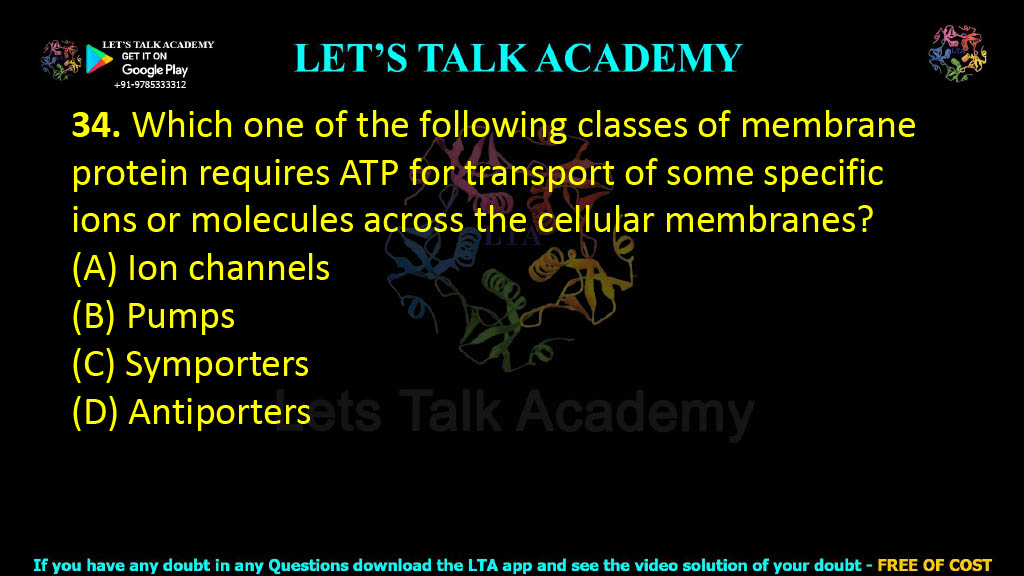
34. Which one of the following classes of membrane protein requires ATP for transport of some specific ions or molecules across the cellular membranes?
(A) Ion channels
(B) Pumps
(C) Symporters
(D) Antiporters
ATP-Driven Membrane Transport Proteins
Introduction
The plasma membrane is a selectively permeable barrier that regulates the movement of ions, nutrients, metabolites, and waste products into and out of the cell. Since many substances cannot freely diffuse across the lipid bilayer, cells depend on specialized membrane transport proteins. These transport proteins maintain cellular homeostasis, generate membrane potential, regulate osmotic balance, transport nutrients, remove toxic compounds, and facilitate cell signaling.
Membrane transport proteins are broadly classified into ion channels, transporters (carriers), and ATP-driven pumps. While ion channels allow passive diffusion of ions along their electrochemical gradients, ATP-driven pumps utilize the energy released from ATP hydrolysis to transport substances against their concentration or electrochemical gradients. Symporters and antiporters generally perform secondary active transport by utilizing energy stored in ion gradients rather than directly hydrolyzing ATP.
Correct Answer
Correct Option: (B) Pumps
Detailed Explanation
ATP-driven pumps perform primary active transport, a process in which the energy released from ATP hydrolysis is directly coupled to the movement of ions or molecules across biological membranes. These pumps transport substances against their concentration or electrochemical gradients, a process that cannot occur through passive diffusion.
The best-known example is the Na+/K+-ATPase, which hydrolyzes one ATP molecule to transport three sodium ions out of the cell and two potassium ions into the cell. Other important ATP-driven pumps include the Ca2+-ATPase, H+/K+-ATPase, V-type proton pumps, and ABC transporters. These proteins are essential for maintaining membrane potential, intracellular ion concentrations, muscle contraction, nerve impulse transmission, gastric acid secretion, and numerous metabolic processes.
Unlike pumps, ion channels allow passive diffusion without ATP consumption, whereas symporters and antiporters usually perform secondary active transport by utilizing ion gradients that have already been established by ATP-driven pumps.
Explanation of Each Option
Option (A): Ion Channels
This statement is incorrect. Ion channels provide aqueous pores that permit specific ions to move rapidly across membranes along their electrochemical gradients. They do not directly hydrolyze ATP because transport occurs through passive diffusion. Voltage-gated, ligand-gated, and mechanically gated channels all function without direct ATP expenditure.
Option (B): Pumps
This statement is correct. Membrane pumps directly utilize ATP hydrolysis to transport ions or molecules against their concentration gradients. They perform primary active transport and are responsible for maintaining ionic gradients essential for cellular physiology. Examples include Na+/K+-ATPase, Ca2+-ATPase, H+/K+-ATPase, and ABC transporters.
Option (C): Symporters
This statement is incorrect. Symporters transport two different substances in the same direction across the membrane. They generally perform secondary active transport by using the energy stored in sodium or proton gradients established by ATP-driven pumps. They do not hydrolyze ATP directly.
Option (D): Antiporters
This statement is incorrect. Antiporters exchange two different substances in opposite directions across the membrane. Like symporters, most antiporters depend on pre-existing ion gradients rather than direct ATP hydrolysis. Therefore, they are considered secondary active transporters.
Why Option (B) is Correct
Pumps are the only class of membrane transport proteins among the given options that directly consume ATP to move substances against their electrochemical gradients. This direct coupling of ATP hydrolysis with transport distinguishes pumps from ion channels, symporters, and antiporters.
Why the Other Options are Incorrect
Why Option (A) is Incorrect
Ion channels facilitate passive transport through diffusion and do not require ATP.
Why Option (C) is Incorrect
Symporters rely on ion gradients created by ATP-driven pumps and therefore perform secondary active transport rather than ATP-dependent transport.
Why Option (D) is Incorrect
Antiporters also utilize ion gradients generated by primary active transporters and generally do not hydrolyze ATP directly.
Comparison of All Options
| Option | Transport Protein | Requires Direct ATP? | Transport Type |
|---|---|---|---|
| A | Ion Channels | No | Passive Transport |
| B | Pumps | Yes | Primary Active Transport |
| C | Symporters | No | Secondary Active Transport |
| D | Antiporters | No | Secondary Active Transport |
Major Classes of Membrane Transport Proteins
| Transport Protein | Energy Source | Examples |
|---|---|---|
| Ion Channels | Electrochemical gradient | Potassium channel, Sodium channel |
| ATP Pumps | ATP Hydrolysis | Na+/K+-ATPase, Ca2+-ATPase |
| Symporters | Ion Gradient | Na+-Glucose Symporter |
| Antiporters | Ion Gradient | Na+/Ca2+ Exchanger |
Primary Active Transport vs Secondary Active Transport
| Feature | Primary Active Transport | Secondary Active Transport |
|---|---|---|
| Energy Source | Direct ATP Hydrolysis | Electrochemical Gradient |
| Main Proteins | Pumps | Symporters and Antiporters |
| ATP Used Directly | Yes | No |
| Examples | Na+/K+-ATPase, Ca2+-ATPase | Na+-Glucose Symporter, Na+/H+ Antiporter |
Biological Significance of ATP-Driven Pumps
ATP-dependent pumps establish and maintain electrochemical gradients that are essential for nearly every cellular process. The sodium-potassium pump maintains resting membrane potential and supports nerve impulse conduction. Calcium pumps regulate intracellular calcium concentration, which controls muscle contraction, neurotransmitter release, and cell signaling. Proton pumps maintain intracellular pH, acidify lysosomes, and facilitate gastric acid secretion. ABC transporters export toxins, drugs, and lipids across membranes and contribute to multidrug resistance in cancer cells.
Final Answer
Correct Option: (B) Pumps
Membrane pumps are ATP-dependent transport proteins that directly hydrolyze ATP to transport specific ions and molecules against their concentration or electrochemical gradients. In contrast, ion channels facilitate passive diffusion, while symporters and antiporters generally utilize ion gradients generated by ATP-driven pumps rather than consuming ATP directly.


