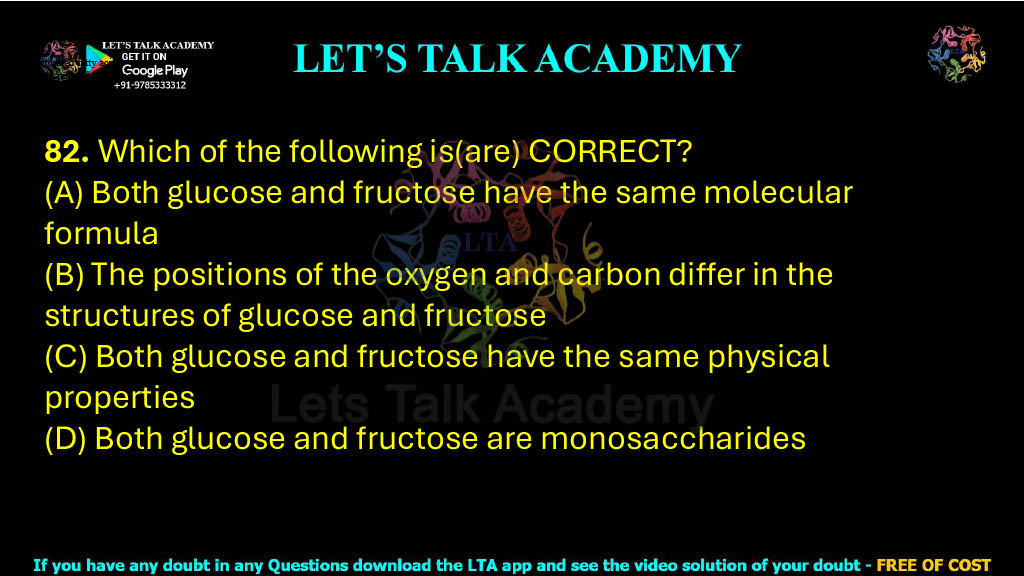
82. Which of the following is(are) CORRECT?
(A) Both glucose and fructose have the same molecular formula
(B) The positions of the oxygen and carbon differ in the structures of glucose and fructose
(C) Both glucose and fructose have the same physical properties
(D) Both glucose and fructose are monosaccharides
Which Statements Are Correct About Glucose and Fructose?
Correct Answer
(A) and (D)
Introduction
Carbohydrates are among the most abundant biological molecules and serve as the primary source of energy for living organisms. They also participate in structural functions, cell signaling, and the formation of nucleic acids and glycoconjugates. Among the simplest carbohydrates are monosaccharides, which cannot be hydrolyzed into smaller sugar units. Two of the most biologically important monosaccharides are glucose and fructose. Although both belong to the family of hexose sugars, they differ significantly in their molecular structure, chemical properties, and metabolism.
Glucose is the principal energy source for most cells and is often referred to as blood sugar. Fructose, commonly known as fruit sugar, is naturally present in fruits, honey, and several vegetables. Despite having the same molecular formula (C₆H₁₂O₆), glucose and fructose differ in the arrangement of atoms, making them structural (constitutional) isomers. This difference influences their chemical behavior, sweetness, metabolism, and physical characteristics.
Understanding the Concept Behind the Question
Glucose and fructose share the same molecular formula but differ in their molecular structure.
- Glucose is an aldohexose, containing an aldehyde group at carbon-1.
- Fructose is a ketohexose, containing a ketone group at carbon-2.
Because the functional group occupies a different position, these sugars are structural isomers rather than identical molecules.
Analysis of Option (A)
Both glucose and fructose have the same molecular formula.
This statement is correct.
Both glucose and fructose possess the molecular formula:
C₆H₁₂O₆
They contain:
- Six carbon atoms
- Twelve hydrogen atoms
- Six oxygen atoms
Although their molecular formulas are identical, the arrangement of atoms differs.
Therefore, they are structural isomers.
Hence,
Option (A) is correct.
Analysis of Option (B)
The positions of the oxygen and carbon differ in the structures of glucose and fructose.
This statement is incorrect.
The carbon skeleton remains identical in both molecules, with six carbon atoms arranged in the same sequence.
The major difference lies in the position of the carbonyl functional group.
- Glucose contains an aldehyde group at carbon-1.
- Fructose contains a ketone group at carbon-2.
The positions of carbon atoms themselves do not change.
Therefore,
Option (B) is incorrect.
Analysis of Option (C)
Both glucose and fructose have the same physical properties.
This statement is incorrect.
Although they have the same molecular formula, glucose and fructose exhibit different physical and chemical properties.
For example:
- Fructose is sweeter than glucose.
- Their melting points differ.
- Their optical rotations differ.
- Their rates of metabolism differ.
- Their crystalline structures differ.
Because structural isomers generally possess different physical properties, this statement is false.
Therefore,
Option (C) is incorrect.
Analysis of Option (D)
Both glucose and fructose are monosaccharides.
This statement is correct.
Both glucose and fructose consist of a single sugar unit and cannot be hydrolyzed into simpler carbohydrates.
Both are:
- Monosaccharides
- Hexose sugars
- Simple carbohydrates
Therefore,
Option (D) is correct.
Structural Difference Between Glucose and Fructose
Although both sugars have the molecular formula C₆H₁₂O₆, they differ in the location of the carbonyl group.
Glucose
- Aldohexose
- Aldehyde group at Carbon-1
- Major circulating blood sugar
Fructose
- Ketohexose
- Ketone group at Carbon-2
- Naturally abundant in fruits and honey
This difference classifies them as constitutional (structural) isomers.
Comparison Between Glucose and Fructose
| Feature | Glucose | Fructose |
|---|---|---|
| Molecular formula | C₆H₁₂O₆ | C₆H₁₂O₆ |
| Classification | Aldohexose | Ketohexose |
| Functional group | Aldehyde | Ketone |
| Carbonyl position | Carbon-1 | Carbon-2 |
| Sweetness | Lower | Higher |
| Monosaccharide | Yes | Yes |
Biological Importance
Glucose is the universal metabolic fuel used by nearly all tissues and serves as the primary substrate for glycolysis and cellular respiration. It is transported through the bloodstream to supply energy to the brain, muscles, and other organs. Fructose, although metabolized differently, provides an important dietary energy source and is primarily processed in the liver. Because both sugars are monosaccharides, they are rapidly absorbed from the intestine and contribute significantly to human energy metabolism. Their structural differences also influence enzyme specificity and metabolic pathways.
High-Yield Points
- Glucose and fructose have the same molecular formula: C₆H₁₂O₆.
- They are structural (constitutional) isomers.
- Glucose is an aldohexose.
- Fructose is a ketohexose.
- Both are monosaccharides.
- Fructose is sweeter than glucose.
- Glucose is the major blood sugar.
- Both are reducing sugars under appropriate conditions.
Frequently Asked Questions
Why are glucose and fructose called structural isomers?
Because they possess the same molecular formula but differ in the arrangement of atoms, specifically the location of the carbonyl functional group.
Which sugar is sweeter?
Fructose is significantly sweeter than glucose and is considered one of the sweetest naturally occurring sugars.
Are glucose and fructose both monosaccharides?
Yes. Both consist of a single sugar unit and cannot be hydrolyzed into smaller carbohydrates.
Key Takeaways
Glucose and fructose are both hexose monosaccharides with the identical molecular formula C₆H₁₂O₆, making them structural isomers. Glucose contains an aldehyde group at carbon-1, whereas fructose contains a ketone group at carbon-2. This structural difference produces distinct physical and chemical properties, including differences in sweetness and metabolism. Although they share the same molecular formula and classification as monosaccharides, they do not possess identical physical properties. Therefore, the correct statements are (A) and (D).
Final Answer
Correct Options: (A) and (D)
Explanation
Both glucose and fructose have the same molecular formula (C₆H₁₂O₆), making Option (A) correct. They are both monosaccharides, meaning each consists of a single sugar unit that cannot be hydrolyzed into simpler carbohydrates, making Option (D) correct. However, glucose is an aldohexose, whereas fructose is a ketohexose. Their functional groups differ, but the carbon skeleton remains the same, so Option (B) is incorrect. Because they are structural isomers, they possess different physical properties such as sweetness, melting point, optical rotation, and metabolic behavior; therefore, Option (C) is also incorrect.


