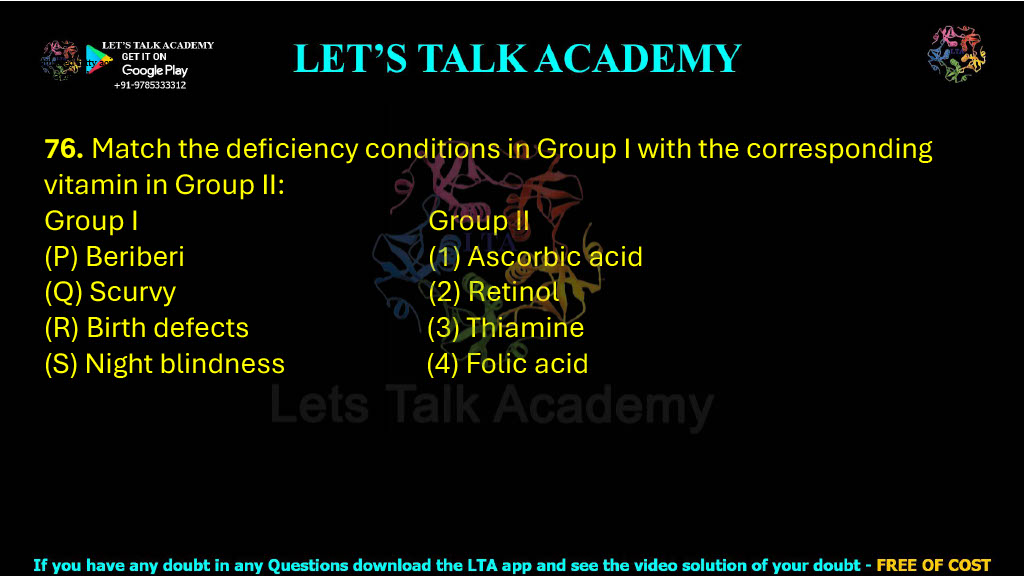
76. Match the deficiency conditions in Group I with the corresponding vitamin in Group II:
Group I
(P) Beriberi
(Q) Scurvy
(R) Birth defects
(S) Night blindness
Group II
(1) Ascorbic acid
(2) Retinol
(3) Thiamine
(4) Folic acid
Match Vitamin Deficiency Diseases with Their Corresponding Vitamins
Correct Answer
P–3, Q–1, R–4, S–2
Introduction
Vitamins are essential organic micronutrients required in very small quantities for normal growth, metabolism, reproduction, immunity, and maintenance of physiological functions. Unlike carbohydrates, proteins, and lipids, vitamins do not serve as major energy sources, but they act as coenzymes, antioxidants, hormone precursors, and regulators of numerous biochemical pathways. Since the human body cannot synthesize most vitamins in adequate amounts, they must be obtained from the diet. Deficiency of specific vitamins results in characteristic clinical disorders that are widely used as diagnostic indicators in medicine and are frequently tested in competitive examinations.
Each vitamin has a unique biochemical role. Thiamine (Vitamin B₁) is essential for carbohydrate metabolism and nerve function, and its deficiency causes beriberi. Ascorbic acid (Vitamin C) is required for collagen synthesis, and deficiency results in scurvy. Folic acid (Vitamin B₉) plays a crucial role in DNA synthesis and fetal neural tube development, making its deficiency a major cause of birth defects. Retinol (Vitamin A) is indispensable for vision, and deficiency leads to night blindness.
Understanding the Concept Behind the Question
The question asks us to correctly match each deficiency disease with the vitamin whose deficiency causes it.
The correct associations are:
- Beriberi → Thiamine (Vitamin B₁)
- Scurvy → Ascorbic acid (Vitamin C)
- Birth defects → Folic acid (Vitamin B₉)
- Night blindness → Retinol (Vitamin A)
Analysis of Pair (P)
Beriberi → Thiamine (Vitamin B₁)
Beriberi is caused by deficiency of thiamine, a water-soluble vitamin that functions as the precursor of thiamine pyrophosphate (TPP).
TPP serves as an essential coenzyme in:
- Pyruvate dehydrogenase
- α-Ketoglutarate dehydrogenase
- Branched-chain α-keto acid dehydrogenase
- Transketolase
Thiamine deficiency impairs carbohydrate metabolism and ATP production, leading to neurological and cardiovascular abnormalities.
Therefore,
P → 3 (Thiamine)
Analysis of Pair (Q)
Scurvy → Ascorbic Acid (Vitamin C)
Scurvy develops because of inadequate ascorbic acid, which is required for hydroxylation of proline and lysine during collagen synthesis.
Defective collagen weakens connective tissue, producing symptoms such as:
- Bleeding gums
- Poor wound healing
- Fragile blood vessels
- Loose teeth
- Joint pain
Therefore,
Q → 1 (Ascorbic acid)
Analysis of Pair (R)
Birth Defects → Folic Acid
Folic acid is essential for:
- DNA synthesis
- Purine and thymidylate synthesis
- Rapidly dividing embryonic cells
Deficiency during pregnancy greatly increases the risk of neural tube defects, including:
- Spina bifida
- Anencephaly
For this reason, folic acid supplementation is routinely recommended before conception and during early pregnancy.
Therefore,
R → 4 (Folic acid)
Analysis of Pair (S)
Night Blindness → Retinol (Vitamin A)
Retinol is converted into 11-cis-retinal, the visual pigment required for rhodopsin formation in rod cells.
Vitamin A deficiency impairs adaptation to dim light, resulting in:
- Night blindness
- Xerophthalmia
- Bitot’s spots
- Keratomalacia in severe cases
Therefore,
S → 2 (Retinol)
Correct Matching
| Disease | Vitamin |
|---|---|
| P. Beriberi | 3. Thiamine |
| Q. Scurvy | 1. Ascorbic acid |
| R. Birth defects | 4. Folic acid |
| S. Night blindness | 2. Retinol |
Therefore,
P–3, Q–1, R–4, S–2
Biological Importance of These Vitamins
Each vitamin supports a distinct physiological process essential for human health. Thiamine enables efficient energy production from carbohydrates and is particularly important for nervous tissue and cardiac muscle. Ascorbic acid maintains connective tissue integrity by promoting collagen synthesis and also acts as a powerful antioxidant. Folic acid is indispensable for DNA replication and fetal development, explaining why deficiency during pregnancy can cause severe congenital abnormalities. Retinol supports normal vision, epithelial differentiation, immune function, and embryonic growth. Together, these vitamins illustrate the critical role of micronutrients in maintaining normal metabolism and preventing deficiency disorders.
High-Yield Points
- Beriberi → Vitamin B₁ (Thiamine)
- Scurvy → Vitamin C (Ascorbic acid)
- Birth defects (Neural tube defects) → Vitamin B₉ (Folic acid)
- Night blindness → Vitamin A (Retinol)
- Thiamine coenzyme = TPP (Thiamine Pyrophosphate)
- Vitamin C is essential for collagen synthesis
- Vitamin A is required for rhodopsin formation
- Folic acid deficiency causes megaloblastic anemia and neural tube defects
Frequently Asked Questions
Why does thiamine deficiency cause beriberi?
Thiamine is required for ATP production through carbohydrate metabolism. Deficiency particularly affects tissues with high energy demands, such as nerves and the heart.
Why is folic acid important during pregnancy?
Folic acid is necessary for DNA synthesis and neural tube closure during early embryonic development. Its deficiency significantly increases the risk of congenital neural tube defects.
Why does vitamin A deficiency cause night blindness?
Vitamin A is converted into retinal, which combines with opsin to form rhodopsin in rod cells. Without sufficient retinal, dim-light vision is impaired.
Key Takeaways
Vitamin deficiency diseases have characteristic clinical manifestations that reflect the biochemical functions of each vitamin. Thiamine deficiency causes beriberi because of impaired carbohydrate metabolism. Ascorbic acid deficiency results in scurvy due to defective collagen synthesis. Folic acid deficiency during pregnancy leads to birth defects, particularly neural tube defects, while retinol deficiency causes night blindness by impairing rhodopsin formation in the retina. Therefore, the correct matching is P–3, Q–1, R–4, S–2.
Final Answer
Correct Matching: P–3, Q–1, R–4, S–2
Explanation
Beriberi is caused by deficiency of thiamine (Vitamin B₁), which functions as the coenzyme thiamine pyrophosphate (TPP) in carbohydrate metabolism. Scurvy results from deficiency of ascorbic acid (Vitamin C) because collagen synthesis becomes defective. Folic acid (Vitamin B₉) deficiency during pregnancy interferes with DNA synthesis and neural tube development, leading to birth defects. Retinol (Vitamin A) is essential for the formation of rhodopsin, the visual pigment in rod cells, and its deficiency causes night blindness. Therefore, the correct matching is P–3, Q–1, R–4, S–2.


