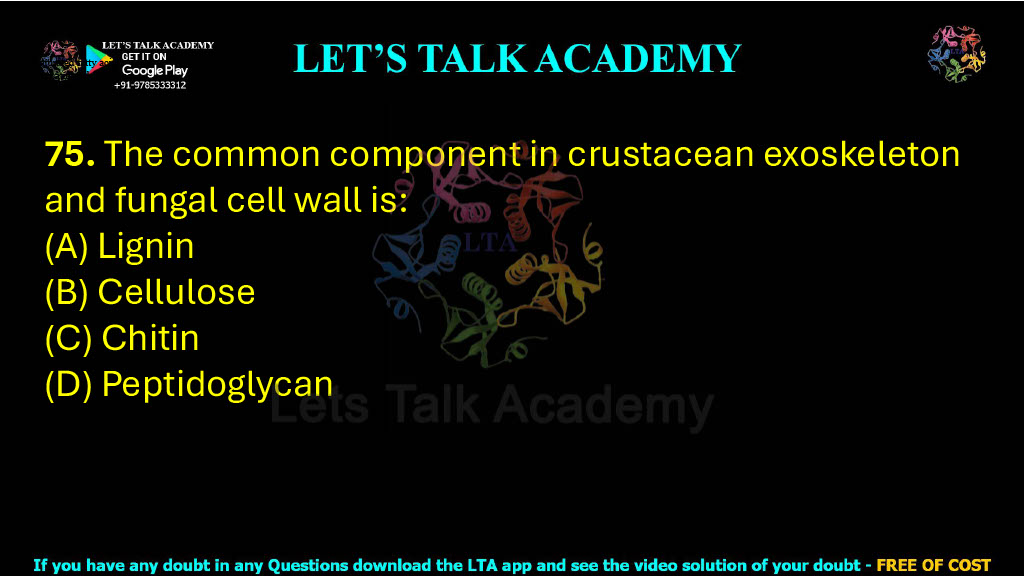
75. The common component in crustacean exoskeleton and fungal cell wall is:
(A) Lignin
(B) Cellulose
(C) Chitin
(D) Peptidoglycan
What Is the Common Structural Component of Crustacean Exoskeleton and Fungal Cell Wall?
Correct Answer
(C) Chitin
Introduction
Structural polysaccharides are essential biological macromolecules that provide mechanical strength, rigidity, protection, and structural support to cells and organisms. Different kingdoms of life utilize different polysaccharides according to their biological requirements. Plants primarily use cellulose and lignin to strengthen their cell walls, bacteria possess peptidoglycan as the major structural component of their cell wall, while fungi and many arthropods depend on chitin for structural integrity. These specialized polymers enable organisms to withstand mechanical stress and environmental challenges.
Among these structural carbohydrates, chitin is one of the most abundant natural polysaccharides, second only to cellulose in global abundance. It is found in the cell walls of fungi and forms the major structural framework of the exoskeleton of crustaceans, insects, spiders, and other arthropods. Because of its remarkable strength, flexibility, and resistance to degradation, chitin is widely studied in biotechnology, medicine, agriculture, and biomaterials research.
Understanding the Concept Behind the Question
The question asks for the common structural component shared by:
- Crustacean exoskeleton
- Fungal cell wall
Both of these biological structures are reinforced by chitin, a nitrogen-containing structural polysaccharide.
Chitin is composed of repeating units of:
N-acetyl-D-glucosamine (GlcNAc)
These monomers are linked through:
β(1→4) glycosidic bonds
This arrangement produces long, strong, unbranched fibers that provide excellent mechanical strength.
Analysis of Option (A)
Lignin
This statement is incorrect.
Lignin is a complex aromatic polymer deposited in the secondary cell walls of vascular plants.
Its major functions include:
- Mechanical support
- Waterproofing of xylem vessels
- Resistance to microbial degradation
Lignin is absent from fungal cell walls and crustacean exoskeletons.
Therefore,
Option (A) is incorrect.
Analysis of Option (B)
Cellulose
This statement is incorrect.
Cellulose is a structural polysaccharide made of β(1→4)-linked D-glucose units.
It is the principal component of plant cell walls.
Although cellulose and chitin possess similar β(1→4) linkages, cellulose is composed of glucose rather than N-acetylglucosamine.
Neither fungal cell walls nor crustacean exoskeletons primarily contain cellulose.
Therefore,
Option (B) is incorrect.
Analysis of Option (C)
Chitin
This statement is correct.
Chitin is a linear polysaccharide composed of N-acetyl-D-glucosamine residues connected by β(1→4) glycosidic bonds.
In fungi, chitin forms an essential component of the cell wall, providing rigidity and maintaining cell shape.
In crustaceans such as crabs, shrimps, and lobsters, chitin forms the framework of the exoskeleton, which is often strengthened further by calcium carbonate.
Because both biological structures contain chitin, this is the correct answer.
Therefore,
Option (C) is correct.
Analysis of Option (D)
Peptidoglycan
This statement is incorrect.
Peptidoglycan is a complex polymer composed of:
- N-acetylglucosamine (NAG)
- N-acetylmuramic acid (NAM)
These sugar chains are cross-linked by short peptides.
Peptidoglycan is the characteristic structural component of bacterial cell walls and is absent from fungi and crustaceans.
Therefore,
Option (D) is incorrect.
Structure of Chitin
Chitin consists of:
- Repeating N-acetyl-D-glucosamine (GlcNAc) units
- β(1→4) glycosidic linkages
- Linear unbranched chains
- Extensive hydrogen bonding between adjacent chains
This highly ordered structure provides exceptional strength while maintaining flexibility.
Comparison of Major Structural Polymers
| Polymer | Monomer | Organisms |
|---|---|---|
| Chitin | N-acetyl-D-glucosamine | Fungi, arthropods |
| Cellulose | D-Glucose | Plants |
| Peptidoglycan | NAG + NAM | Bacteria |
| Lignin | Phenolic alcohols | Vascular plants |
This comparison clearly distinguishes the major structural polymers found in different kingdoms of life.
Biological Importance
Chitin plays an essential structural role in fungi by maintaining cell wall rigidity and protecting cells against osmotic stress. In crustaceans and other arthropods, it forms a lightweight yet durable exoskeleton that provides protection, mechanical support, and sites for muscle attachment. Because chitin is biodegradable, biocompatible, and non-toxic, it has become an important biomaterial used in wound dressings, drug delivery systems, tissue engineering, biodegradable plastics, water purification, and agricultural applications.
High-Yield Points
- Chitin is composed of N-acetyl-D-glucosamine (GlcNAc).
- Monomers are connected by β(1→4) glycosidic bonds.
- Chitin occurs in fungal cell walls.
- Chitin forms the exoskeleton of arthropods, including crustaceans.
- Cellulose is found in plant cell walls.
- Peptidoglycan is characteristic of bacterial cell walls.
- Lignin strengthens secondary plant cell walls.
Frequently Asked Questions
Why is chitin stronger than many other polysaccharides?
Extensive hydrogen bonding between linear β(1→4)-linked N-acetylglucosamine chains gives chitin exceptional tensile strength and rigidity.
Is chitin found in plants?
No. Plants primarily contain cellulose and lignin, whereas chitin is found mainly in fungi and arthropods.
Why do crustaceans have hard exoskeletons?
The chitin framework in crustaceans is reinforced with calcium carbonate, producing a hard and protective exoskeleton.
Key Takeaways
Chitin is a structural polysaccharide composed of β(1→4)-linked N-acetyl-D-glucosamine residues. It serves as the principal structural component of fungal cell walls and the exoskeleton of crustaceans and other arthropods, providing strength, rigidity, and protection. Unlike cellulose, lignin, and peptidoglycan, chitin is the only polymer common to both fungi and crustaceans. Therefore, the correct answer is Option (C).
Final Answer
Correct Option: (C) Chitin
Explanation
Chitin is a linear structural polysaccharide composed of N-acetyl-D-glucosamine (GlcNAc) units joined by β(1→4) glycosidic bonds. It forms the major structural framework of the cell walls of fungi and the exoskeleton of crustaceans such as crabs, lobsters, and shrimps. In crustaceans, chitin is often reinforced with calcium carbonate, providing additional mechanical strength. In contrast, cellulose and lignin are characteristic components of plant cell walls, while peptidoglycan is unique to bacterial cell walls. Therefore, the common structural component present in both fungal cell walls and crustacean exoskeletons is chitin, making Option (C) the correct answer.


