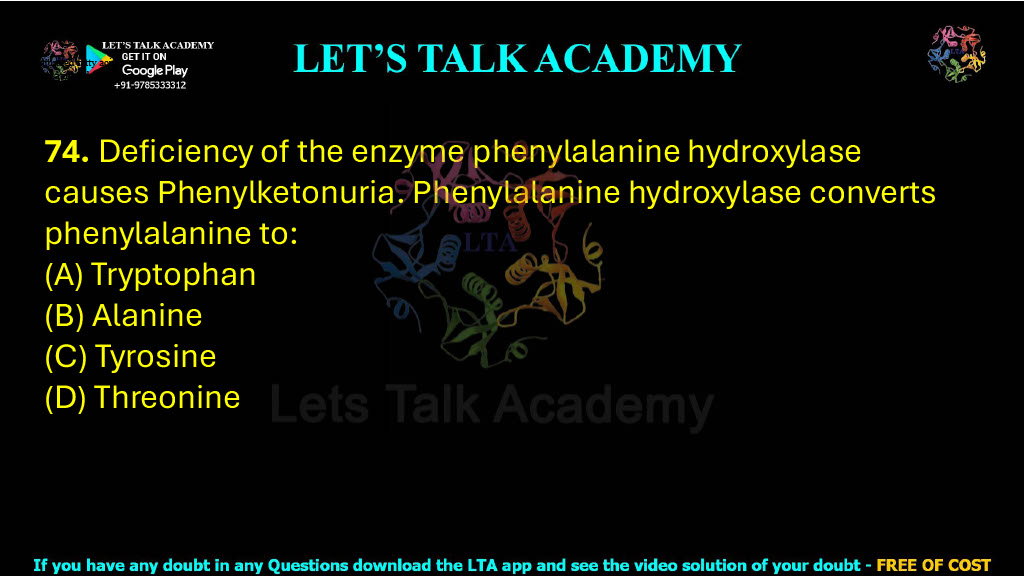
74. Deficiency of the enzyme phenylalanine hydroxylase causes Phenylketonuria. Phenylalanine hydroxylase converts phenylalanine to:
(A) Tryptophan
(B) Alanine
(C) Tyrosine
(D) Threonine
Phenylalanine Hydroxylase Converts Phenylalanine into Which Amino Acid?
Correct Answer
(C) Tyrosine
Introduction
Amino acid metabolism is an essential component of human biochemistry because amino acids not only serve as the building blocks of proteins but also function as precursors for numerous biologically important molecules, including neurotransmitters, hormones, pigments, and coenzymes. Among the aromatic amino acids, phenylalanine occupies a central position because it is converted into tyrosine, which subsequently gives rise to catecholamines, thyroid hormones, and melanin. This conversion is catalyzed by the enzyme phenylalanine hydroxylase (PAH) and requires the cofactor tetrahydrobiopterin (BH₄).
A deficiency of phenylalanine hydroxylase results in Phenylketonuria (PKU), one of the most common inherited disorders of amino acid metabolism. In affected individuals, phenylalanine cannot be efficiently converted into tyrosine, leading to the accumulation of phenylalanine and its abnormal metabolites in blood and urine. Early diagnosis and dietary management are essential to prevent irreversible neurological damage.
Understanding the Concept Behind the Question
The reaction catalyzed by phenylalanine hydroxylase is:
Phenylalanine + O₂ + BH₄ → Tyrosine + H₂O + BH₂
During this reaction, a hydroxyl (–OH) group is introduced onto the aromatic ring of phenylalanine, converting it into tyrosine.
Since tyrosine is synthesized from phenylalanine, it is considered a conditionally essential amino acid in individuals with phenylketonuria.
Analysis of Option (A)
Tryptophan
This statement is incorrect.
Tryptophan is an essential aromatic amino acid that must be obtained from the diet.
It is not synthesized from phenylalanine and belongs to an entirely different metabolic pathway.
Therefore,
Option (A) is incorrect.
Analysis of Option (B)
Alanine
This statement is incorrect.
Alanine is a non-essential aliphatic amino acid synthesized primarily by transamination of pyruvate.
It has no metabolic relationship with phenylalanine hydroxylase.
Therefore,
Option (B) is incorrect.
Analysis of Option (C)
Tyrosine
This statement is correct.
Phenylalanine hydroxylase catalyzes the hydroxylation of phenylalanine to produce tyrosine.
This reaction requires:
- Tetrahydrobiopterin (BH₄)
- Molecular oxygen
- Phenylalanine hydroxylase enzyme
Tyrosine produced in this reaction serves as the precursor for:
- Dopamine
- Norepinephrine
- Epinephrine
- Thyroxine
- Melanin
Therefore,
Option (C) is correct.
Analysis of Option (D)
Threonine
This statement is incorrect.
Threonine is an essential amino acid obtained directly from dietary proteins.
It is not synthesized from phenylalanine and is unrelated to phenylalanine hydroxylase.
Therefore,
Option (D) is incorrect.
Biochemical Reaction
The complete reaction catalyzed by phenylalanine hydroxylase is:
Phenylalanine + O₂ + BH₄ → Tyrosine + H₂O + BH₂
Where:
- BH₄ (Tetrahydrobiopterin) acts as the reducing cofactor.
- BH₂ is regenerated back to BH₄ by dihydropteridine reductase using NADH.
Phenylketonuria (PKU)
Phenylketonuria is an autosomal recessive metabolic disorder caused by deficiency of phenylalanine hydroxylase or, less commonly, defects in BH₄ metabolism.
Because phenylalanine cannot be converted into tyrosine:
- Blood phenylalanine concentration increases.
- Phenylpyruvate, phenylacetate, and phenyllactate accumulate.
- Tyrosine becomes conditionally essential.
If untreated, PKU may lead to:
- Intellectual disability
- Developmental delay
- Seizures
- Hypopigmentation
- Musty odor of urine
Early diagnosis by newborn screening and lifelong dietary restriction of phenylalanine are highly effective in preventing complications.
Biological Importance
Tyrosine occupies a central position in human metabolism because it serves as the precursor for numerous physiologically important compounds. Catecholamine neurotransmitters such as dopamine, norepinephrine, and epinephrine are synthesized from tyrosine, as are thyroid hormones (T₃ and T₄) and the skin pigment melanin. Consequently, defects in phenylalanine hydroxylase not only impair amino acid metabolism but also reduce the availability of these essential biomolecules.
High-Yield Points
- Phenylalanine hydroxylase converts phenylalanine → tyrosine.
- Cofactor required = Tetrahydrobiopterin (BH₄).
- Disease caused by enzyme deficiency = Phenylketonuria (PKU).
- PKU is inherited as an autosomal recessive disorder.
- Tyrosine becomes conditionally essential in PKU.
- Tyrosine is the precursor of dopamine, norepinephrine, epinephrine, melanin, and thyroid hormones.
- Newborn screening enables early diagnosis of PKU.
Frequently Asked Questions
Why does phenylalanine accumulate in PKU?
Because deficiency of phenylalanine hydroxylase prevents its conversion into tyrosine, leading to elevated phenylalanine concentrations in blood and tissues.
Why does tyrosine become conditionally essential?
In healthy individuals, tyrosine is synthesized from phenylalanine. In PKU, this pathway is blocked, so tyrosine must be supplied through the diet.
Which cofactor is required by phenylalanine hydroxylase?
The enzyme requires tetrahydrobiopterin (BH₄) as its essential reducing cofactor.
Key Takeaways
Phenylalanine hydroxylase catalyzes the hydroxylation of phenylalanine to form tyrosine, using molecular oxygen and tetrahydrobiopterin (BH₄) as a cofactor. This reaction is the first and most important step in the catabolism of phenylalanine and provides tyrosine for the synthesis of neurotransmitters, thyroid hormones, and melanin. Deficiency of phenylalanine hydroxylase results in Phenylketonuria (PKU), characterized by accumulation of phenylalanine and reduced tyrosine production. Therefore, the correct answer is Option (C).
Final Answer
Correct Option: (C) Tyrosine
Explanation
Phenylalanine hydroxylase catalyzes the conversion of phenylalanine into tyrosine by adding a hydroxyl group to the aromatic ring of phenylalanine. The reaction requires tetrahydrobiopterin (BH₄) and molecular oxygen. Deficiency of this enzyme causes Phenylketonuria (PKU), leading to accumulation of phenylalanine and reduced synthesis of tyrosine. Since tyrosine serves as the precursor for catecholamines, thyroid hormones, and melanin, it becomes a conditionally essential amino acid in affected individuals. Therefore, the correct answer is Option (C) Tyrosine.


