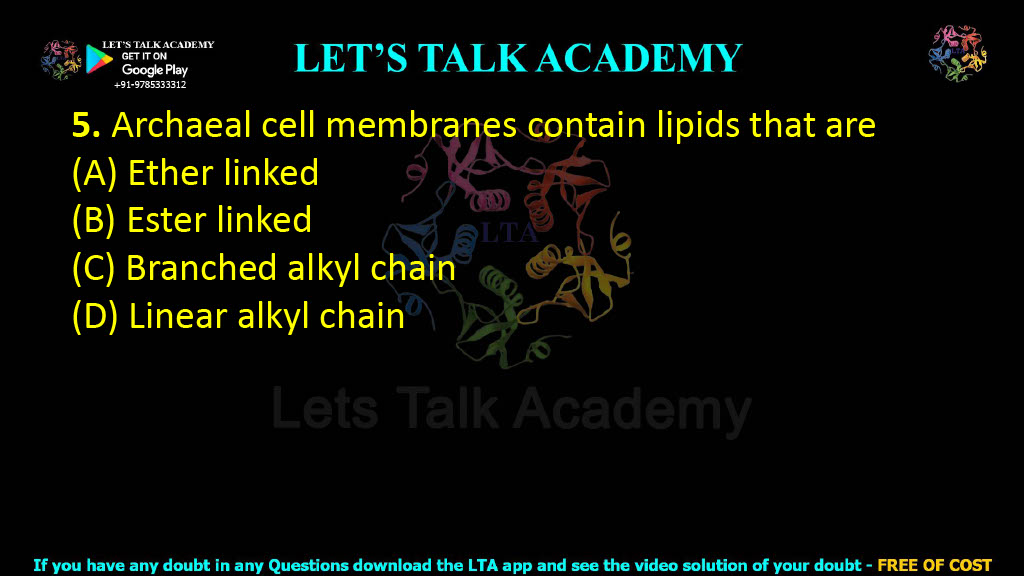
5. Archaeal cell membranes contain lipids that are
(A) Ether linked
(B) Ester linked
(C) Branched alkyl chain
(D) Linear alkyl chain
Archaeal Cell Membrane Lipids: Ether Linkages, Branched Alkyl Chains
Introduction
Archaea represent one of the three domains of life and possess several unique biochemical and structural characteristics that distinguish them from bacteria and eukaryotes. Among these unique features, the composition of the archaeal cell membrane is one of the most important and frequently tested topics in microbiology and cell biology. Unlike bacterial and eukaryotic membranes, archaeal membranes are composed of ether-linked lipids with highly branched isoprenoid alkyl chains. These specialized membrane lipids provide exceptional chemical stability, allowing archaea to survive in extreme environments such as hot springs, hydrothermal vents, hypersaline lakes, acidic environments, and highly alkaline habitats.
Correct Answer
Correct Option: (A) and (C)
Detailed Explanation
The plasma membrane of Archaea is fundamentally different from that of bacteria and eukaryotes. While bacterial and eukaryotic membranes consist of phospholipids containing fatty acids attached to glycerol through ester linkages, archaeal membranes contain isoprenoid hydrocarbon chains attached to glycerol by ether bonds. These two structural differences—ether linkages and branched alkyl chains—provide archaeal membranes with remarkable resistance to heat, oxidation, acidic conditions, and chemical degradation.
The hydrocarbon chains found in archaeal membranes are synthesized from repeating isoprene units, producing branched alkyl chains rather than the straight-chain fatty acids found in bacteria and eukaryotes. Because ether bonds are chemically more stable than ester bonds, archaeal membranes remain functional even under extreme environmental conditions where ordinary biological membranes would rapidly degrade.
Explanation of Each Option
Option (A): Ether Linked
This statement is correct. Archaeal membrane lipids are connected to glycerol through ether linkages. Ether bonds are significantly more resistant to hydrolysis, oxidation, and high temperatures than ester bonds. This increased chemical stability enables archaeal membranes to function efficiently in extreme environments such as boiling hot springs and highly acidic habitats. Ether-linked phospholipids are therefore considered one of the defining characteristics of archaeal cell membranes.
Option (B): Ester Linked
This statement is incorrect. Ester linkages are characteristic of bacterial and eukaryotic phospholipids rather than archaeal membranes. Ester bonds are formed between glycerol and fatty acids, making them more susceptible to hydrolysis under harsh environmental conditions. Because archaea have evolved to survive in extreme habitats, they utilize ether linkages instead of ester linkages for greater membrane stability.
Option (C): Branched Alkyl Chain
This statement is correct. Archaeal membrane lipids contain highly branched hydrocarbon chains derived from isoprenoid units. These branched alkyl chains increase membrane rigidity, reduce permeability, and enhance thermal stability. In many archaeal species, two phospholipid molecules are joined to form tetraether lipids that span the entire membrane, creating a lipid monolayer instead of a conventional bilayer. This unique organization further improves membrane stability under extreme environmental conditions.
Option (D): Linear Alkyl Chain
This statement is incorrect. Linear hydrocarbon chains are characteristic of bacterial and eukaryotic fatty acids. Archaeal membrane lipids instead contain branched isoprenoid chains, which provide greater structural stability and resistance to environmental stress. Therefore, linear alkyl chains are not a defining feature of archaeal membranes.
Why the Correct Answer is (A) and (C)
Archaeal membranes are distinguished from all other biological membranes by two unique structural characteristics: the presence of ether linkages between glycerol and hydrocarbon chains, and the presence of branched isoprenoid alkyl chains. These adaptations make archaeal membranes exceptionally stable under extreme environmental conditions. Ester linkages and linear fatty acid chains are typical features of bacterial and eukaryotic membranes rather than archaeal membranes. Therefore, the correct answer is Options (A) and (C).
Comparison of All Options
| Option | Feature | Present in Archaeal Membranes? | Explanation |
|---|---|---|---|
| A | Ether Linked | Yes | Provides high chemical and thermal stability. |
| B | Ester Linked | No | Characteristic of bacterial and eukaryotic membranes. |
| C | Branched Alkyl Chain | Yes | Derived from isoprenoid units and increases membrane stability. |
| D | Linear Alkyl Chain | No | Characteristic of bacterial and eukaryotic fatty acids. |
Comparison Between Archaeal, Bacterial, and Eukaryotic Membranes
| Feature | Archaea | Bacteria | Eukaryotes |
|---|---|---|---|
| Lipid Linkage | Ether Bond | Ester Bond | Ester Bond |
| Hydrocarbon Chain | Branched Isoprenoid Chains | Linear Fatty Acids | Linear Fatty Acids |
| Membrane Organization | Bilayer or Monolayer | Bilayer | Bilayer |
| Environmental Stability | Extremely High | Moderate | Moderate |
Biological Significance of Archaeal Membrane Lipids
The unique membrane composition of archaea is a major evolutionary adaptation that enables survival under extreme environmental conditions. Ether bonds resist hydrolysis more effectively than ester bonds, while branched isoprenoid chains increase membrane rigidity and decrease permeability. Some archaeal species possess tetraether lipids that span the entire membrane, forming highly stable lipid monolayers capable of withstanding temperatures exceeding 100°C, extremely low pH, or very high salt concentrations. These adaptations explain why archaea are commonly found in environments considered inhospitable for most other organisms.
Final Answer
Correct Option: (A) and (C)
Archaeal cell membranes are composed of ether-linked phospholipids containing branched isoprenoid alkyl chains. These unique structural features provide exceptional thermal and chemical stability, allowing archaea to survive in extreme environments. In contrast, bacterial and eukaryotic membranes contain ester-linked phospholipids with linear fatty acid chains.


