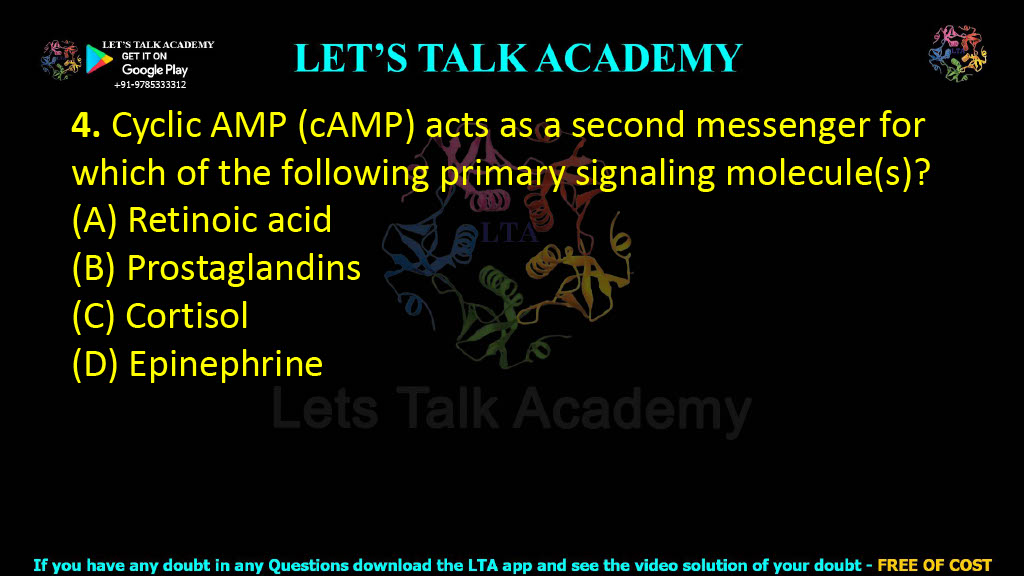
4. Cyclic AMP (cAMP) acts as a second messenger for which of the following primary signaling molecule(s)?
(A) Retinoic acid
(B) Prostaglandins
(C) Cortisol
(D) Epinephrine
cAMP as a Second Messenger: Complete Explanation on Cell Signaling Pathways
Introduction
Cell signaling is one of the most fundamental processes that enables cells to communicate with one another and respond appropriately to changes in their internal and external environments. Most signaling molecules, also known as first messengers, cannot directly enter the cell because they are either large or hydrophilic. Instead, they bind to specific receptors on the plasma membrane, triggering intracellular signaling pathways that amplify and transmit the signal. One of the most important intracellular signaling molecules involved in this process is cyclic adenosine monophosphate (cAMP), commonly known as cyclic AMP.
Correct Answer
Correct Option: (B) and (D)
Detailed Explanation
Second messengers are intracellular molecules that relay signals from activated cell surface receptors to various target proteins inside the cell. Among all second messengers, cyclic AMP (cAMP) is one of the most extensively studied. It is synthesized from ATP by the enzyme adenylate cyclase after activation of G-protein-coupled receptors (GPCRs). Once produced, cAMP activates protein kinase A (PKA), which phosphorylates numerous target proteins and transcription factors, thereby regulating metabolism, gene expression, cell growth, hormone secretion, and many other physiological processes.
Only signaling molecules that bind to receptors coupled to stimulatory G proteins (Gs proteins) activate adenylate cyclase and increase intracellular cAMP levels. Hormones and signaling molecules that act through intracellular nuclear receptors do not require cAMP because they directly regulate gene transcription after entering the cell.
Explanation of Each Option
Option (A): Retinoic Acid
This option is incorrect. Retinoic acid is a lipid-soluble derivative of vitamin A that easily diffuses across the plasma membrane. Instead of binding to cell surface receptors, it enters the nucleus and binds to nuclear receptors known as Retinoic Acid Receptors (RARs) and Retinoid X Receptors (RXRs). These receptors function as transcription factors that directly regulate gene expression. Since retinoic acid acts through intracellular nuclear receptors, it does not require cAMP as a second messenger.
Option (B): Prostaglandins
This option is correct. Many prostaglandins, particularly prostaglandin E2 (PGE2) and prostacyclin (PGI2), bind to G-protein-coupled receptors located on the plasma membrane. Several of these receptors are coupled to Gs proteins, which activate adenylate cyclase and increase intracellular cAMP production. The elevated cAMP then activates protein kinase A, producing diverse physiological responses such as vasodilation, inhibition of platelet aggregation, regulation of inflammation, and smooth muscle relaxation. Although not every prostaglandin receptor signals through cAMP, many important prostaglandin signaling pathways utilize this second messenger.
Option (C): Cortisol
This option is incorrect. Cortisol is a steroid hormone synthesized by the adrenal cortex. Because it is lipid soluble, cortisol diffuses directly through the plasma membrane and binds to intracellular glucocorticoid receptors located in the cytoplasm. The hormone-receptor complex subsequently enters the nucleus, where it binds to glucocorticoid response elements on DNA and regulates gene transcription. Since cortisol signals through intracellular receptors rather than membrane-bound GPCRs, cAMP is not involved in its signaling pathway.
Option (D): Epinephrine
This option is correct. Epinephrine is one of the classical hormones that utilizes cAMP as its second messenger. When epinephrine binds to β-adrenergic receptors on the plasma membrane, the receptor activates a stimulatory G protein (Gs). The activated Gs protein stimulates adenylate cyclase, which converts ATP into cAMP. The resulting increase in cAMP activates protein kinase A, leading to phosphorylation of target enzymes involved in glycogen breakdown, lipolysis, increased heart rate, and enhanced cardiac contraction. Because epinephrine signaling through β-adrenergic receptors depends directly on cAMP, it is one of the best-known examples of cAMP-mediated signal transduction.
Why the Correct Answer is (B) and (D)
Both prostaglandins and epinephrine activate signaling pathways involving G-protein-coupled receptors that stimulate adenylate cyclase and increase intracellular cAMP levels. Retinoic acid and cortisol, on the other hand, are lipid-soluble molecules that diffuse into cells and regulate gene expression through intracellular nuclear receptors without requiring second messengers such as cAMP. Therefore, the correct answer is Options (B) and (D).
Comparison of All Options
| Option | Primary Signaling Molecule | Uses cAMP? | Reason |
|---|---|---|---|
| A | Retinoic Acid | No | Acts through intracellular nuclear receptors that regulate gene transcription. |
| B | Prostaglandins | Yes | Many prostaglandin receptors activate Gs proteins and adenylate cyclase. |
| C | Cortisol | No | Signals through intracellular glucocorticoid receptors. |
| D | Epinephrine | Yes | Activates β-adrenergic GPCRs, stimulating adenylate cyclase and cAMP production. |
The cAMP Signaling Pathway
Activation of G-Protein Coupled Receptors
The signaling pathway begins when a hormone or signaling molecule binds to its specific G-protein-coupled receptor on the plasma membrane. This interaction activates a heterotrimeric G protein, which exchanges GDP for GTP on its α-subunit.
Activation of Adenylate Cyclase
The activated Gs α-subunit stimulates adenylate cyclase, an enzyme embedded within the plasma membrane. Adenylate cyclase converts ATP into cyclic AMP, leading to a rapid increase in intracellular cAMP concentration.
Activation of Protein Kinase A
cAMP binds to the regulatory subunits of protein kinase A (PKA), releasing its catalytic subunits. Activated PKA phosphorylates numerous enzymes, ion channels, structural proteins, and transcription factors, producing cellular responses such as glycogen breakdown, increased cardiac output, lipolysis, hormone secretion, and altered gene expression.
Biological Significance of cAMP
cAMP serves as one of the most important intracellular signaling molecules because it amplifies extracellular signals into large intracellular responses. A single activated receptor can stimulate the production of thousands of cAMP molecules, allowing even very small amounts of hormone to generate substantial physiological effects. This signal amplification is essential for regulating metabolism, endocrine function, immune responses, neuronal communication, cardiac physiology, and cellular differentiation.
Competitive Examination Perspective
Questions involving cAMP signaling are extremely common in competitive examinations because they integrate concepts from cell biology, molecular biology, physiology, and biochemistry. Students should clearly distinguish hormones that use G-protein-coupled receptors from those that act through intracellular nuclear receptors. Particular emphasis should be placed on hormones utilizing cAMP, IP3/DAG, calcium-calmodulin pathways, receptor tyrosine kinases, and steroid hormone receptors. Understanding these signaling mechanisms greatly improves performance in conceptual and application-based questions.
Final Answer
Correct Option: (B) and (D)
cAMP functions as an intracellular second messenger for signaling molecules such as prostaglandins (through specific GPCRs) and epinephrine (through β-adrenergic receptors). In contrast, retinoic acid and cortisol diffuse directly into cells and regulate gene expression through intracellular nuclear receptors without requiring cAMP.


