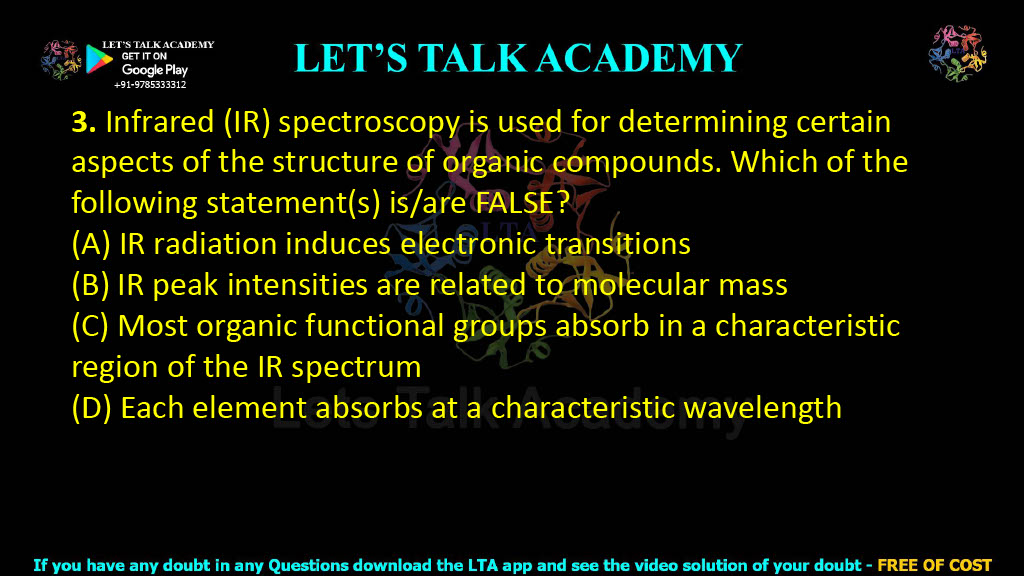
3. Infrared (IR) spectroscopy is used for determining certain aspects of the structure of organic compounds. Which of the following statement(s) is/are FALSE?
(A) IR radiation induces electronic transitions
(B) IR peak intensities are related to molecular mass
(C) Most organic functional groups absorb in a characteristic region of the IR spectrum
(D) Each element absorbs at a characteristic wavelength
Infrared (IR) Spectroscopy: Complete Explanation on Organic Compound Structure
Introduction
Infrared (IR) spectroscopy is one of the most widely used analytical techniques in organic chemistry, biochemistry, pharmaceutical sciences, and material science for identifying functional groups present in a molecule. Every organic compound possesses characteristic chemical bonds that vibrate continuously. When infrared radiation of an appropriate frequency interacts with these bonds, the molecule absorbs energy, causing changes in its vibrational motion. Since different functional groups absorb infrared radiation at characteristic wavelengths, an IR spectrum acts as a molecular fingerprint that helps identify unknown organic compounds.
Correct Answer
Correct Option: (A), (B), and (D)
Detailed Explanation
Infrared spectroscopy is based on the interaction of infrared radiation with molecules rather than individual atoms. Unlike ultraviolet-visible spectroscopy, which promotes electrons from lower-energy molecular orbitals to higher-energy orbitals, infrared radiation possesses much lower energy. This energy is sufficient only to excite molecular vibrations such as bond stretching and bond bending. Consequently, IR spectroscopy provides information about the types of chemical bonds and functional groups present in a molecule rather than electronic structure or elemental identity.
The position of an absorption peak in an IR spectrum depends mainly on bond strength, atomic masses involved in the bond, and molecular environment. The intensity of an absorption band depends on the change in dipole moment during vibration rather than the molecular mass of the compound. Therefore, understanding the physical basis of molecular vibrations is essential for evaluating each statement correctly.
Explanation of Each Option
Option (A): IR Radiation Induces Electronic Transitions
This statement is false. Infrared radiation does not possess enough energy to promote electrons between molecular orbitals. Instead, IR radiation excites molecules from one vibrational energy level to another. Electronic transitions occur in ultraviolet-visible (UV-Visible) spectroscopy, where photons have significantly higher energy. Therefore, IR spectroscopy is a vibrational spectroscopy rather than an electronic spectroscopy.
Option (B): IR Peak Intensities are Related to Molecular Mass
This statement is false. The intensity of an IR absorption peak primarily depends on the magnitude of the change in dipole moment during molecular vibration. Vibrations involving highly polar bonds generally produce stronger absorption bands than nonpolar bonds. Although atomic masses influence the vibrational frequency according to Hooke’s law, they do not directly determine peak intensity. Therefore, relating IR peak intensity solely to molecular mass is incorrect.
Option (C): Most Organic Functional Groups Absorb in a Characteristic Region of the IR Spectrum
This statement is true. One of the greatest strengths of IR spectroscopy is that common functional groups absorb at characteristic frequencies. For example, O–H stretching vibrations appear around 3200–3600 cm−1, C=O stretching vibrations occur near 1650–1750 cm−1, N–H stretching vibrations are typically observed near 3300 cm−1, and C≡N stretching appears around 2210–2260 cm−1. These characteristic absorption regions allow chemists to identify functional groups rapidly.
Option (D): Each Element Absorbs at a Characteristic Wavelength
This statement is false. Infrared spectroscopy measures molecular vibrations involving chemical bonds rather than isolated elements. Individual elements do not produce characteristic IR absorption bands. Instead, specific chemical bonds and functional groups absorb infrared radiation at characteristic frequencies depending on bond strength and reduced mass. Element-specific absorption is associated with atomic spectroscopy rather than molecular infrared spectroscopy.
Why the Correct Answer is (A), (B), and (D)
Only Option (C) correctly describes the principle of infrared spectroscopy because organic functional groups absorb infrared radiation within characteristic frequency ranges that are widely used for structural identification. Option (A) is incorrect because IR spectroscopy measures vibrational transitions rather than electronic transitions. Option (B) is incorrect because peak intensity depends on changes in dipole moment instead of molecular mass. Option (D) is incorrect because IR spectroscopy detects molecular bond vibrations rather than individual elemental absorption. Therefore, the false statements are (A), (B), and (D).
Comparison of All Options
| Option | Statement | True/False | Explanation |
|---|---|---|---|
| A | IR radiation induces electronic transitions | False | IR radiation excites molecular vibrations, not electronic transitions. |
| B | IR peak intensities are related to molecular mass | False | Peak intensity depends mainly on the change in dipole moment during vibration. |
| C | Most organic functional groups absorb in characteristic regions | True | Each functional group has characteristic vibrational frequencies in the IR spectrum. |
| D | Each element absorbs at a characteristic wavelength | False | IR spectroscopy measures molecular bond vibrations, not elemental absorption. |
Important Regions of the IR Spectrum
Functional Group Region (4000–1500 cm−1)
The functional group region contains absorption bands corresponding to most important functional groups such as alcohols, amines, carbonyl compounds, alkynes, nitriles, and alkenes. These peaks are highly useful for identifying the presence of specific chemical groups within an unknown molecule.
Fingerprint Region (1500–500 cm−1)
The fingerprint region contains numerous complex absorption bands arising from skeletal vibrations and molecular bending motions. Since every compound produces a unique fingerprint pattern, this region is extensively used for confirming the identity of unknown compounds by comparison with reference spectra.
Applications of Infrared Spectroscopy
Infrared spectroscopy is extensively used for structural elucidation, identification of functional groups, quality control in pharmaceutical industries, forensic investigations, environmental monitoring, polymer characterization, food analysis, and biochemical research. Because it is rapid, non-destructive, and highly sensitive to chemical bonding, IR spectroscopy remains one of the most valuable analytical techniques in modern chemistry and life sciences.
Final Answer
Correct Answer: (A), (B), and (D)
Infrared spectroscopy measures molecular vibrational transitions rather than electronic transitions, identifies functional groups through characteristic absorption frequencies, and detects vibrations of chemical bonds instead of individual elements. Furthermore, IR peak intensity depends primarily on changes in dipole moment during vibration rather than molecular mass. Therefore, statements (A), (B), and (D) are false, while statement (C) is true.


