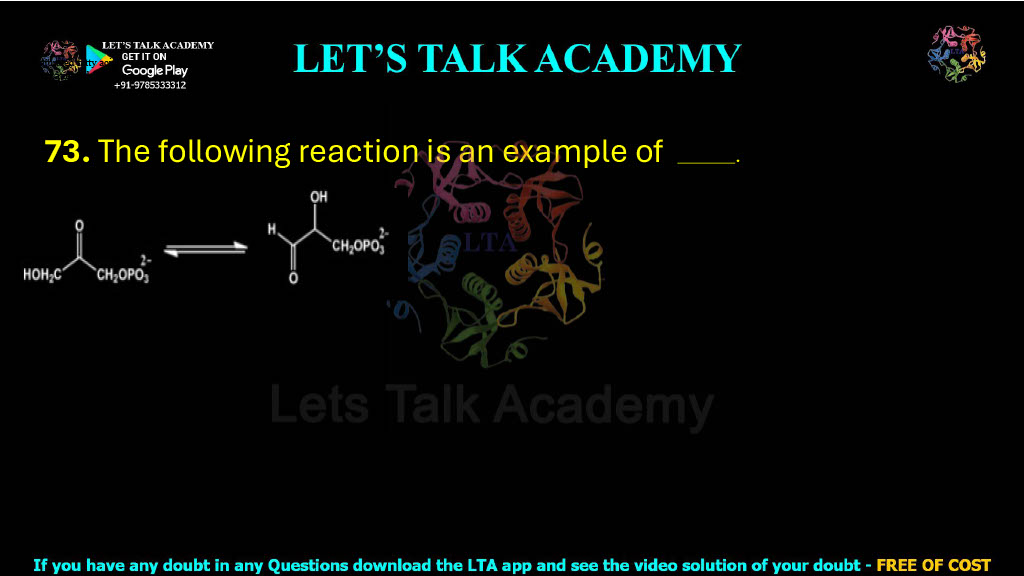
73. The following reaction is an example of .
(A) enolization
(B) racemization
(C) isomerization
(D) epimerization
Is the Conversion of Dihydroxyacetone Phosphate to Glyceraldehyde-3-Phosphate an Isomerization Reaction?
Correct Answer
(C) Isomerization
Introduction
Glycolysis is the central metabolic pathway responsible for converting glucose into pyruvate while producing ATP and NADH. Several reactions in glycolysis involve rearrangements of atoms within the same molecule without altering its molecular formula. These reactions are known as isomerization reactions and are catalyzed by enzymes belonging to the isomerase class. One of the most important examples is the reversible conversion of dihydroxyacetone phosphate (DHAP) into glyceraldehyde-3-phosphate (G3P), catalyzed by the enzyme triose phosphate isomerase (TPI).
In this reaction, the carbonyl group shifts from the second carbon atom to the first carbon atom, converting a ketose phosphate into an aldose phosphate. Although the mechanism proceeds through an enediol (enol) intermediate, the overall biochemical transformation is classified as an isomerization reaction because the reactant and product possess the same molecular formula but different structural arrangements.
Understanding the Concept Behind the Question
The structures shown in the question represent:
Dihydroxyacetone phosphate (DHAP) ⇌ Glyceraldehyde-3-phosphate (G3P)
DHAP is a ketotriose phosphate, whereas G3P is an aldotriose phosphate.
Both molecules contain:
- Three carbon atoms
- One phosphate group
- The same molecular formula
Only the position of the carbonyl group changes.
Since no atoms are added or removed and only the internal arrangement changes, the reaction is classified as an isomerization.
Analysis of Option (A)
Enolization
This statement is incorrect.
Enolization refers to the formation of an enol or enediol intermediate during a reaction.
Although triose phosphate isomerase temporarily forms an enediol intermediate, this is only a mechanistic step and not the overall classification of the reaction.
Therefore,
Option (A) is incorrect.
Analysis of Option (B)
Racemization
This statement is incorrect.
Racemization involves the conversion of one optical isomer into its mirror-image form, producing a racemic mixture of D- and L-isomers.
The reaction shown does not alter chirality or generate optical isomers.
Therefore,
Option (B) is incorrect.
Analysis of Option (C)
Isomerization
This statement is correct.
The enzyme triose phosphate isomerase converts the ketose DHAP into the aldose G3P.
Both molecules possess the same molecular formula but differ in the arrangement of atoms.
Because the reaction converts one structural isomer into another without changing molecular composition, it is an isomerization reaction.
Therefore,
Option (C) is correct.
Analysis of Option (D)
Epimerization
This statement is incorrect.
Epimerization involves a change in configuration around only one chiral carbon atom.
Examples include the conversion of glucose to mannose or UDP-glucose to UDP-galactose.
The DHAP–G3P conversion does not involve inversion at a single stereocenter; instead, it involves relocation of the carbonyl group.
Therefore,
Option (D) is incorrect.
Reaction Mechanism
The conversion is catalyzed by triose phosphate isomerase.
The enzyme first abstracts a proton to generate an enediol intermediate.
The proton is then added back at a different position, converting the ketose into an aldose.
Although an enediol intermediate is formed, the overall transformation remains an isomerization reaction because only the internal arrangement of atoms changes.
Biological Importance
Only glyceraldehyde-3-phosphate can proceed directly through the subsequent ATP-generating steps of glycolysis. During the cleavage of fructose-1,6-bisphosphate, one molecule each of DHAP and G3P is produced. Triose phosphate isomerase rapidly converts DHAP into G3P, ensuring that both three-carbon products continue through glycolysis. This reaction effectively doubles the ATP and NADH yield obtained from each glucose molecule. Triose phosphate isomerase is considered a catalytically perfect enzyme, operating near the diffusion-controlled limit.
High-Yield Points
- DHAP is a ketotriose phosphate.
- G3P is an aldotriose phosphate.
- The enzyme is Triose Phosphate Isomerase (TPI).
- The reaction proceeds through an enediol intermediate.
- Overall reaction type = Isomerization.
- TPI belongs to EC Class 5 (Isomerases).
- Both DHAP and G3P have the same molecular formula.
Frequently Asked Questions
Why is this reaction called an isomerization?
Because DHAP and G3P have the same molecular formula but differ only in the arrangement of atoms, making them structural isomers.
Why is enolization not the correct answer?
Enolization describes only the intermediate mechanism, whereas the overall biochemical transformation is classified as an isomerization.
Which enzyme catalyzes this reaction?
The enzyme responsible is Triose Phosphate Isomerase (TPI), one of the most efficient enzymes known.
Key Takeaways
The reaction shown represents the reversible conversion of dihydroxyacetone phosphate (DHAP) into glyceraldehyde-3-phosphate (G3P) during glycolysis. Although the enzyme forms an enediol intermediate, the overall reaction simply rearranges atoms within the same molecule without changing its molecular formula. DHAP, a ketose phosphate, is converted into G3P, an aldose phosphate, by triose phosphate isomerase. Therefore, the reaction is classified as an isomerization reaction, making Option (C) the correct answer.
Final Answer
Correct Option: (C) Isomerization
Explanation
The reaction shown is the reversible conversion of dihydroxyacetone phosphate (DHAP) into glyceraldehyde-3-phosphate (G3P), catalyzed by triose phosphate isomerase during glycolysis. DHAP is a ketose phosphate, whereas G3P is an aldose phosphate. Both molecules have the same molecular formula, and only the position of the carbonyl group changes. Although the reaction proceeds through an enediol intermediate, the overall biochemical transformation is classified as an isomerization reaction. Therefore, the correct answer is Option (C).


