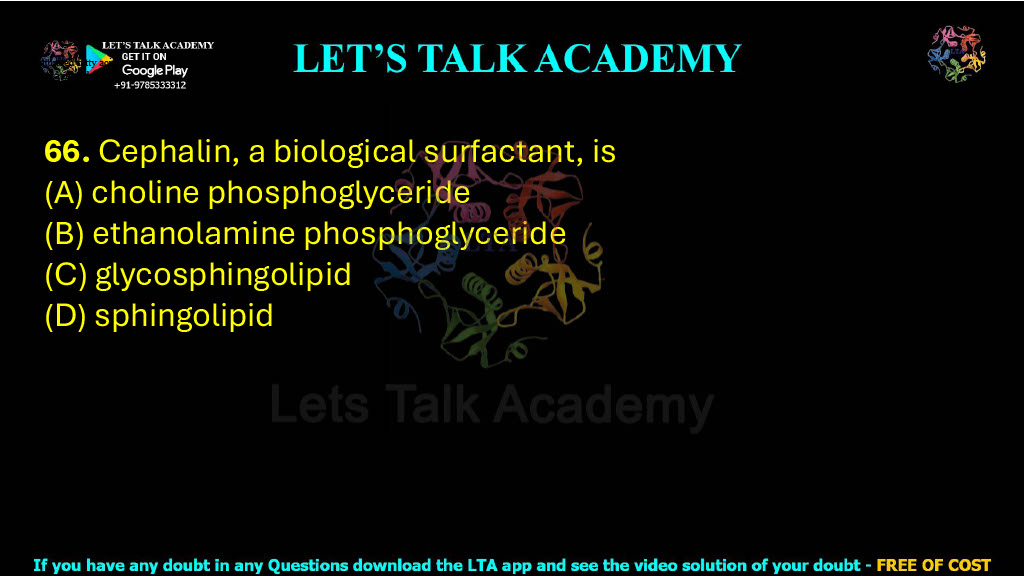
66. Cephalin, a biological surfactant, is
(A) choline phosphoglyceride
(B) ethanolamine phosphoglyceride
(C) glycosphingolipid
(D) sphingolipid
What is Cephalin? Complete Explanation of Biological Surfactant and Phospholipids
Correct Answer
(B) Ethanolamine phosphoglyceride
Introduction
Lipids are one of the four major classes of biological macromolecules and play essential roles in energy storage, membrane structure, cell signaling, and molecular recognition. Among membrane lipids, phospholipids are the principal structural components of biological membranes because of their amphipathic nature, possessing both hydrophilic and hydrophobic regions. This unique property enables them to function as biological surfactants, reducing surface tension and facilitating the formation of lipid bilayers. Different phospholipids are distinguished by the alcohol attached to the phosphate group, giving rise to molecules such as phosphatidylcholine, phosphatidylethanolamine, phosphatidylserine, and phosphatidylinositol.
Cephalin is the traditional biochemical name for a group of phospholipids that primarily includes phosphatidylethanolamine and, in some contexts, phosphatidylserine. Among these, phosphatidylethanolamine is the major constituent and is therefore regarded as cephalin in most competitive examinations. It is one of the most abundant phospholipids in biological membranes, especially in the inner leaflet of the plasma membrane and in mitochondrial membranes.
Understanding the Concept Behind the Question
Cephalin belongs to the class of glycerophospholipids.
Its structure consists of:
- A glycerol backbone
- Two fatty acid chains
- A phosphate group
- Ethanolamine attached to the phosphate group
Because ethanolamine is the polar head group, cephalin is chemically known as phosphatidylethanolamine.
Its amphipathic nature allows it to function as a biological surfactant and as a major structural component of cellular membranes.
Analysis of Option (A)
Choline Phosphoglyceride
This statement is incorrect.
A phosphoglyceride containing choline as its polar head group is known as phosphatidylcholine, commonly called lecithin.
Although lecithin is also an important membrane phospholipid and biological surfactant, it is not cephalin.
Therefore,
Option (A) is incorrect.
Analysis of Option (B)
Ethanolamine Phosphoglyceride
This statement is correct.
Cephalin is another name for phosphatidylethanolamine, a glycerophospholipid in which ethanolamine is attached to the phosphate group.
Phosphatidylethanolamine is abundant in biological membranes, particularly in nervous tissue, mitochondria, bacterial membranes, and the inner leaflet of the plasma membrane.
Its amphipathic nature contributes to membrane stability, curvature, fusion, and biological surfactant activity.
Therefore,
Option (B) is correct.
Analysis of Option (C)
Glycosphingolipid
This statement is incorrect.
Glycosphingolipids contain a ceramide backbone linked to one or more carbohydrate residues.
Examples include cerebrosides and gangliosides.
Cephalin lacks both a ceramide backbone and carbohydrate groups.
Therefore,
Option (C) is incorrect.
Analysis of Option (D)
Sphingolipid
This statement is incorrect.
Sphingolipids are built upon a sphingosine backbone, whereas cephalin possesses a glycerol backbone.
Although both are membrane lipids, they belong to different lipid classes.
Therefore,
Option (D) is incorrect.
Structure of Cephalin
Cephalin contains four major structural components:
- Glycerol backbone
- Two fatty acid chains
- Phosphate group
- Ethanolamine head group
Because it possesses both hydrophobic fatty acid tails and a hydrophilic ethanolamine head, it behaves as an amphipathic phospholipid capable of forming biological membranes.
Difference Between Lecithin and Cephalin
| Feature | Cephalin | Lecithin |
|---|---|---|
| Common Name | Cephalin | Lecithin |
| Chemical Name | Phosphatidylethanolamine | Phosphatidylcholine |
| Polar Head Group | Ethanolamine | Choline |
| Lipid Class | Glycerophospholipid | Glycerophospholipid |
| Major Function | Membrane structure and curvature | Membrane stability and surfactant activity |
Although both are phosphoglycerides, the head group distinguishes cephalin from lecithin.
Biological Importance
Cephalin is one of the most abundant phospholipids in biological membranes and plays a vital role in maintaining membrane architecture. It contributes to membrane curvature, facilitates membrane fusion during vesicle trafficking, and supports the function of membrane-bound proteins. Phosphatidylethanolamine is particularly abundant in mitochondrial membranes, where it influences respiratory enzyme activity and mitochondrial dynamics.
In addition to its structural role, cephalin participates in blood coagulation, lipoprotein assembly, autophagy, and intracellular signaling. Because of its amphipathic properties, it behaves as a natural biological surfactant, reducing interfacial tension between aqueous and lipid phases.
High-Yield Points
- Cephalin = Phosphatidylethanolamine.
- It is a glycerophospholipid.
- Polar head group = Ethanolamine.
- Lecithin = Phosphatidylcholine.
- Cephalin contains a glycerol backbone, not sphingosine.
- Glycosphingolipids contain ceramide + carbohydrate.
- Cephalin is abundant in the inner leaflet of plasma membranes and mitochondria.
Frequently Asked Questions
Why is cephalin called a biological surfactant?
Cephalin possesses both hydrophilic and hydrophobic regions, enabling it to reduce surface tension and stabilize biological membranes.
Is cephalin a phospholipid?
Yes. Cephalin is a glycerophospholipid, specifically phosphatidylethanolamine, one of the major phospholipids present in cell membranes.
What is the difference between cephalin and lecithin?
The difference lies in the polar head group. Cephalin contains ethanolamine, whereas lecithin contains choline.
Key Takeaways
Cephalin is the common biochemical name for phosphatidylethanolamine, an ethanolamine phosphoglyceride that serves as a major structural component of biological membranes. It contains a glycerol backbone, two fatty acid chains, a phosphate group, and an ethanolamine head group, making it an amphipathic molecule capable of functioning as a biological surfactant. Unlike glycosphingolipids and sphingolipids, cephalin belongs to the glycerophospholipid family and should not be confused with lecithin (phosphatidylcholine). Therefore, the correct answer is Option (B).
Final Answer
Correct Option: (B) Ethanolamine phosphoglyceride
Explanation
Cephalin is the common name for phosphatidylethanolamine, a glycerophospholipid in which ethanolamine serves as the polar head group attached to a phosphate moiety on a glycerol backbone. It is an important biological surfactant and a major constituent of cell membranes, especially in the inner leaflet of the plasma membrane and mitochondrial membranes. Cephalin is not a sphingolipid or glycosphingolipid, and it differs from lecithin, which is phosphatidylcholine. Therefore, the correct answer is Option (B).


