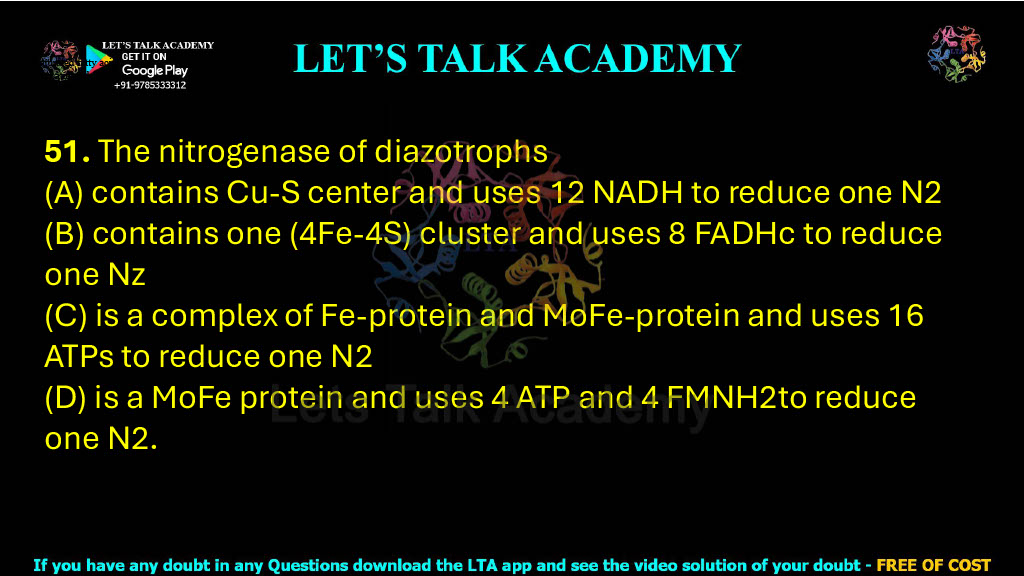
51. The nitrogenase of diazotrophs
(A) contains Cu-S center and uses 12 NADH to reduce one N2
(B) contains one (4Fe-4S) cluster and uses 8 FADHc to reduce one Nz
(C) is a complex of Fe-protein and MoFe-protein and uses 16 ATPs to reduce one N2
(D) is a MoFe protein and uses 4 ATP and 4 FMNH2to reduce one N2.
Nitrogenase of Diazotrophs: Structure, Function, and ATP Requirement
Correct Answer
(C) Is a complex of Fe-protein and MoFe-protein and uses 16 ATPs to reduce one N₂
Introduction
Biological nitrogen fixation is one of the most important biochemical processes in nature because it converts atmospheric nitrogen gas (N₂) into ammonia (NH₃), a form that plants and other organisms can readily utilize. Although the Earth’s atmosphere contains nearly 78% nitrogen, molecular nitrogen is extremely stable due to its strong triple bond (N≡N), making it unavailable to most living organisms. Specialized microorganisms known as diazotrophs, including species of Rhizobium, Azotobacter, and certain cyanobacteria, overcome this challenge by using the enzyme nitrogenase.
Nitrogenase is a highly specialized metalloenzyme that catalyzes one of the most energy-demanding reactions in biology. The enzyme functions as a two-component protein complex consisting of an Fe-protein (dinitrogenase reductase) and a MoFe-protein (dinitrogenase). Electron transfer between these proteins is coupled to the hydrolysis of large amounts of ATP, allowing the reduction of atmospheric nitrogen into ammonia.
Understanding the Concept Behind the Question
Nitrogenase catalyzes the reaction:
N₂ + 8H⁺ + 8e⁻ + 16ATP → 2NH₃ + H₂ + 16ADP + 16Pi
The enzyme consists of two functional components:
- Fe-protein (Iron protein or dinitrogenase reductase), which transfers electrons using ATP.
- MoFe-protein (Molybdenum-Iron protein or dinitrogenase), where the actual reduction of nitrogen gas occurs.
During the transfer of each electron from the Fe-protein to the MoFe-protein, two molecules of ATP are hydrolyzed. Since eight electrons are required to complete the reduction process, a total of 16 ATP molecules are consumed.
Thus, nitrogenase is correctly described as a complex of Fe-protein and MoFe-protein that requires 16 ATP molecules to reduce one molecule of nitrogen gas.
Therefore,
Option (C) is correct.
Why Option (A) Is Incorrect
Contains Cu-S Center and Uses 12 NADH
Nitrogenase does not contain a copper-sulfur (Cu-S) center. Instead, its catalytic centers are composed of iron (Fe) and molybdenum-iron (MoFe) clusters.
Furthermore, nitrogenase does not directly utilize 12 NADH molecules to reduce nitrogen. Electrons are delivered through carriers such as ferredoxin or flavodoxin, and ATP hydrolysis is essential for electron transfer.
Therefore,
Option (A) is incorrect.
Why Option (B) Is Incorrect
Contains One (4Fe–4S) Cluster and Uses 8 FADH₂
The Fe-protein does contain a 4Fe–4S cluster, but nitrogenase is not composed solely of this component. The catalytic activity requires both the Fe-protein and the MoFe-protein.
Additionally, FADH₂ is not the direct electron donor used during biological nitrogen fixation. Electrons are supplied primarily by reduced ferredoxin or flavodoxin, not FADH₂.
Therefore,
Option (B) is incorrect.
Why Option (C) Is Correct
Complex of Fe-Protein and MoFe-Protein Using 16 ATP
Nitrogenase consists of two interacting proteins:
- Fe-protein, which binds ATP and transfers electrons.
- MoFe-protein, which contains the active site where nitrogen reduction occurs.
The reduction of one molecule of nitrogen requires:
- 8 electrons
- 16 ATP molecules
- Formation of 2 NH₃
- Evolution of 1 H₂
This ATP expenditure is necessary because the nitrogen molecule possesses an extremely stable triple bond that requires a large energy input for reduction.
Therefore,
Option (C) is correct.
Why Option (D) Is Incorrect
MoFe Protein Alone Uses 4 ATP and 4 FMNH₂
Although the MoFe-protein contains the catalytic center, it cannot function independently. The Fe-protein is essential for ATP-dependent electron transfer.
Moreover, nitrogen fixation requires 16 ATP molecules, not four, and FMNH₂ is not the physiological electron donor for nitrogenase.
Therefore,
Option (D) is incorrect.
Structure of Nitrogenase
Nitrogenase is composed of two proteins that work together:
Fe-Protein (Dinitrogenase Reductase)
The Fe-protein is a homodimer containing a 4Fe–4S cluster. It binds ATP and transfers electrons from reduced ferredoxin or flavodoxin to the MoFe-protein.
MoFe-Protein (Dinitrogenase)
The MoFe-protein is the catalytic component responsible for nitrogen reduction. It contains the P-cluster and the FeMo-cofactor (FeMo-co), which serves as the active site for breaking the nitrogen triple bond.
Neither component alone is capable of reducing atmospheric nitrogen; efficient catalysis requires the coordinated interaction of both proteins.
Overall Nitrogen Fixation Reaction
The balanced nitrogenase reaction is:
N₂ + 8H⁺ + 8e⁻ + 16ATP → 2NH₃ + H₂ + 16ADP + 16Pi
This reaction highlights three important features:
- 16 ATP molecules are hydrolyzed.
- Ammonia (NH₃) is the primary product.
- Hydrogen gas (H₂) is released as a by-product.
Biological Importance
Nitrogen fixation is essential for maintaining the global nitrogen cycle because it converts inert atmospheric nitrogen into biologically usable ammonia. Plants cannot directly utilize atmospheric nitrogen, so they depend on nitrogen-fixing microorganisms to provide reduced nitrogen compounds for the synthesis of amino acids, nucleotides, proteins, and chlorophyll.
The nitrogenase enzyme therefore supports agricultural productivity, ecosystem sustainability, and global food production. Legume–Rhizobium symbiosis alone contributes millions of tons of biologically fixed nitrogen each year, reducing dependence on industrial nitrogen fertilizers.
High-Yield Points
- Nitrogenase is present in diazotrophic microorganisms.
- It consists of Fe-protein and MoFe-protein.
- The Fe-protein contains a 4Fe–4S cluster.
- The MoFe-protein contains the FeMo-cofactor, the catalytic center.
- Reduction of one N₂ molecule requires 16 ATP molecules.
- Electrons are supplied by ferredoxin or flavodoxin.
- Products of the reaction are NH₃ and H₂.
Frequently Asked Questions
Why does nitrogen fixation require 16 ATP molecules?
Breaking the strong N≡N triple bond requires a substantial energy input. Nitrogenase couples ATP hydrolysis with electron transfer, consuming 16 ATP molecules for each molecule of nitrogen reduced.
What is the role of the Fe-protein?
The Fe-protein transfers electrons from reduced ferredoxin or flavodoxin to the MoFe-protein in an ATP-dependent manner.
What is the function of the MoFe-protein?
The MoFe-protein contains the FeMo-cofactor, which serves as the active site where atmospheric nitrogen is reduced to ammonia.
Key Takeaways
Nitrogenase is a two-component enzyme complex consisting of the Fe-protein and the MoFe-protein. The Fe-protein transfers electrons using energy obtained from ATP hydrolysis, while the MoFe-protein catalyzes the reduction of atmospheric nitrogen to ammonia. The complete reduction of one nitrogen molecule requires 8 electrons and 16 ATP molecules, making nitrogen fixation one of the most energy-intensive biological processes. Understanding the structure, cofactors, and ATP requirement of nitrogenase is fundamental for microbiology, plant physiology, and competitive examination preparation.
Final Answer
Correct Option: (C) Is a complex of Fe-protein and MoFe-protein and uses 16 ATPs to reduce one N₂
Explanation
Nitrogenase is the enzyme responsible for biological nitrogen fixation in diazotrophic microorganisms. It consists of two interacting proteins: the Fe-protein (dinitrogenase reductase), which transfers electrons in an ATP-dependent manner, and the MoFe-protein (dinitrogenase), which contains the FeMo-cofactor where nitrogen reduction occurs. The overall reaction requires 8 electrons and 16 ATP molecules to convert one molecule of atmospheric nitrogen into two molecules of ammonia, with hydrogen gas released as a by-product. Therefore, Option (C) is the correct answer.


