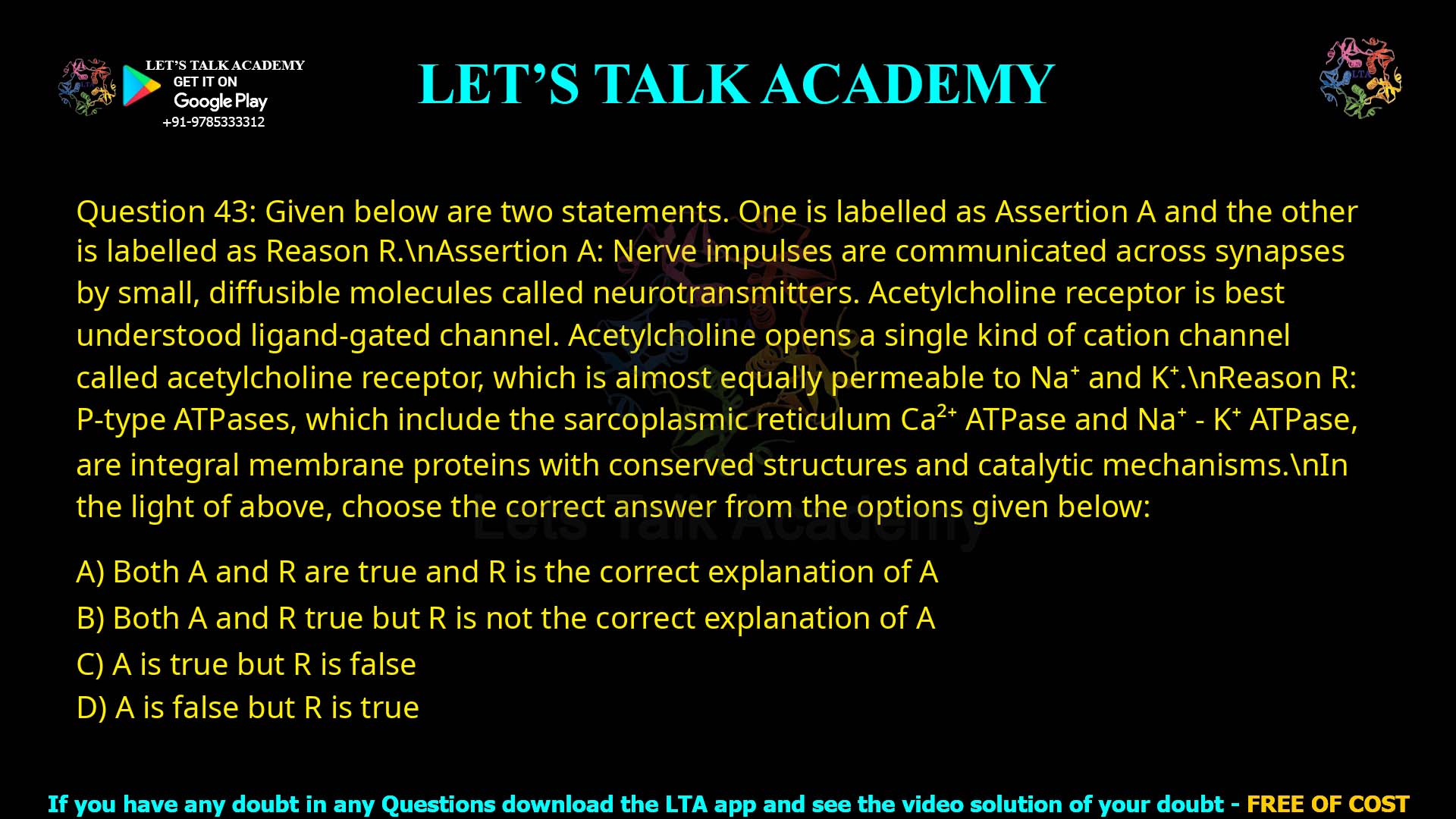
Q.43 Given below are two statements. One is labelled as Assertion A
and the other is labelled as Reason R.
Assertion A: Nerve impulses are communicated across synapses by small,
diffusible molecules called neurotransmitters. Acetylcholine receptor is best understood
ligand-gated channel. Acetylcholine opens a single kind of cation channel called
acetylcholine receptor, which is almost equally permeable to Na+ and K+.
Reason R: P-type ATPases, which include the sarcoplasmic reticulum
Ca2+-ATPase and Na+-K+ ATPase, are integral membrane
proteins with conserved structures and catalytic mechanisms.
In the light of above, choose the correct answer from the options given below:
- Both A and R are true and R is the correct explanation of A
- Both A and R true but R is not the correct explanation of A
- A is true but R is false
- A is false but R is true
Nerve Impulses and Synapses: Assertion-Reason
Explore the correct answer (option 2) for this NEET biology question on neurotransmitter action and ATPases. Detailed analysis of acetylcholine receptors and P-type pumps for exam prep.
Correct Answer
Option 2: Both A and R are true but R is not the correct explanation of A
Assertion A Analysis
Nerve impulses cross synapses via neurotransmitters like acetylcholine, which bind ligand-gated channels such as nicotinic acetylcholine receptors (nAChRs) at neuromuscular junctions. These receptors open a cation channel permeable to both Na+ and K+, with near-equal permeability (P_Na/P_K ≈ 1.4), driving depolarization. This matches muscle-type nAChR structure, confirmed by cryo-EM studies showing a pentameric assembly with M2 helices lining the pore.
Reason R Analysis
P-type ATPases, including Na+-K+ ATPase and sarcoplasmic reticulum Ca2+-ATPase (SERCA), are integral membrane proteins using phosphorylation for ion transport. They share conserved features like actuator (A), nucleotide-binding (N), and phosphorylation (P) domains, plus 10 transmembrane helices, enabling vectorial ion pumping via E1-E2 transitions. This structural and mechanistic homology is well-established across species.
Why R Fails to Explain A
Assertion A addresses synaptic transmission via ligand-gated channels, while Reason R describes unrelated ion-motive ATPases involved in maintaining gradients (e.g., Na+/K+ for action potentials). No mechanistic or structural link exists between nAChR gating and P-type ATPase catalysis.
Options Breakdown
Option Statement Why Correct/Incorrect 1. Both true; R explains A R justifies A’s mechanism Incorrect—no connection between channels and pumps 2. Both true; R doesn’t explain A Independent facts Correct 3. A true; R false Denies ATPase conservation Incorrect—R accurate 4. A false; R true Rejects neurotransmitter role Incorrect—A correct This covers synaptic physiology and membrane proteins for NEET revision on acetylcholine receptor synapse assertion reason.


