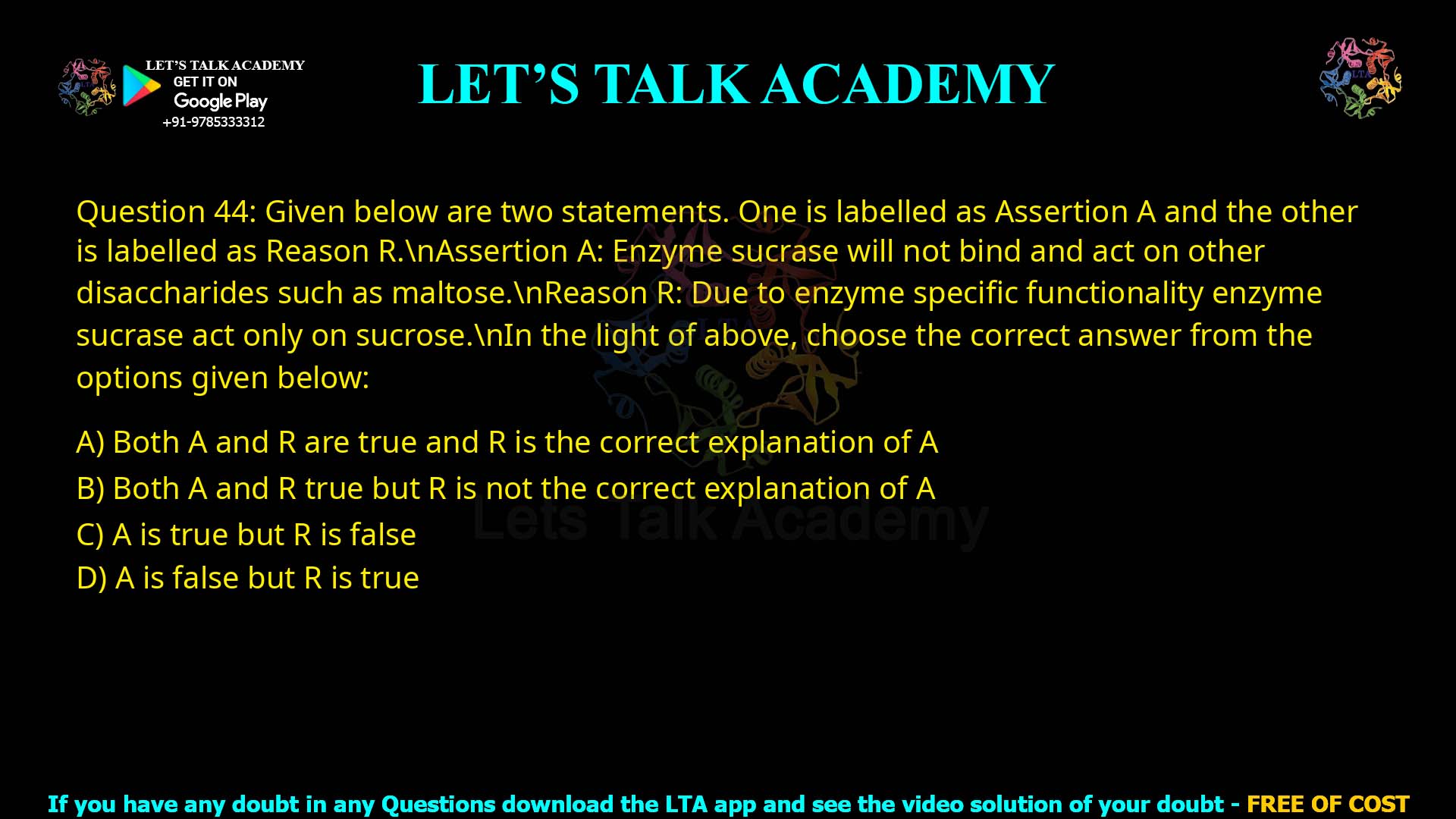
Q.44 Given below are two statements. One is labelled as Assertion A and the other is labelled as Reason R.
Assertion A: Enzyme sucrase will not bind and act on other disaccharides such as maltose.
Reason R: Due to enzyme specific functionality enzyme sucrase act only on sucrose.
In the light of above, choose the correct answer from the options given below:
1. Both A and R are true and R is the correct explanation of A
2. Both A and R true but R is not the correct explanation of A
3. A is true but R is false
4. A is false but R is true
Sucrase Enzyme Specificity: Assertion-Reason Explained
Sucrase demonstrates high substrate specificity, primarily hydrolyzing sucrose into glucose and fructose, but its complex nature as part of the sucrase-isomaltase enzyme challenges simplistic views of exclusivity. This assertion-reason question tests understanding of enzyme functionality in biochemical exams.
Correct Answer
Option 1: Both A and R are true and R is the correct explanation of A.
Assertion A holds as sucrase does not effectively bind or act on maltose due to mismatched active site geometry. Reason R accurately explains this through enzyme specificity, a core principle where the active site’s unique shape fits only sucrose’s α-1,2 glycosidic bond.
Option Breakdown
-
Option 1 (Correct): Both statements align with enzyme kinetics; R directly justifies A’s observation via specificity, rooted in the lock-and-key or induced-fit model.
-
Option 2: Invalid, as R precisely accounts for A’s claim—sucrase’s sucrose-only action stems from its specific functionality, not unrelated factors.
-
Option 3: Incorrect; R is true, as specificity is a defining enzyme trait, enabling selective catalysis in metabolic pathways.
-
Option 4: False; A is true, confirmed by sucrase’s inability to hydrolyze maltose efficiently, despite minor maltase-like activity in the isomaltase domain.
Why Sucrase is Specific
Sucrase, from the sucrase-isomaltase complex on intestinal brush borders, targets sucrose’s glucose-fructose linkage. Maltose (glucose-glucose via α-1,4) requires maltase-glucoamylase, preventing cross-reactivity and ensuring efficient digestion. This selectivity prevents metabolic errors in carbohydrate breakdown.


