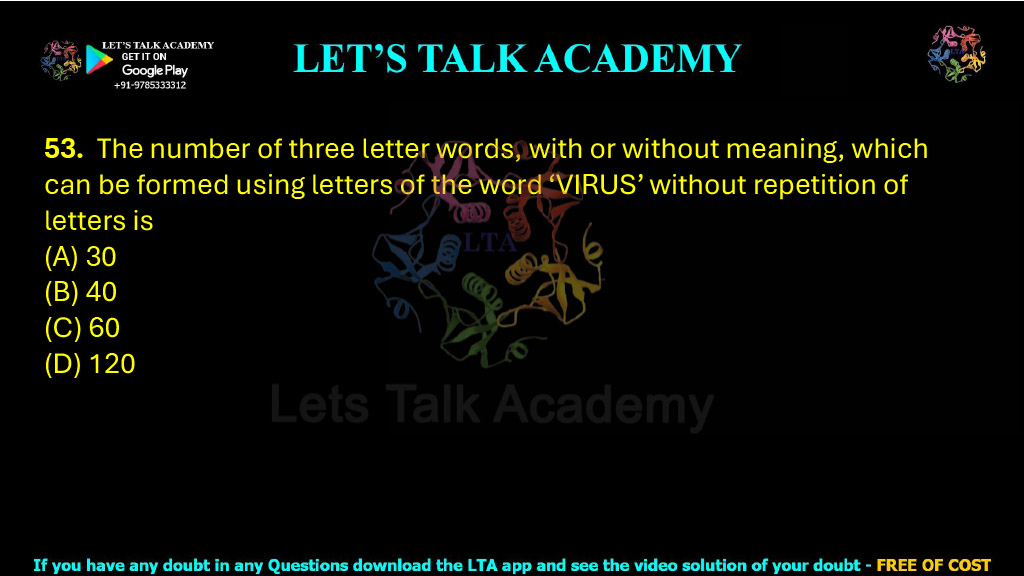
53. The number of three letter words, with or without meaning, which can be formed using letters of the word ‘VIRUS’ without repetition of letters is
(A) 30
(B) 40
(C) 60
(D) 120
Number of Three-Letter Words Formed From VIRUS Without Repetition
Understanding the Given Permutation Problem
This question is based on the concept of permutations. We are asked to form three-letter words using the letters of the word VIRUS. The words may have meaning or may be meaningless, so every possible arrangement of three different letters must be counted.
The word VIRUS contains the following five letters:
V, I, R, U, S
All five letters are distinct. The question also clearly states that repetition of letters is not allowed. Therefore, once a letter is used in a particular three-letter word, the same letter cannot be used again in that word.
Since the order of the letters changes the word, this is a permutation problem rather than a combination problem. For example, VIR and RIV contain the same three letters, but they are different arrangements and must be counted separately.
Counting the Available Letters
The word VIRUS contains five distinct letters:
V, I, R, U, S
Therefore, the total number of available letters is:
5
We need to select and arrange exactly three of these five letters without repetition. Thus, the problem requires the number of permutations of 5 distinct objects taken 3 at a time.
Using the Fundamental Counting Principle
A three-letter word contains three positions. We can count the number of choices available for each position separately.
Choices for the First Position
For the first position, any one of the five letters can be selected:
V, I, R, U, or S
Therefore, the number of choices for the first position is:
5
Choices for the Second Position
After one letter has been used in the first position, only four unused letters remain. Since repetition is not allowed, the letter selected for the first position cannot be used again.
Therefore, the number of choices for the second position is:
4
Choices for the Third Position
After choosing letters for the first two positions, three unused letters remain. Any one of these three letters can occupy the third position.
Therefore, the number of choices for the third position is:
3
Calculating the Total Number of Three-Letter Words
According to the fundamental principle of counting, when a process is completed through successive independent choices, the total number of possible outcomes is obtained by multiplying the number of choices available at each stage.
Therefore, the total number of three-letter words is:
5 × 4 × 3
First:
5 × 4 = 20
Then:
20 × 3 = 60
Therefore, the total number of three-letter words that can be formed is:
60
Solution Using the Permutation Formula
The same problem can be solved directly using the standard permutation formula. The number of arrangements of n distinct objects taken r at a time is:
nPr = n!/(n − r)!
In this problem:
n = 5
because the word VIRUS contains five distinct letters, and:
r = 3
because three-letter words are required.
Therefore:
5P3 = 5!/(5 − 3)!
Simplifying:
5P3 = 5!/2!
Expanding the factorials:
5! = 5 × 4 × 3 × 2 × 1
and:
2! = 2 × 1
Therefore:
5P3 = (5 × 4 × 3 × 2 × 1)/(2 × 1)
Cancelling the common factor gives:
5P3 = 5 × 4 × 3
Hence:
5P3 = 60
Why Permutation Is Used Instead of Combination
The difference between a permutation and a combination depends on whether the order of selection matters. In this question, different arrangements of the same letters produce different three-letter words.
For example, consider the three letters V, I, and R. They can be arranged as:
VIR, VRI, IVR, IRV, RVI, RIV
These are six different three-letter arrangements. Therefore, simply selecting three letters is not enough; their different orders must also be counted.
This is why the correct mathematical operation is:
5P3
rather than:
5C3
Alternative Method Using Selection and Arrangement
Another way to solve the problem is to divide it into two stages. First, select any three letters from the five letters of VIRUS. Then, arrange the selected three letters.
The number of ways to select three letters from five distinct letters is:
5C3 = 10
Each selected group of three distinct letters can be arranged in:
3! = 6
different ways.
Therefore, the total number of three-letter words is:
5C3 × 3!
Substituting the values:
10 × 6 = 60
This again confirms that the required number of three-letter words is 60.
Analysis of All the Given Options
Option (A): 30
This option is incorrect. There are five choices for the first letter, four choices for the second letter, and three choices for the third letter. Therefore, the required number is 5 × 4 × 3 = 60, not 30.
Option (B): 40
This option is incorrect. The number 40 does not account correctly for all possible arrangements of three distinct letters chosen from the five letters of VIRUS.
Option (C): 60
This option is correct. Since the letters cannot be repeated, the three positions can be filled in 5, 4, and 3 ways, respectively. Therefore:
5 × 4 × 3 = 60
Option (D): 120
This option is incorrect. The number 120 = 5! represents the number of ways to arrange all five letters of the word VIRUS. However, the question asks for three-letter words, not five-letter words.
Final Answer
The word VIRUS contains five distinct letters, and three-letter words are to be formed without repetition.
Therefore:
Number of three-letter words = 5P3
= 5 × 4 × 3
= 60
Correct Option: (C) 60


