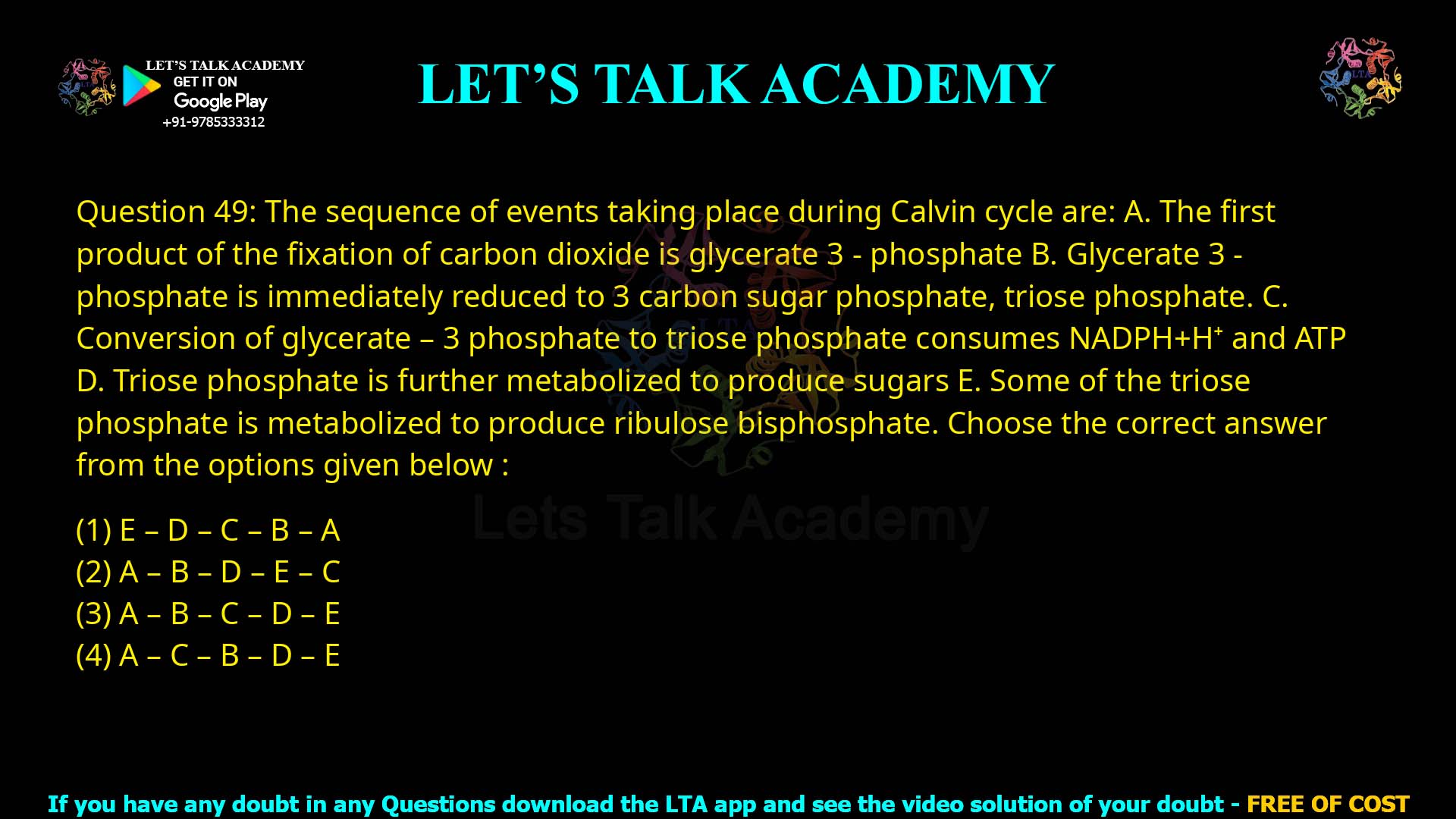
A – B – C – D – E is the correct sequence for the events in the Calvin cycle.
Question Breakdown
This question assesses the logical order of key biochemical transformations in the Calvin cycle (C3 cycle), the light-independent phase of photosynthesis where CO2 is fixed into sugars. The statements map to phases: fixation (A), reduction (B, C), sugar production (D), and RuBP regeneration (E).
Correct Sequence Explanation
The Calvin cycle follows this exact progression:
-
A: CO2 fixation by RuBisCO produces glycerate 3-phosphate (3-PGA) from RuBP + CO2.
-
B: 3-PGA reduces immediately to triose phosphate (G3P) using ATP and NADPH.
-
C: This reduction consumes NADPH + H+ and ATP (phosphoglycerate kinase and GAPDH enzymes).
-
D: Some G3P exports to form sugars like glucose.
-
E: Remaining G3P regenerates RuBP via multiple ATP-dependent steps.
Thus, A – B – C – D – E reflects the cycle’s flow: fixation → reduction → output → regeneration.
Why Other Options Are Wrong
-
E – D – C – B – A: Starts with regeneration (E), which requires prior products; illogical reversal.
-
A – B – D – E – C: Places sugar production (D) before reduction details (C); C must precede D.
-
A – C – B – D – E: Swaps reduction steps; B (product formation) precedes C (energy consumption description).
The Calvin cycle sequence is essential for understanding CO2 fixation in photosynthesis. This guide details the correct sequence of events taking place during Calvin cycle—A (first product glycerate 3-phosphate), B (reduction to triose phosphate), C (NADPH + ATP consumption), D (sugar production), E (RuBP regeneration)—ideal for competitive exams like GATE Life Sciences.
Calvin Cycle Overview
The Calvin cycle occurs in chloroplast stroma, using ATP/NADPH from light reactions to convert 3 CO2 into G3P (net gain 1 G3P per turn). It has three phases: carbon fixation, reduction, and regeneration.
Step-by-Step Sequence (A-B-C-D-E)
-
A: RuBisCO fixes CO2 to RuBP, yielding 3-PGA (glycerate 3-phosphate).
-
B: 3-PGA reduces to triose phosphate (G3P).
-
C: Reduction uses NADPH + H+ and ATP.
-
D: G3P forms hexoses (e.g., glucose from 2 G3P).
-
E: 5/6 G3P regenerates RuBP (3 ATP).
| Event |
Phase |
Key Inputs |
Output |
| A |
Fixation |
CO2, RuBP |
Glycerate 3-P |
| B |
Reduction |
ATP, NADPH |
Triose phosphate |
| C |
Reduction |
NADPH + H+, ATP |
G3P |
| D |
Output |
G3P |
Sugars |
| E |
Regeneration |
G3P, ATP |
RuBP |
This Calvin cycle events sequence ensures continuous sugar synthesis, powering plant growth and the global carbon cycle.